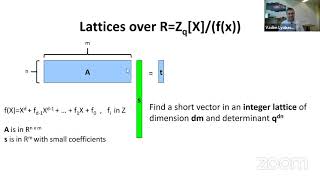
Signatures, Commitments, Zero-Knowledge, and Applications
Explore lattice-based cryptography, focusing on polynomial rings, homomorphic encryption, and zero-knowledge proofs. Learn about theoretical foundations and practical applications in modern cryptographic systems.
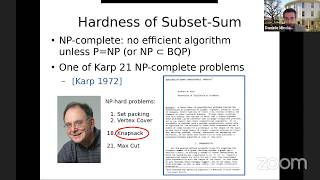
Lattices, Post-Quantum Security and Homomorphic Encryption
Explore lattice-based cryptography's foundations, quantum resistance, and encrypted data computation capabilities in this lecture on modern cryptographic techniques and applications.
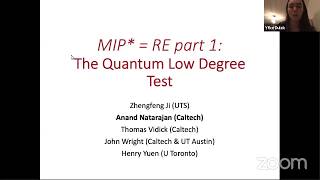
MIP* = RE Part 1 - The Quantum Low-Degree Test
Explore quantum protocols, nonlocal games, and MIP* complexity, focusing on the Magic Square game and self-testing through representation theory in quantum computing.
Mind Over Data - The One Thing You Know and Machines Don't
Explore the intersection of human intuition and machine learning in causal reasoning, examining Bayesian networks, confounding factors, and real-world applications in AI and data analysis.
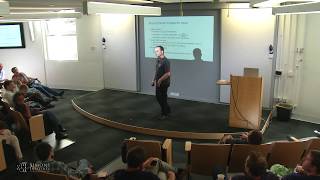
Recent Advances in Quantum Simulation
Explore recent advancements in quantum simulation, focusing on dynamical simulation, unitary access, and applications in quantum chemistry and physics.

The Information Bottleneck Theory of Deep Neural Networks
Explore the Information Bottleneck Theory's application to deep neural networks, examining statistical learning, information theory, and stochastic gradient descent in brain data analysis.
From Classical Statistics to Modern Machine Learning
Explore the evolution from classical statistics to modern machine learning, examining key concepts like generalization, interpolation, and the "double descent" phenomenon in supervised learning.
Can Non-Convex Optimization Be Robust?
Explore non-convex optimization's robustness, examining locally optimizable functions, perturbed objectives, and matrix completion. Insights on empirical vs. population risk and semi-random adversaries.
Nearest Neighbors I
Explore nearest neighbor algorithms in machine learning, covering regression, classification, consistency, and convergence rates in metric spaces. Gain insights into statistical learning frameworks and smoothness conditions.
Invariant Theory for Computer Scientists
Explore algebraic methods in computer science, focusing on invariant theory, graph isomorphism, and group actions. Learn about algorithms, moment polytopes, and open problems in the field.
K-Means and K-Medians Under Dimension Reduction
Explore k-means and k-medians clustering algorithms under dimension reduction, examining distortion graphs, cost analysis, and combinatorial lemmas for robust high-dimensional statistics.
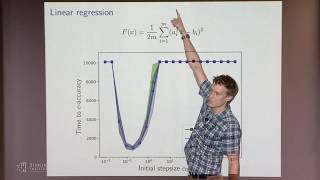
The Importance of Better Models in Stochastic Optimization
Explore stochastic optimization models, focusing on robustness, stability, and asymptotic minimax theory. Learn about weak convexity, sharp growth problems, and practical experiments.
An LLL Algorithm for Module Lattices
Explore an LLL algorithm for module lattices, covering key concepts, previous works, and algorithm details. Gain insights into lattice geometry and computational challenges.

Algebraic Lattices and Ring Learning With Errors
Explore algebraic lattices and Ring Learning with Errors, covering key concepts, operations, and hardness theorems in cryptography and lattice-based algorithms.
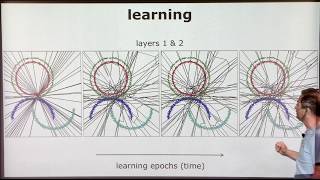
Mad Max - Affine Spline Insights into Deep Learning
Explore deep learning through spline theory, focusing on max-affine splines and their role in neural networks, data memorization, and network complexity.
Computation in Very Wide Neural Networks
Explore infinite-width neural networks, their correspondence to Gaussian processes, and implications for deep learning performance and dynamics in parameter space.
Understanding Unstructured Data with Language Models - Alex Peattie
Explore language models for unstructured data analysis, covering classification, predictive modeling, and information retrieval. Learn key concepts and practical applications in various fields.
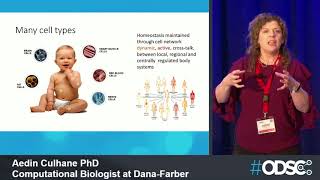
Unsupervised Feature Learning with Matrix Decomposition - Aedin Culhane, PhD | ODSC East 2018
Explore unsupervised learning techniques for high-dimensional data analysis, focusing on matrix factorization methods and their applications in oncology and precision medicine.
Free as in Monads - Understanding and Applying Free Monads - Lecture 44
Explore the Free monad concept through live coding, understanding its origins, applications, and powerful impact on software development. Learn how to derive and utilize this abstraction for solving complex problems.
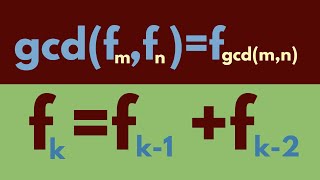
Greatest Common Divisor of Fibonacci Numbers
Explore the fascinating relationship between Fibonacci numbers and their greatest common divisors through a rigorous mathematical proof and analysis.
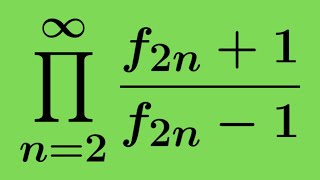
An Infinite Product Involving Fibonacci Numbers
Explore closed forms of Fibonacci numbers and discover the value of an intriguing infinite product involving this famous sequence.