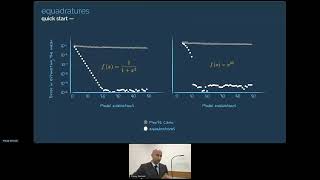
AIUK 2022 Workshop - Equadratures: The Open Source Model Development Platform
Explore Equadratures, an open-source platform for model development. Learn about polynomials, variable projection, and applications in this interactive workshop from the Alan Turing Institute.

Textures in OpenGL
Learn to implement textures in OpenGL, covering image loading, texture initialization, parameters, coordinates, sampling, and blending for enhanced graphics rendering.
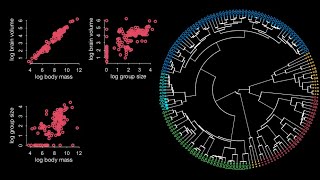
Statistical Rethinking 2022 - Gaussian Processes
Explore Gaussian processes, spatial confounding, and phylogenetic inference in statistical modeling. Learn to apply these concepts to real-world examples like oceanic covariance and primate phylogeny.
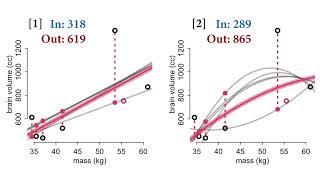
Statistical Rethinking 2022 - Overfitting
Explore overfitting in statistical modeling, covering cross-validation, regularization, information criteria, and robust regression techniques for improved predictive accuracy.
PLONK - Permutations Over Lagrange-Bases for Oecumenical Noninteractive Arguments of Knowledge
Explore PLONK, a cryptographic protocol for zero-knowledge proofs, covering permutation checks, polynomial protocols, and applications in blockchain technology.
Designing Robust Learners
Explore robust machine learning techniques to handle data perturbations and improve model resilience, focusing on TV estimation, modulus examples, and arbitrary loss scenarios.

Better Learning from the Past - Counterfactual - Batch RL
Explore counterfactual and batch reinforcement learning for improved decision-making under uncertainty, with focus on generalization bounds and policy optimization techniques.

Reinforcement Learning in Recommender Systems - Some Challenges
Explore challenges in applying reinforcement learning to recommender systems, including scale, stochastic action sets, and user learning over long horizons. Gain insights on addressing these issues.
Reinforcement Learning in Feature Space: Complexity and Regret
Explore reinforcement learning in feature space, focusing on complexity, regret analysis, and innovative approaches like MatrixRL. Learn about state feature mapping and its applications in real-world scenarios.

The Hamiltonian Monte Carlo Revolution Is Open Source - Probabilistic Programming with PyMC3
Explore Bayesian statistical computation and Hamiltonian Monte Carlo algorithms using PyMC3, an open-source probabilistic programming package. Learn to apply these advanced techniques to complex models in Python.
Deep Learning Survival Analysis for Consumer Credit Risk Modelling
Explore deep learning survival analysis for precise credit risk prediction in consumer lending, combining traditional methods with advanced techniques for improved time-to-event forecasting.
Price Optimisation - From Exploration to Productionising - David Adey, PhD & Alexey Drozdetskiy, PhD
Explore dynamic price optimization using machine learning, from data analysis to cloud deployment. Learn about feature encoding, model selection, efficiency improvements, and practical implementation strategies for revenue growth.
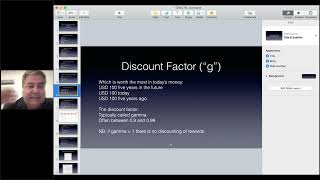
An Intuition-Based Approach to Reinforcement Learning
Explore an intuition-based approach to reinforcement learning, covering key concepts like exploit vs. explore, Q-tables, and stochastic actions, with practical examples and applications.

Complexity Theory III
Explore advanced complexity theory concepts, including minimal circuits, probabilistic formulas, and explicit obstructions in this in-depth theoretical computer science lecture.

Approximation Algorithms
Explore approximation algorithms for network design, including connectivity augmentation, Steiner trees, and spectral rounding techniques. Learn about linear programming and future research directions.

Asymmetric Traveling Salesman Problem: Advances and Challenges - Session 1A
Explore cutting-edge research on the Asymmetric Traveling Salesman Problem, including algorithms, lower bounds, and approximation results in this advanced theoretical computer science talk.
Does Learning Require Memorization? A Short Tale About a Long Tail
Explore the relationship between learning and memorization in machine learning, focusing on dataset fitting, interpolation, and long-tailed data distribution challenges.

Algorithms for Heavy-Tailed Statistics - Regression, Covariance Estimation, and Beyond
Explore advanced statistical techniques for handling heavy-tailed data, including regression and covariance estimation, with a focus on SOS assumptions and median of means framework.
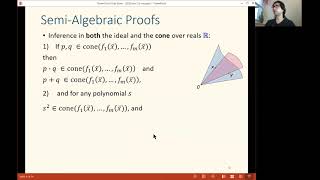
Semi-Algebraic Proofs, IPS Lower Bounds and the τ-Conjecture
Explore semi-algebraic proofs, IPS lower bounds, and the τ-Conjecture in computational complexity theory, focusing on proof systems and algebraic circuits.
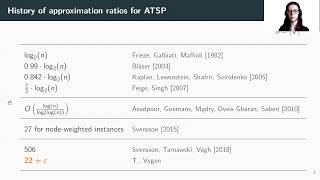
An Improved Approximation Algorithm for ATSP
Explore an advanced approximation algorithm for the Asymmetric Traveling Salesman Problem, covering linear programming relaxation, reductions, and recursive techniques to improve solution quality.
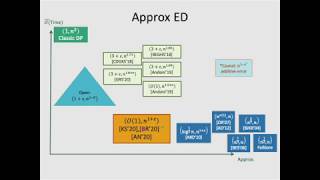
Constant Factor Approximations to Edit Distance in Nearly Linear Time
Explore efficient algorithms for approximating edit distance in near-linear time, merging insights from two papers to tackle dense and sparse graph scenarios.