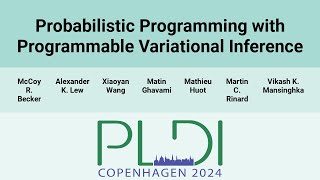
Probabilistic Programming with Programmable Variational Inference
Explore a modular approach to variational inference in probabilistic programming, enhancing expressiveness and enabling user-defined objectives with systematic gradient estimation transformations.
Bayesian Inference Using Probabilistic Programming
Explore Bayesian inference techniques and probabilistic programming concepts with expert insights from Hong Ge at LAFI'24.
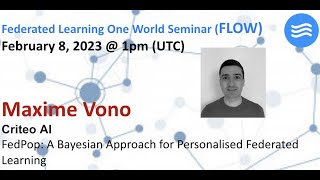
A Bayesian Approach for Personalized Federated Learning - Seminar 93
Discover how Bayesian approaches enhance personalized federated learning through innovative statistical methods and practical applications in distributed machine learning environments.

Polyregular Functions on Unordered Trees of Bounded Height
Explore polyregular functions on unordered trees with bounded height, examining first-order interpretations, decidability of equivalence problems, and applications to graph classes with bounded tree-depth.

Code-It-Yourself 3D Graphics Engine - Triangles and Projection - Part 1
Learn to build a 3D graphics engine from scratch, covering triangles, projection matrices, and basic rotation. Gain hands-on experience in creating a rotating cube using fundamental 3D graphics concepts.
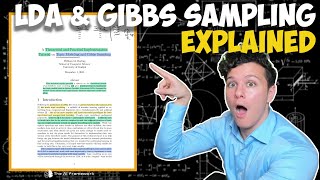
Latent Dirichlet Allocation with Gibbs Sampling Explained
Comprehensive explanation of Latent Dirichlet Allocation (LDA) with Gibbs Sampling, covering topic modeling, posterior inference, and implementation details. Ideal for those interested in understanding this classic machine learning technique.
Diffusion Models Beat GANs on Image Synthesis - ML Coding Series - Part 2
Explore diffusion models for image synthesis, focusing on classifier guidance, training, and sampling techniques. Includes code walkthrough and paper analysis.

Machine Learning with Flax - From Zero to Hero
Comprehensive guide to Flax, a JAX-based ML library. Learn basics, custom models, optimization, and practical examples like linear regression and CNN on MNIST. Ideal for ML enthusiasts.
Logistic Regression and Ensemble Learning - Bagging and Boosting - AdaBoost
Explore logistic regression, ensemble learning, bagging, and boosting in this AI/ML course. Learn AdaBoost and decision stumps for strong non-linear classification.
How to Get Started With Graph ML - Blog Walkthrough
Comprehensive introduction to Graph Machine Learning, covering applications, methods, and resources. Explores research challenges, GNN expressivity, and related subfields, providing a solid foundation for beginners.
Temporal Graph Networks - GNN Paper Explained
Explore temporal graph networks and dynamic graphs, learning advanced techniques for graph machine learning, including time-based sampling, memory management, and attention mechanisms.
Graph SAGE - Inductive Representation Learning on Large Graphs - GNN Paper Explained
Deep dive into Graph SAGE, exploring its innovative approach to large-scale graph learning. Covers key concepts, training methods, aggregator functions, and comparisons with other graph neural networks.
Graph Convolutional Networks - GNN Paper Explained
Comprehensive exploration of Graph Convolutional Networks, covering theory, implementation, and applications. Delves into spectral methods, Weisfeiler-Lehman perspective, and GNN depth, offering insights for both beginners and experts.
Graph Attention Networks - GNN Paper Explained
Explore Graph Attention Networks (GAT) in-depth, covering graph theory basics, GAT methodology, multi-head versions, visualizations, and applications in transductive/inductive learning scenarios.
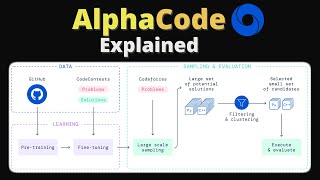
AlphaCode Explained - AI Code Generation
Explore DeepMind's AlphaCode, a powerful AI model for code generation. Learn its workings, competitive programming applications, and key insights from recent research.

The Spelled-Out Intro to Language Modeling - Building Makemore
Comprehensive tutorial on building a bigram character-level language model, covering tensor operations, neural networks, and PyTorch fundamentals for natural language processing tasks.

Intro to Neural Networks and Backpropagation - Building Micrograd
Step-by-step guide to neural networks and backpropagation, covering core concepts, implementation in Python, and practical exercises. Ideal for beginners with basic Python knowledge.
AlphaTensor by DeepMind Explained
Explore DeepMind's AlphaTensor, a revolutionary AI system that discovers efficient matrix multiplication algorithms, outperforming human-designed methods and advancing computational efficiency across various fields.
Topographic VAEs Learn Equivariant Capsules - Machine Learning Research Paper Explained
Explore Topographic VAEs: a novel approach to deep generative models with organized latent variables, bridging topographic organization and equivariance in neural networks for improved feature learning and transformation handling.

Efficient and Modular Implicit Differentiation - Machine Learning Research Paper Explained
Explores a unified framework for implicit differentiation in machine learning, enabling automatic differentiation of optimization problems without manual derivations or loop unrolling, with applications in meta-learning and hyperparameter optimization.
Reproducible Machine Learning and Experiment Tracking Pipeline with Python and DVC
Learn to build reproducible machine learning pipelines using Python and DVC. Track experiments, manage data versions, and compare model metrics for improved ML workflow efficiency.