Build Your First Model with PyTorch and Python - PyTorch Tutorial for Beginners
Learn to implement a Simple Linear Regression model using PyTorch, covering data exploration, model creation, tensor conversion, training, and prediction analysis in this beginner-friendly tutorial.
Preprocessing Data for Machine Learning - Deep Dive
Comprehensive guide to preprocessing data for logistic regression, covering standardization, encoding, data imbalance, correlation, multicollinearity, and missing data handling techniques.

Visualizing Data with 7-Segment Displays
Explore data visualization using 7-segment displays, covering binary-to-decimal conversion, Boolean algebra, and the double dabble algorithm for efficient number representation in digital systems.

Build Your First Machine Learning Model in Python
Learn to build a machine learning model in Python using scikit-learn. Covers data loading, splitting, model building with linear regression and random forest, comparison, and visualization.

PyTorch Crash Course - Getting Started with Deep Learning
Comprehensive introduction to PyTorch, covering tensor basics, autograd, linear regression, neural networks, and CNNs. Ideal for beginners in deep learning.
OpenAI Embeddings Explained With Code Examples - How to Use OpenAI GPT-3 ADA Vectorized Embeddings API
Explore OpenAI's ADA vectorized embeddings API for advanced NLP, search, and machine learning applications with practical code examples and visualizations.
ChatGPT Teaches Numpy - Python Numpy Tutorial
Comprehensive tutorial on NumPy: from basics to advanced concepts. Learn array creation, manipulation, mathematical operations, reshaping, and integration with Python data structures.
A Brief Introduction to Algorithms, Game Theory and Risk-Averse Decision Making
Explore algorithms, game theory, and risk-averse decision making, covering shortest paths, NP-Complete problems, equilibria, and various risk frameworks for real-world applications.
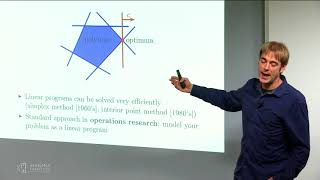
Lower Bounds on the Size of Linear Programs
Explore computational complexity, linear programming, and extended formulations in this lecture on lower bounds for linear program sizes, featuring geometric views and advanced topics.
Faster Algorithms and New Iterative Methods for Computing the Stationary Distribution
Explore advanced algorithms and iterative methods for computing stationary distributions, with applications in optimization and graph theory.
On Gradient-Based Optimization - Accelerated, Distributed, Asynchronous and Stochastic
Explore advanced gradient-based optimization techniques for machine learning, including accelerated, distributed, asynchronous, and stochastic methods, with insights from differential geometry and nonconvex optimization.
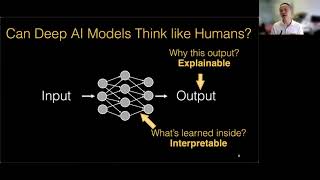
Human-Centric AI for Computer Vision and Machine Autonomy - ICCV'21 Tutorial
Explore human-centric AI in computer vision, covering explainable models, interpretable neural networks, and interactive machine learning for improved AI systems and autonomous machines.
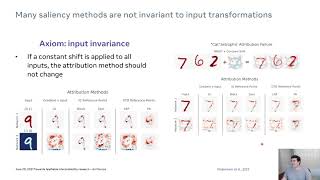
Towards Falsifiable Interpretability Research in Machine Learning - Lecture
Explore techniques for falsifiable interpretability in machine learning, focusing on saliency, individual neurons, and populations. Learn to build stronger hypotheses for more robust research.
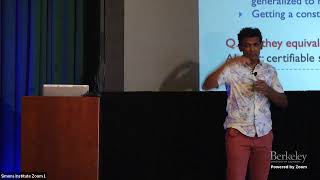
Continuous Algorithms - Sampling and Optimization in High Dimension
Explore high-dimensional sampling and optimization techniques, including cutting plane methods, interior-point algorithms, and Riemannian Hamiltonian Monte Carlo, with insights on complexity and open problems.
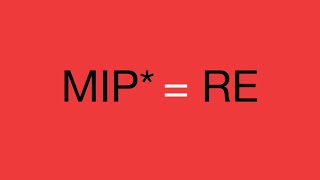
MIP* = RE
Explore the intersection of physics, mathematics, and computer science through a two-player game, delving into quantum mechanics, operator algebras, and interactive proofs.

Moore's Law, Exponential Growth, and Extrapolation!
Explore Moore's Law, exponential growth in computing, and its impact on AI, scientific computing, and future technologies. Understand the implications for technological advancement.
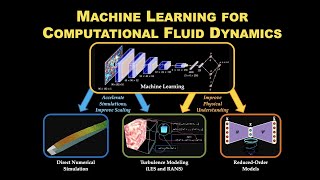
Machine Learning for Computational Fluid Dynamics
Explore machine learning's potential to enhance computational fluid dynamics, covering applications in simulations, turbulence modeling, and reduced-order models while emphasizing physics-informed approaches.

Deep Learning to Discover Coordinates for Dynamics - Autoencoders & Physics Informed Machine Learning
Explore deep learning techniques for discovering effective coordinate systems in dynamical systems, enabling simpler models and physical law discovery. Focus on autoencoders and physics-informed machine learning.
Neural Networks Part 7 - Cross Entropy Derivatives and Backpropagation
Detailed guide on calculating cross entropy derivatives and applying them in neural network backpropagation, with step-by-step explanations and practical examples.

Regression Trees, Clearly Explained
Clear explanation of regression trees, their applications, and step-by-step construction process. Covers differences from classification trees and use with multiple variables.
Gradient Descent, Step-by-Step
Comprehensive step-by-step explanation of Gradient Descent, covering its application in Machine Learning, optimization techniques, and variations like Stochastic Gradient Descent.