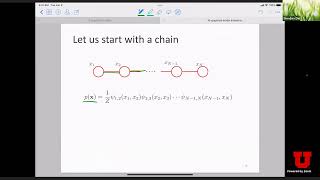
Probabilistic Machine Learning - Lecture 14
Dive into advanced data science concepts through comprehensive lecture coverage of key theoretical and practical aspects in this graduate-level academic session.
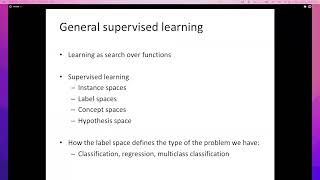
Machine Learning Mid-Semester Review - Lecture 15
Dive into a comprehensive mid-semester review of fundamental machine learning concepts, covering key principles and techniques explored throughout the academic term.
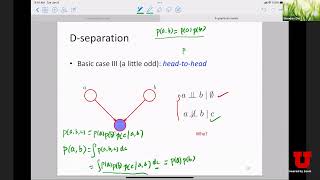
Probabilistic Graphical Models and Maximum Likelihood Estimation - Lecture 13
Dive into probabilistic graphical models, exploring likelihood estimation, Gaussian models, and network structures while learning to analyze real-world data using conditional independence concepts.
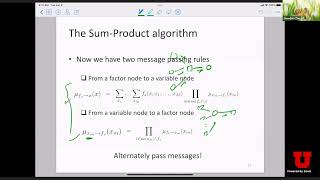
Probabilistic Machine Learning - Lecture 15
Dive into advanced data science concepts through a comprehensive graduate-level lecture covering key theoretical foundations and practical applications in modern data analysis and machine learning.
Machine Learning Career Roadmap 2024 - From Beginner to Expert
Discover a comprehensive YouTube learning path for mastering Machine Learning and AI, from mathematical foundations to specialized areas like NLP and Computer Vision - all through free resources.
Chain-of-Thought Limitations and Google's SCoRe Method for Language Models
Discover how Google's SCoRe method revolutionizes language models' self-correction abilities through reinforcement learning, surpassing traditional chain-of-thought approaches in mathematical reasoning and code generation.
SciAgents and AI Research Idea Generation - Comparing Stanford and MIT Approaches
Explore groundbreaking research from Stanford and MIT on AI agents' capabilities in scientific discovery, idea generation, and knowledge graph reasoning, with practical Python implementations.
Task-Optimized Multi-Agent Communication Protocols with G-Designer
Explore the G-Designer framework for optimizing multi-agent AI communication through Graph Neural Networks, focusing on efficiency, scalability, and robust topology design.
AFLOW: Automating Agentic Workflows for Large Language Models
Discover how AFLOW framework optimizes LLM workflows through automated code-based representations, specialized Monte Carlo Tree Search, and reusable operators to enhance AI performance while reducing computational costs.

Google's Dual-Agent AI Architecture: Thinking Fast and Slow
Explore Google's innovative dual-agent AI system that combines fast, intuitive responses with deep, deliberate reasoning for enhanced human-AI interactions and complex problem-solving.
Gödel's Theorem and Self-Learning AI Machines - From Incompleteness to Recursive Agents
Explore the groundbreaking Gödel Agent framework for AI, examining how self-referential systems and recursive self-improvement enable machines to autonomously evolve and optimize their own code and decision-making processes.
Neuro-Symbolic Graph Reasoning and Knowledge Graph Analysis - From Theory to Implementation
Explore neuro-symbolic AI frameworks and graph-based reasoning through practical examples, from biomedical research applications to Python implementations and logical rule learning.

Intelligence at the Edge of Chaos - Understanding Complex Reasoning in Overparameterized LLMs
Explore groundbreaking research on how intelligence emerges in LLMs through complex datasets, focusing on the critical balance between order and chaos in cellular automata-based training.

Monte Carlo and Bayesian Networks for AI Agent Decision Making
Explore advanced probabilistic frameworks combining Dynamic Bayesian Networks and Monte Carlo methods to enhance AI agent decision-making in complex, high-dimensional environments through practical implementations.
Understanding Grokking - A New Performance Phase in Large Language Models
Discover how extended training of LLMs leads to "grokking" - a breakthrough phase where models develop superior generalization abilities and form geometric patterns in embedding spaces.
The Art of Text to Vector Transformation - A Comprehensive Look at AI and NLP Transformers
Dive into the fundamentals of converting text to mathematical vectors, understanding tokenization methods like BERT and BPE for NLP applications and AI transformer models.

Local Random Quantum Circuits Form Approximate Designs
Delve into the mathematical foundations of random quantum circuits on arbitrary graphs, exploring how they form approximate unitary designs with polynomial-size circuits and bounded spectral gaps.
New Approaches to Complexity via Quantum Graphs
Explore groundbreaking research on quantum graph complexity theory, examining clique problems and quantum channels while comparing complexity classes QMA(2), QMA, MA, and NP.
Reversible Pebbling - Parallel Quantum Circuits with Low Amortized Space-Time Complexity
Explore parallel quantum circuit construction through reversible pebbling games, focusing on efficient space-time complexity and quantum algorithm optimization for enhanced computational performance.
Generalized Rényi Entropy Accumulation Theorem and Quantum Probability Estimation
Delve into advanced quantum cryptography through an exploration of the generalized Rényi entropy accumulation theorem, focusing on improved finite-size bounds and convex optimization techniques.
Stochastic Error Cancellation in Analog Quantum Simulation
Explore how stochastic error cancellation improves analog quantum simulation accuracy, demonstrating reduced error scaling and enhanced fidelity in noisy quantum systems.