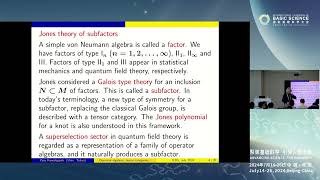
Operator Algebras, Tensor Categories and Tensor Networks in Topological Order
Explore tensor networks in topological order using operator algebra techniques. Discover quantum symmetries and their mathematical representation through tensor categories.
Derived Approach to Highest Weight Categories
Explore highest weight categories in Representation Theory, examining their interpretation through exact categories, abelian envelops, and exceptional collections in derived categories.
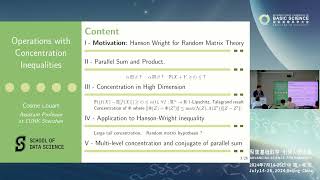
Operation on Concentration Inequalities and Conjugate of Parallel Sum
Explore advanced techniques in concentration inequalities, including operations on concentrated vectors and applications of the convex conjugate of parallel sum in measure theory.
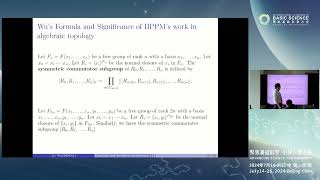
Topology and Artificial Intelligence - Applications and Recent Progress
Explore recent advancements in algebraic topology and AI, including language models for homotopy groups and statistical modeling for complex networks and diseases.
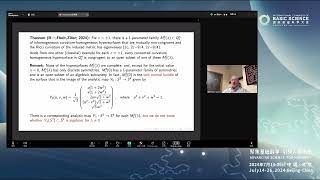
Curvature-Homogeneous Riemannian 3-Manifolds and Integrable Systems
Explore curvature-homogeneous Riemannian 3-manifolds, surveying known examples and recent discoveries. Delve into connections with integrable systems, particularly Toda lattices, to construct new explicit examples.
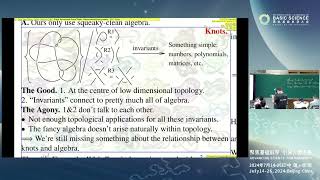
Knot Invariants from Finite Dimensional Integration
Explore finite dimensional integration for computing powerful knot invariants, surpassing traditional methods in efficiency and rigor while challenging established notions in knot theory.
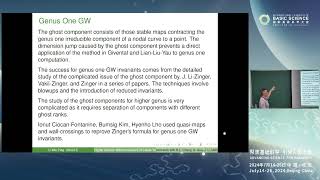
Higher Gromov-Witten Invariants of Calabi-Yau Threefolds
Explore mixed-spin-p-fields method for Calabi-Yau quintics, its application to BCOV Feynman summation rule, and generalization to hypersurfaces in toric varieties.
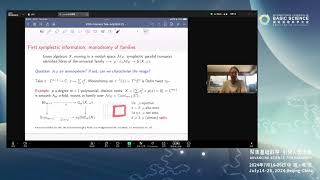
Symplectic Topology, Stability Conditions and Quadratic Differentials
Explore connections between symplectic topology, stability conditions, and quadratic differentials in Fukaya categories and mapping class groups.
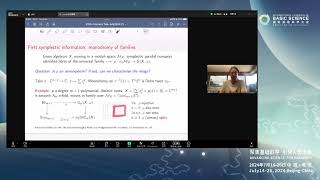
Symplectic Topology, Stability Conditions and Quadratic Differentials
Explore connections between symplectic topology, stability conditions, and quadratic differentials in Fukaya categories and mapping class groups.
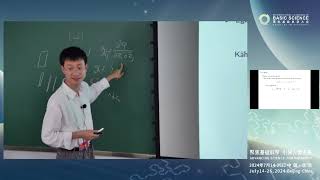
Exotic Calabi-Yau Metric and Holomorphic Fibration
Explore complete Calabi-Yau metrics, from historical developments to recent constructions on C^3, with insights into collapsing metrics on Calabi-Yau 3-folds.
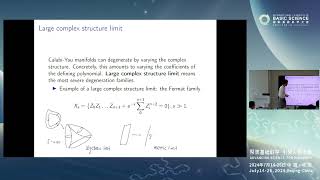
Metric SYZ Conjecture for Calabi-Yau Manifolds - ICBS 2024
Explore special Lagrangian torus fibrations on Calabi-Yau manifolds, focusing on recent progress and the Fermat family of hypersurfaces.

Generic and Random Behavior of Minimal Surfaces
Explore minimal surfaces in Differential Geometry, focusing on recent quantitative findings under genericity and randomness conditions. Discover spatial equidistribution and hyperbolic properties.

Geometric Analysis of Phase Retrieval
Explore geometric analysis of phase retrieval, examining nonconvex heuristics and proving benign geometric structure for efficient signal recovery using iterative optimization methods.
Semiclassical Measures on Compact Hyperbolic Surfaces
Explore semiclassical measures on compact hyperbolic surfaces, focusing on eigenfunctions of the Laplacian operator and the quantum ergodicity theorem. Delve into fractal uncertainty principles and their implications.
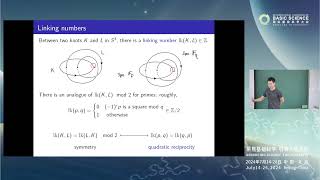
Structure in the Search for Structure - Algebraic Number Theory and Motivic Cohomology
Explore algebraic number theory through analogies between numbers and shapes, including quadratic reciprocity and linking numbers, leading to insights on Tate's 1966 conjecture.
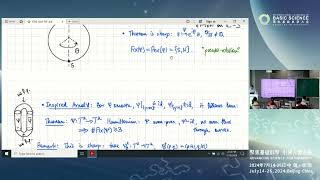
On the Hofer-Zehnder Conjecture - Periodic Points of Hamiltonian Diffeomorphisms
Explore Hofer-Zehnder conjecture on periodic points of Hamiltonian diffeomorphisms, examining recent progress using persistence modules, barcodes, and Floer cohomology power operations.
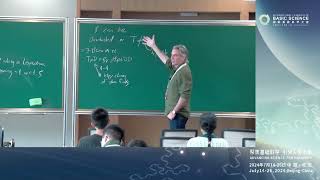
Tightness and Legendrian Surgery in Contact Structures
Explore contact structures, open book decompositions, and tightness characterization in 3-manifolds. Investigate preservation of tightness under Legendrian surgery.
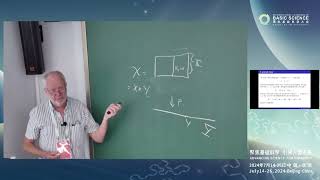
Complex Brunn-Minkowski Theory and Uniqueness Theorems in Kähler Geometry
Explore complex Brunn-Minkowski theory and its applications in Kähler geometry, focusing on uniqueness theorems and generalizations of Bando-Mabuchi's work on Kähler-Einstein metrics.

Categorification of Lagrangian Floer Theory and Its Relation to Various Mathematics
Explore categorification of Lagrangian Floer theory and its connections to diverse mathematical fields with renowned mathematician Kenji Fukaya.
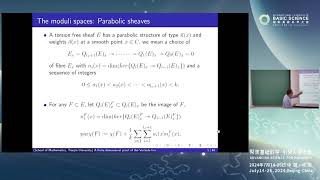
A Finite Dimensional Proof of the Verlinde Formula
Explore a purely algebro-geometric proof of the Verlinde formula, examining recurrence relations for curve genus and parabolic points in generalized theta function spaces.
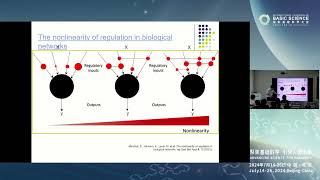
Quasi-Dynamic System Representation of Multiple Nonlinear Regression
Explore evolutionary game theory and allometric scaling to model nonlinear relationships between variables, overcoming limitations of linear regression for complex systems analysis.