
Pareto, Power Laws, and Fat Tails: A Beginner's Guide to Non-Gaussian Statistics
Explore power laws, fat tails, and their impact on statistical analysis. Learn why traditional methods fall short and gain insights into analyzing extreme events in various domains.

Causal Effects via Regression with Python Code - Part 5
Explore regression-based techniques for computing causal effects, including linear regression, double machine learning, and metalearners. Gain practical insights with Python code examples.

Causal Effects via DAGs: Handling Unobserved Confounders - Part 4
Explore graphical criteria for evaluating causal effects in non-Markovian models, focusing on handling unobserved confounders through back and front door criteria.

Causal Effects via the Do-operator: Overview and Example - Part 3
Explore the do-operator for estimating causal effects from observational data. Learn alternative formulations of average treatment effect and techniques for handling unmeasured confounders.

Causal Effects - Introduction to the Potential Outcomes Framework
Explore the Potential Outcomes Framework and three types of causal effects in this introductory video on causal inference, laying the groundwork for future discussions on observational data analysis.
S-duality and Lie Super-algebras
Explore geometric realization of quantum simple Lie super-algebras, S-duality, and connections to geometric Langlands correspondence and relative Langlands duality.
Weyl-Strength Subconvexity for Dirichlet L-Functions
Explore Weyl-strength subconvexity for Dirichlet L-functions, examining the subconvexity problem and progress on obtaining the Weyl exponent via the method of moments.
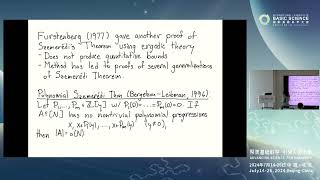
Quantitative Bounds in the Polynomial Szemerédi Theorem and Related Results
Explore quantitative bounds in polynomial Szemerédi theorem and related problems in additive combinatorics, harmonic analysis, and ergodic theory.
Minimal Surfaces and the Allen-Cahn Equation on 3-Manifolds
Explore minimal surfaces and the Allen–Cahn equation on 3-manifolds, focusing on recent results and the multiplicity-one theorem in three dimensions.
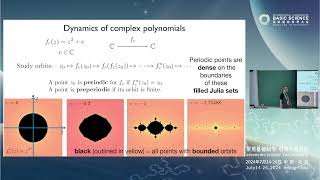
Rigidity and Uniformity in Algebraic Dynamics
Explore connections between algebraic dynamics and arithmetic geometry, focusing on preperiodic points and torsion points in abelian varieties. Learn about recent breakthroughs in uniform bounds and conjectures.
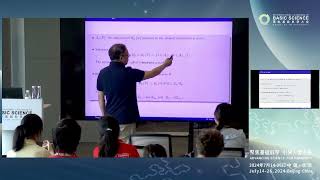
Analytic and Reidemeister Torsions of Digraphs and Path Complexes
Explore Reidemeister and analytic torsions on finite digraphs using path homology theory. Learn about Hodge Laplace operators, torsion identities, and formulas for Cartesian products and joins.
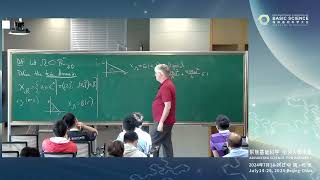
Symplectomorphism Invariants of Open Domains
Explore symplectomorphism invariants of open domains, focusing on zeta functions, Reeb dynamics, and equivariant symplectic homology to distinguish toric domains.
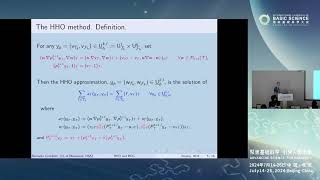
Bridging the Hybrid High-Order and Hybridizable Discontinuous Galerkin Methods
Explore the connection between hybrid high-order and hybridizable discontinuous Galerkin methods for diffusion problems, unveiling new efficient approaches and optimal convergence.

Homological Aspects of Branching Laws in p-adic Groups
Explore homological aspects of branching laws for p-adic group representations, focusing on restriction to subgroups and projective representations in Bernstein blocks.

Hausdorff Dimension of Three-Dimensional Kakeya Sets
Explore groundbreaking research on Kakeya sets in R^3, uncovering a new lower bound for Hausdorff dimension and its implications in geometric measure theory.
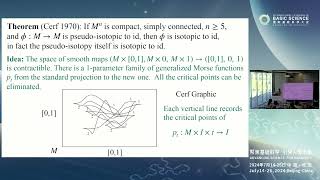
Pseudo-Isotopy and Diffeomorphisms of 4-Manifolds
Explore recent advancements in pseudo-isotopy theory and its applications to studying diffeomorphisms of 4-manifolds with David Gabai.
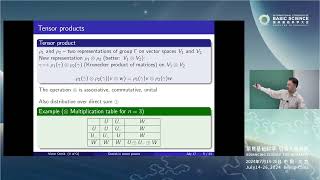
Growth in Tensor Powers
Explore tensor power decomposition in group representations, focusing on asymptotic behavior and non-negligible summands using symmetric tensor category theory.

The Ricci Flow - Lecture by Richard Hamilton
Explore the Ricci flow equation, its applications in geometry, and its role in understanding manifold curvature evolution. Gain insights into singularities and geometric analysis.
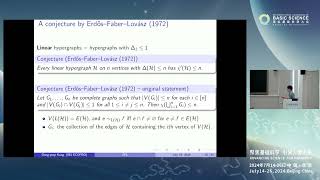
A Proof of the Erdos-Faber-Lovasz Conjecture
Explore the recent proof of the Erdos-Faber-Lovasz conjecture and its generalization, delving into linear hypergraphs and chromatic index concepts.
Rectifiable-Reifenberg and the Regularity of Stationary and Minimizing Harmonic Maps
Explore sharp rectifiability results for singular sets of minimizing harmonic maps, with uniform Minkowski bounds and integrability. Analyze quantitative stratification and dimension-reduction techniques.
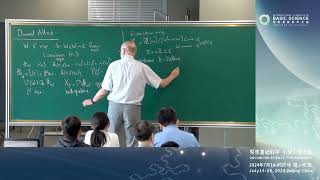
Ball Quotients and Algebraic Geometry - ICBS 2024
Explore ball quotients in algebraic geometry, focusing on moduli spaces, Kaehler metrics, and their connections to sporadic finite simple groups. Examine known examples and recent progress on the Allcock ball quotient.