Complex Numbers and Curves in 19th Century Mathematics
Explore complex numbers, algebraic curves, and their intersection with projective geometry and topology. Discover how these concepts revolutionized 19th-century mathematics and laid the foundation for modern algebraic geometry.
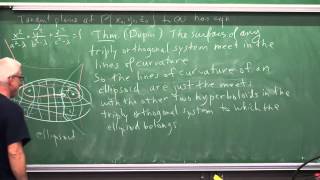
Differential Geometry: Meusnier, Monge, and Dupin's Work on Surfaces - Lecture 33
Explore Dupin's discoveries in differential geometry, including triply orthogonal surfaces, lines of curvature, and the Dupin indicatrix, with applications to ellipsoids and confocal systems.
Applications of the Dot Product to Planar Geometry - Part 1
Explore how the dot product shapes planar Euclidean geometry, introducing linear functionals, normal vectors for lines, and geometric projections in linear algebra.
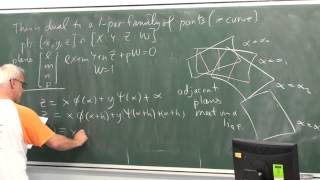
Meusnier, Monge and Dupin - Differential Geometry - Lecture 32
Explore Monge's contributions to differential geometry, including descriptive geometry, theorems, and studies on curves, surfaces, and lines of curvature in this advanced mathematics lecture.
Meusnier, Monge and Dupin - Differential Geometry - Lecture 1
Explores the contributions of French geometer Meusnier to differential geometry, focusing on curvature, asymptotic directions, and umbilic points, with applications of Rational Trigonometry.
Examples of Curvatures of Surfaces - Differential Geometry Lecture 30
Explore curvature formulas for surfaces through examples like spheres, ellipsoids, and cubic surfaces. Learn to calculate mean and Gaussian curvatures using linear algebra and characteristic coefficients.
Review of Decimal Arithmetic - Year 9 Mathematics
Comprehensive review of decimal arithmetic for Year 9, covering addition, subtraction, conversion to fractions, and operations with powers of 10. Includes practical money analogies and exercises for skill practice.
Curvature for General Algebraic Surfaces - Differential Geometry Lecture 29
Explore curvature formulas for general algebraic surfaces, extending from paraboloids to general quadrics. Learn to compute curvatures for hypersurfaces in affine space.
Dedekind Cuts and Computational Difficulties with Real Numbers - Famous Math Problems 19
Explores the challenges and misconceptions surrounding 'real numbers', examining various approaches like infinite decimals, Dedekind cuts, and Cauchy sequences, while emphasizing the importance of concrete computations in mathematics.
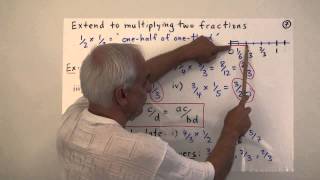
Review of Arithmetic with Fractions - Year 9 Mathematics
Comprehensive review of fraction arithmetic for Year 9, covering addition, subtraction, multiplication, and division. Emphasizes geometric interpretation and practical exercises for solid understanding.
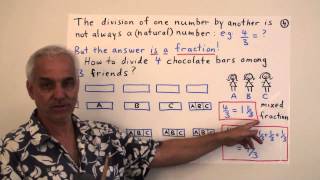
Review of Arithmetic with Fractions - Year 9 Mathematics
Comprehensive review of fraction arithmetic for Year 9, emphasizing number line visualization. Covers basic concepts, division, equivalent fractions, and practical problem-solving.
The Rational Number Line and Irrationalities - Famous Math Problems 19b
Geometric approach to modeling the continuum using the rational number line. Explores properties, projective view, and introduces irrationalities through Euclidean geometry and polynomial equations.
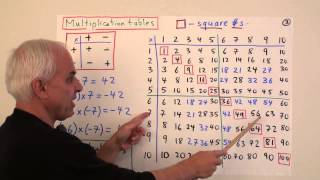
Review of Integer Arithmetic - Year 9 Mathematics
Comprehensive review of integer arithmetic, covering multiplication, tables, and laws. Includes practice problems for students to reinforce understanding of fundamental mathematical concepts.
The Most Fundamental Problem in Mathematics - Famous Math Problems 19a
Explore the fundamental problem of modeling the continuum in mathematics, examining its historical significance, practical applications, and implications for various mathematical areas.
Are All True Mathematical Statements Provable? - Famous Math Problems
Explores the philosophical question of mathematical truth and provability, challenging conventional views with explicit examples of likely true but unprovable mathematical statements.
Euler's Relation Between Vertices, Edges, and Faces of Platonic Solids - Famous Math Problems 15
Explore Euler's famous formula relating vertices, edges, and faces of Platonic solids. Discover its historical context, proof, and significance in modern topology.
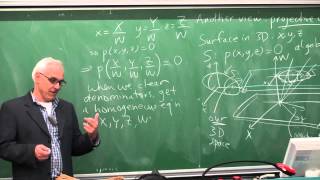
More General Surfaces in Differential Geometry - Lecture 22
Explores advanced surface types in differential geometry, including ruled and developable surfaces, minimal surfaces, algebraic surfaces, and projective constructions, with historical context and mathematical insights.
Japanese Temple Problems - Famous Math Problems 14
Explore Japanese temple geometry problems, focusing on a 13-year-old's 1847 challenge. Compare classical and rational trigonometry approaches, revealing surprising algebraic insights and symmetries in triangle geometry.
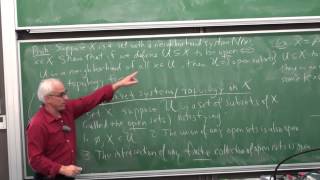
Topological Spaces and Manifolds - Differential Geometry Lecture 24
Explore topological spaces and manifolds through neighborhood systems and open sets. Learn key concepts, solve problems, and understand the foundations of continuous space theory in modern mathematics.
Differential Geometry Problems Tutorial - Lecture 21
Detailed solutions for three differential geometry problems: rational parametrization of cissoid, parametrization of a specific conic, and finding the evolute of y=x^n. Enhances problem-solving skills in advanced geometry.
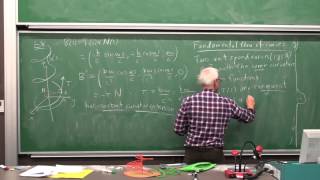
The Frenet-Serret Equations - Example of a Helix - Differential Geometry Lecture 19
Detailed exploration of a helix as an example of Frenet Serret equations, discussing curvature, torsion, and the Fundamental theorem of curves. Introduces osculating, normal, and rectifying planes.