The Sign Rule and Continuous Probability Distributions - Probability and Statistics
Explore sign rule, continuous probability distributions, uniform and normal distributions, and key concepts like mean and variance for continuous random variables in probability and statistics.
Random Variables, Means, Variance, and Standard Deviations in Probability and Statistics
Explore key concepts in probability and statistics: random variables, probability distributions, mean, variance, and standard deviation. Learn through examples and practical applications.
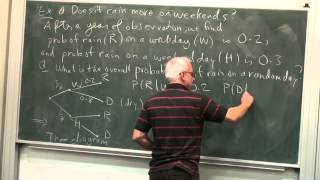
Total Probability, Bayes' Rule and Tree Diagrams - Probability and Statistics
Explore total probability, Bayes' rule, and tree diagrams in probability and statistics. Learn about mutually independent events and apply these concepts to real-world scenarios, including medical statistics.
Quadratic Curvature for Algebraic Curves - Differential Geometry Lecture 14
Explores quadratic curvature for algebraic curves, extending from parabolas to general conics. Discusses connections between curvature and foci, emphasizing the power of formulas in differential geometry.
Probability Spaces, Events, and Conditional Probabilities
Explore probability spaces, events, and conditional probabilities. Learn about sample spaces, visualizations, independence, and practical applications using chess board examples.
Curvature for the General Parabola - Differential Geometry Lecture 13
Explores curvature of general parabolas using projective geometry, focus-directrix definition, and local behavior. Introduces formulas for parabola curvature as a foundation for understanding curvature of general curves.
Basic Counting and Probability - Introduction to Probability and Statistics
Explore fundamental counting techniques, probability concepts, and their applications in dice rolls, card games, and birthday scenarios. Learn to calculate odds for informed decision-making in various contexts.
Review of Sets and Functions - Probability and Statistics Introduction
Comprehensive review of set theory and functions, covering key concepts like Venn diagrams, distributive laws, partitions, and disjoint sets. Essential foundation for probability and statistics.
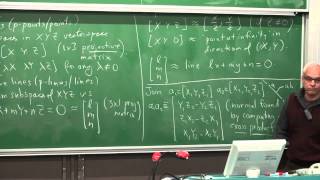
Duality, Polarity and Projective Linear Algebra in Differential Geometry - Lecture 10
Explore projective geometry's impact on differential geometry, focusing on conics, projective linear algebra, and duality between points and lines in the projective plane.
Duality, Polarity and Projective Linear Algebra - Differential Geometry Lecture 11
Explores projective geometry, quadratic forms, and pole-polar duality in relation to the unit circle. Connects these concepts to Lorentz/Einstein/Minkowski geometry and Apollonius' work.
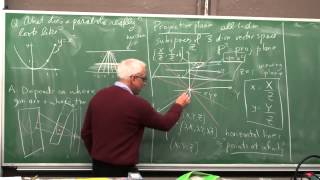
Projective View of Conics and Quadrics - Differential Geometry Lecture 9
Explore projective geometry's application to conics and quadrics, using homogeneous coordinates to unify the study of algebraic curves and surfaces in plane and space.
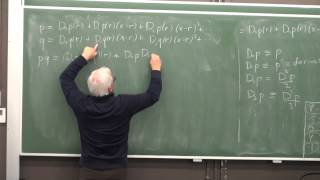
The Differential Calculus for Curves - Lagrange's Algebraic Approach - Lecture 4
Explore Lagrange's algebraic approach to differential calculus, focusing on polynomial functions and Taylor approximations. Learn about tangent lines, conics, and sub-derivatives without limits or real numbers.
The Rotation Problem and Hamilton's Discovery of Quaternions - Part 4
Practical implementation of quaternions for 3D rotations, focusing on half-turns and vector trigonometry. Explores quaternion multiplication and its geometric interpretation for rotations.
The Rotation Problem and Hamilton's Discovery of Quaternions - Part 2 - Famous Math Problems 13b
Explore 3D rotations, their composition, and algebraic representation. Learn about Euler's theorem, vector operations, and the foundations for understanding quaternions in graphics and rocket science.
Euler's Triangulation of a Polygon - Famous Math Problems
Explore Euler's polygon triangulation problem, Catalan numbers, and their applications in combinatorics. Derive Euler's formula and discover connections to other mathematical concepts.
The Graceful Tree Conjecture - Famous Math Problems
Explore the Graceful Tree Conjecture in graph theory, learning about vertex labeling, graceful graphs, and evidence supporting this famous mathematical problem.

The Collatz Conjecture - Famous Math Problems - Lecture 2
Explore the intriguing Collatz conjecture, its variants, and strategies for tackling this famous unsolved mathematical problem. Learn about base-2 arithmetic and number theory applications.
An Introduction to Measuring - Elementary Mathematics Explained 19
Explore measurement concepts including length, weight, area, volume, and temperature. Learn about Imperial and Metric systems, create rulers, and practice measuring everyday objects.

Multiplication Tricks and Practice - Elementary Mathematics
Discover helpful multiplication tricks and practice problems for elementary math. Learn strategies for multiplying by 10, 5, 3, and 9, and apply these skills to solve word problems effectively.
More Multiplication: The 10x10 Table - Elementary Mathematics Explained
Strategies for mastering the 10x10 multiplication table, emphasizing understanding over rote memorization. Includes tips on using patterns, symmetry, and the commutative law to aid learning.
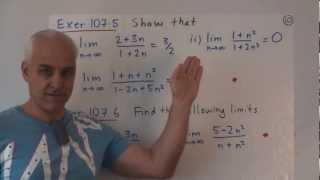
Inequalities and Limits in Real Numbers - Math Foundations 107
Simplified epsilon-delta limit definition for rational polynumbers, with visual interpretation and practical examples. Comprehensive review of inequalities for natural numbers, integers, and rational numbers.