
Real Numbers as Cauchy Sequences - Limitations and Challenges - Math Foundations 114
Explores logical weaknesses in using Cauchy sequences to define real numbers, challenging traditional approaches and highlighting ambiguities in fundamental mathematical concepts.
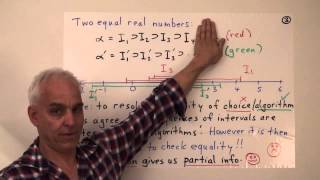
Real Numbers and Cauchy Sequences of Rationals - Math Foundations 113
Explore Archimedean real numbers and Cauchy sequences, examining their definitions, properties, and applications in mathematical analysis and approximation theory.
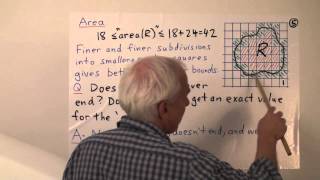
Real Numbers and Cauchy Sequences of Rationals - Math Foundations 112
Explores the concept of real numbers, challenging their existence and examining how quantities like length, area, and function values are inherently approximate rather than exact 'real' values.

Real Numbers and Cauchy Sequences of Rationals - Math Foundations 111
Explores Cauchy sequences of rational numbers as a foundation for real numbers, discussing limits, equivalence classes, and the logical challenges in this approach to constructing the real number system.
The Chromatic Algebra of 2x2 Matrices - Part 2
Explores chromatic algebra of 2x2 matrices, focusing on subalgebras, complexions, dot products, and the four-dimensional Dihedrons algebra. Compares to quaternions and highlights unique properties.

Limits to Infinity - Real Numbers and Limits
Exploring limits of sequences approaching infinity, focusing on rational polynomials and functions. Introduces a simplified definition for verifying limits as finite tasks.
The Chromatic Algebra of 2x2 Matrices - Wild Linear Algebra B41
Explore chromatic algebra in 2x2 matrices, covering subalgebras, complexions, trace, determinant, and characteristic polynomials. Introduces unique dot products on 2x2 matrices.
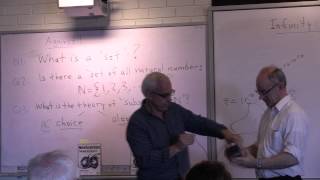
Infinity: Does It Exist? - A Debate on Mathematical Philosophy
A thought-provoking debate on the existence and nature of infinity in mathematics, exploring philosophical perspectives and practical implications for modern computing and mathematical foundations.
Relativistic Dot Products and Complex Numbers in Linear Algebra - Part 2
Exploring triality of dot products and associated complex numbers in chromogeometry, organized within 2x2 matrices. Delves into interactions between three geometries.
Simple Groups, Lie Groups, and the Search for Symmetry - Part 2
Explores the evolution of group theory in mathematics, from number theory to symmetry in geometry, covering simple groups, tessellations, and Lie groups. Highlights key mathematical objects and the classification of finite simple groups.
Algebraic Number Theory and Rings - Math History II
Explores 19th-century algebraic number theory, focusing on extension fields, abstract rings, and algebraic integers. Discusses Gaussian integers, unique factorization, and foundational challenges in the field.

Galois Theory I - Introduction to Polynomial Equations and Symmetries
Explore Galois theory's insights into solving polynomial equations, from quadratic to quartic, and the historical development of algebraic problem-solving techniques.
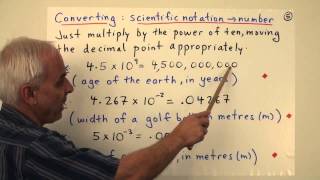
Scientific Notation - Part 2
Explore scientific notation for large and small numbers, including writing techniques, real-world applications, and conversions. Learn to compare numbers efficiently using this powerful mathematical tool.
Historical Development of Group Theory - From Number Theory to Geometry
Explore the historical development of group theory, from its roots in number theory and algebra to its impact on geometry, covering key concepts and influential mathematicians.
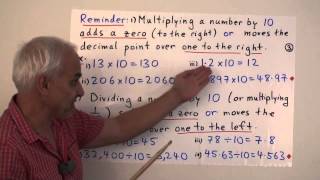
Scientific Notation - Year 9 Mathematics
Learn scientific notation for expressing very large and small numbers efficiently. Explore powers of ten, decimal point shifts, and connections to percentages using real-world examples like city populations.
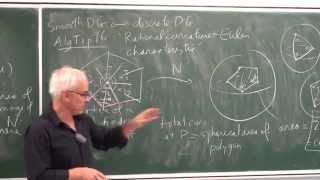
Gauss's View of Curvature and the Theorema Egregium - Differential Geometry Lecture 35
Explores Gauss's curvature concept, Theorema Egregium, and discrete curvature in polyhedra. Covers Gauss-Rodrigues map, paraboloids, and the Gauss-Bonnet theorem for a comprehensive look at differential geometry.
Circles and Spheres via Dot Products - Part 1
Explore circles using dot products in linear algebra. Learn two approaches: quadratic and bilinear equations. Discover applications to tangents, pole/polar duality, and classical theorems in projective geometry.
Gauss, Normals and Fundamental Forms in Differential Geometry - Lecture 34
Explore Gauss's approach to differential geometry, including parametric surface descriptions, fundamental forms, and the Gauss-Rodrigues map. Learn about Gaussian curvature and its applications in surface analysis.
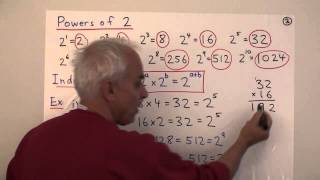
Index Laws and Powers of 2 - Year 9 Mathematics
Explore index laws and powers of 2, from ancient Indian chess to practical applications. Learn the reasoning behind these mathematical concepts and practice solving problems to develop fluency and problem-solving skills.
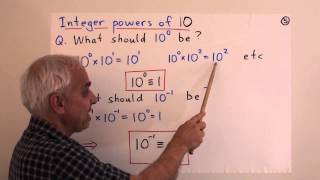
Index Laws, Powers of 10, and Negative Exponents - Year 9 Mathematics
Explore index laws and powers of 10, including negative exponents. Learn to handle very large and small numbers efficiently, with practical applications and terminology for scientific notation.
Applications of the Dot Product to Planar Geometry - Part 2
Explore advanced applications of dot product in planar geometry, including linear functionals, point-normal form of lines, vector projections, isometries, and rotations.