Sphere Geometry and Complex Analysis - Algebraic Topology Lecture 4
Explore advanced concepts in sphere geometry, including inversive geometry, Riemann sphere, complex analysis, and projective lines, enhancing understanding of algebraic topology.
The Geometry of Surfaces - Algebraic Topology Lecture 20
Explore the connection between 2D surfaces and classical geometries, focusing on isometries and introducing hyperbolic geometry through circle inversions in the Beltrami Poincare disk model.
Classification of Combinatorial Surfaces - Lecture 2
Explores the classification of two-dimensional surfaces using polygon reduction techniques. Covers cutting, pasting, and creating crosscaps and handles to achieve standard forms in algebraic topology.
Rational Curvature of a Polytope - Algebraic Topology Lecture 15
Introduces a new rational definition of polytope curvature, using turn-angle to connect curvature with Euler number. Explores opposite cones and applies Harriot's theorem on spherical triangles.
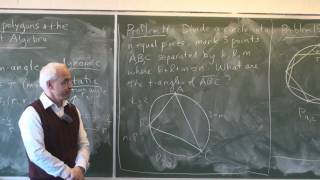
Duality for Polygons and the Fundamental Theorem of Algebra - Algebraic Topology Lecture 12
Explore duality in polygons and a rational proof of the Fundamental Theorem of Algebra using winding numbers. Gain insights into algebraic topology concepts and their applications.
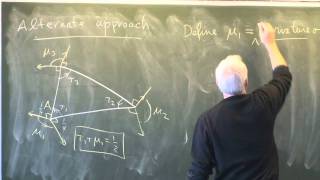
Rational Curvature, Winding, and Turning in Algebraic Topology - Lecture 11
Explores rational curvature, turn angles, and winding numbers in algebraic topology. Introduces new geometric concepts for describing polygons and planar curves, emphasizing practical applications in mathematics.
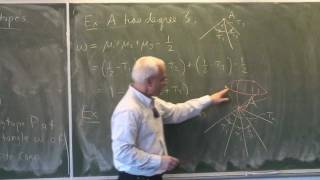
Rational Curvature of Polytopes and the Euler Number - Algebraic Topology Lecture 16
Explore the relationship between polyhedron curvature and Euler number using rational formulation. Learn about Harriot's theorem and analyze various polyhedra, including tetrahedron, cube, and dodecahedron.
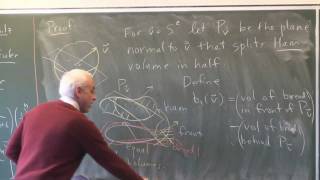
The Ham Sandwich Theorem and the Continuum - Algebraic Topology Lecture 14
Explore the Borsuk-Ulam theorem, Ham Sandwich theorem, and their applications in algebraic topology. Learn how these concepts relate to continuous maps and homeomorphisms in affine spaces.
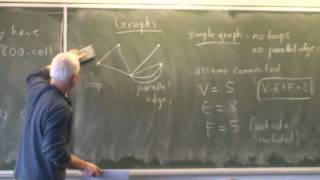
Applications of Euler's Formula and Graphs in Algebraic Topology
Explore Euler's formula applications to Platonic solids, polyhedra, and higher dimensions. Learn about planar graphs and delve into advanced geometric concepts in algebraic topology.
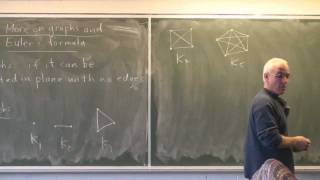
More on Graphs and Euler's Formula in Algebraic Topology - Lecture 10
Explores applications of Euler's formula in planar graphs, including complete and bipartite graphs, Five neighbours theorem, Six colouring theorem, and Pick's formula for computing areas of integral polygonal figures.

The Hindu-Arabic Number System - Elementary Mathematics Explained - Lecture 4
Explore the evolution of number systems from basic counting to the revolutionary Hindu-Arabic system. Learn about number symbols, decimals, and the abacus while discovering the importance of zero in mathematics.
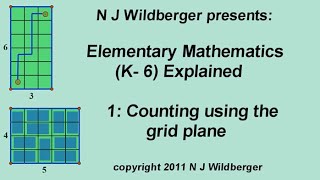
Counting Using the Grid Plane - Elementary Mathematics Explained - Lecture 1
Explore geometry using graph paper, introducing grid points, segments, and rectangles. Learn to measure, count, and tile shapes while practicing arithmetic in a geometric context.
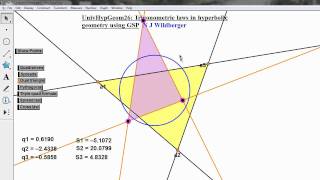
Trigonometric Laws in Hyperbolic Geometry Using Geometer's Sketchpad - Universal Hyperbolic Geometry 26
Explore trigonometric laws in hyperbolic geometry using Geometer's Sketchpad. Learn about Pythagoras' theorem, Triple quad formula, Spread law, and Cross law with practical examples and custom tools.
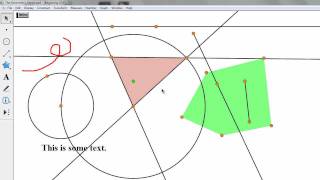
Geometer's Sketchpad and Circles in Universal Hyperbolic Geometry - Lecture 25
Explore Geometer's Sketchpad for dynamic illustrations in universal hyperbolic geometry. Learn custom tools, construct point duals, and discover various circles, including equidistant curves, in hyperbolic space.
Pure and Applied Geometry - Understanding the Continuum - Universal Hyperbolic Geometry 20
Explores the distinction between pure and applied geometry, challenging traditional views on real numbers and the continuum. Offers a rational number-based approach to understanding geometric concepts and continuums.
Reflections in Hyperbolic Geometry - Universal Hyperbolic Geometry Lecture 14
Explore reflections in hyperbolic geometry, comparing with Euclidean counterparts. Discover unique properties and surprising connections to circle geometry in this advanced mathematical exploration.
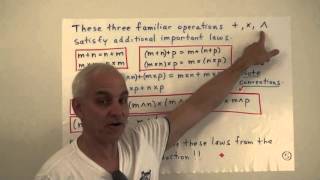
Complexity and Hyperoperations in Arithmetic - Data Structures Math Foundations 174
Explore complexity in arithmetic, from basic operations to advanced hyperoperations. Learn about number representation, operation hierarchies, and the intricacies of mathematical complexity.
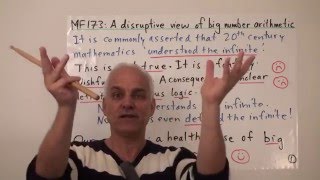
A Disruptive View of Big Number Arithmetic - Math Foundations 173
Explore the challenges of big number arithmetic, its impact on mathematical understanding, and the limitations of traditional approaches to infinity and proof techniques.
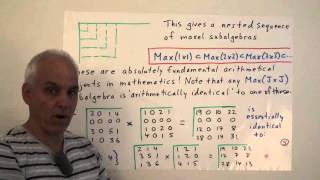
Maxel Algebra II - Data Structures in Mathematics
Exploring maxel algebra as an extension of matrix algebra, focusing on diagonal maxels and their role in projecting and restricting maxels, revealing nested matrix algebra structures.
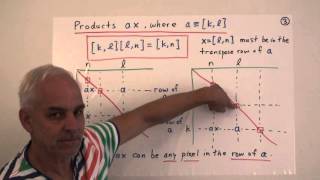
Maxel Theory - New Thinking About Matrices - Data Structures Math Foundations 168
Exploring maxel theory and its impact on linear algebra, focusing on pixel geometry and matrix multiplication for new insights into matrix algebra.
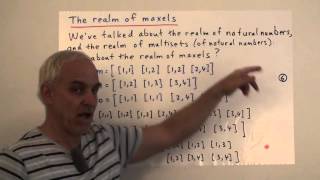
Maxel Theory: New Thinking About Matrices - Math Foundations 166
Explore Maxel theory, a novel approach to matrix theory using pixels. Learn about maxel algebra, multiplicative structure, and applications in linear algebra.