How to Set Up Fractions - Famous Math Problems 24
Rigorous exploration of fraction theory, covering fundamental operations, comparisons, proofs, and arithmetic laws. Emphasizes the importance of robust number systems in mathematics.
Quadratic Curvature for Algebraic Curves - Differential Geometry Lecture 15
Explores advanced formulas for curvature of algebraic surfaces in 3D space, focusing on the normal paraboloid as key to encoding quadratic metrical information and curvatures in general situations.
Tips and Tricks for Computing Cyclotomic Polynomials - Famous Math Problems 20d
Explore techniques for computing cyclotomic polynomials, including the Euler totient function and prime power decomposition. Learn to tackle complex calculations like Phi_1001.
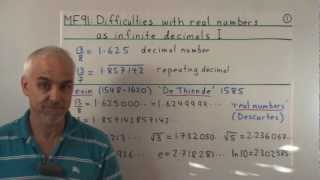
Difficulties with Real Numbers as Infinite Decimals - Part 1
Explores challenges in defining real numbers as infinite decimals, examining advantages and drawbacks of the infinite choice approach, and discussing historical debates on arithmetic laws and mathematical foundations.
The Number Theory Revival - From Diophantus to Fermat
Explore the revival of number theory, from Diophantus to Fermat, covering key concepts like combinatorics, algebraic curves, and famous theorems in this comprehensive mathematical journey.
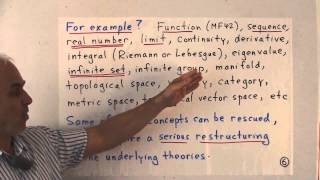
Logical Weaknesses in Modern Pure Mathematics - Real Numbers and Limits - Math Foundations 87
Explores logical weaknesses in modern pure mathematics, focusing on inconsistent rigor and problematic definitions. Challenges conventional views and invites discussion on foundational issues in mathematics.
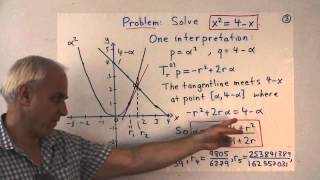
Solving Quadratics and Cubics Approximately - Real Numbers and Limits - Math Foundations 85
Explore approximate solutions for quadratic and cubic equations using standard formulas and Newton's method. Learn historical context and connect algebraic techniques with numerical methods.
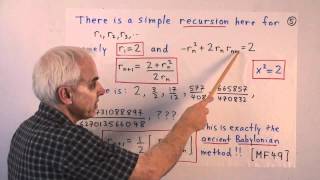
Newton's Method for Finding Zeros - Real Numbers and Limits
Explore Newton's method for finding zeros, focusing on quadratic functions and approximating square roots. Learn about tangent lines, recursion, and practical applications in mathematics.
Multiples and Number Names - Elementary Mathematics Explained - Lecture 9
Explore number multiples, their names, and geometric representations. Learn simplified naming systems for numbers up to 200, bridging addition to multiplication through visual and conceptual understanding.
Addition and Number Names - Elementary Mathematics Explained
Explore addition fundamentals, number naming, and efficient calculation methods. Learn to create and interpret addition tables, with insights into logical numbering systems and their properties.
Fun with Polyominoes - Elementary Mathematics Explained - Lecture 6
Explore polyominoes: shapes made from connected squares. Learn to count different forms, solve tiling puzzles, and use checkerboard patterns in this engaging mathematical adventure.
Inconvenient Truths About the Square Root of 2 - Real Numbers and Limits
Explores the concept of sqrt(2), its historical significance, and modern approaches, challenging traditional views on irrational numbers and highlighting logical issues in mathematical analysis.
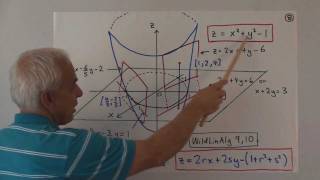
Calculus on the Unit Circle - Arithmetic and Geometry Math Foundations 78
Explore algebraic calculus on unit circles, covering subderivatives, Taylor expansions, tangents, and 3D visualizations. Gain insights into foundational mathematics with a unique approach to this fundamental topic.
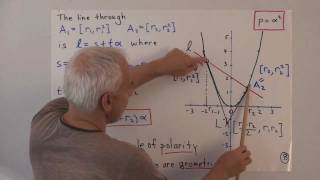
Lines and Parabolas - Quadratic Polynomials and Geometric Relations
Explore advanced parabola concepts: algebraic calculus, subderivatives, tangent lines, Taylor expansions, and geometric relations. Learn to analyze and graph parabolas using completing the square method.
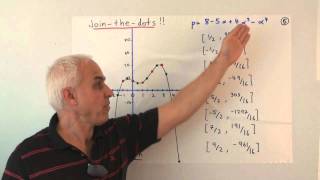
Graphing Polynomials - Arithmetic and Geometry Math Foundations
Learn to graph polynomials using integer and rational points, explore quartic polynomials, and understand the foundations of mathematical graphing. Gain insights into Cartesian coordinates and tangent lines.
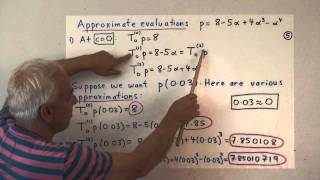
Tangent Lines and Conics of Polynomials - Math Foundations 71
Explore tangent lines and conics of polynomials using polynumbers. Learn to define tangents, compute approximations, and understand Taylor expansions in this advanced mathematical exploration.
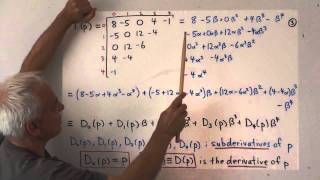
Calculus with Integral Polynumbers - Arithmetic and Geometry Math Foundations 70
Explore calculus with integral polynumbers, covering Pascal's Array, Taylor polynumbers, derivatives, and subderivatives. Learn alternative approaches to traditional calculus concepts and their applications.
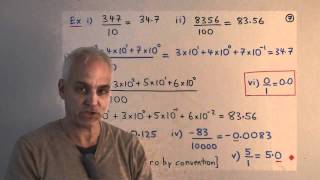
Visualizing Decimal Numbers and Their Arithmetic - MathFoundations 67
Explore decimal numbers as special rational numbers, their visualization on a number line, and arithmetic operations. Learn precise definitions and unique properties of decimals in mathematics.
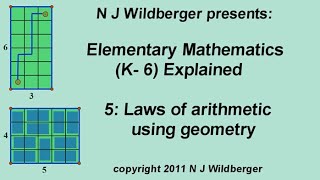
Laws of Arithmetic Using Geometry - Elementary Mathematics Explained - Lecture 5
Explore geometric interpretations of arithmetic laws using translations and reflections in the grid plane, enhancing understanding of commutativity in addition and multiplication.
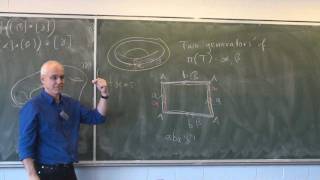
Fundamental Group of Surfaces - Multiplication and Properties
Explores fundamental group of surfaces, proving loop multiplication forms a group. Covers torus and projective plane, with examples and a problem on describing fundamental groups.
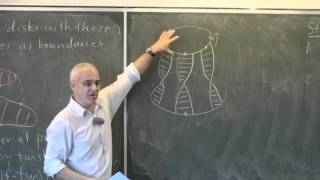
Knots and Surfaces - Seifert Surfaces in Algebraic Topology - Lecture 2
Explore Seifert surfaces, their construction for knots like the trefoil, and learn about Euler numbers for surfaces with boundaries in this advanced algebraic topology lecture.