Pappus' Theorem and Cross Ratio in Projective Geometry - Universal Hyperbolic Geometry 3
Explore Pappus' theorem, cross ratio, and key projective geometry concepts. Learn about invariance, transformations, and applications in hyperbolic geometry through theorems and exercises.
Stirling Numbers and Pascal Triangles - Foundations of Linear Algebra
Explore Stirling numbers and Pascal triangles in linear algebra. Learn about falling and rising powers, change of basis, and applications to polynomial sequences. Gain insights into combinatorial and number theoretic interpretations.
More Bases of Polynomial Spaces - Lecture 21
Explore advanced polynomial bases: Lagrange, Chebyshev, Bernstein, and Spread. Learn their properties, applications in approximation, and relationships, enhancing understanding of polynomial spaces in linear algebra.
Applications of 2x2 Matrices - Wild Linear Algebra A6
Explores 2x2 matrices, focusing on coordinate changes, linear equations, vector operations, and determinants. Covers fundamental concepts and applications in linear algebra.
Arithmetic with Negative Multisets and Integral Polynumbers - Math Foundations 232
Explores advanced arithmetic using negative msets and anti-objects, introducing integral polynumbers and Laurent polynomials in a pure algebraic context, revolutionizing traditional algebra understanding.
Negative Numbers from Antimultisets - Math Foundations 231
Explore negative numbers through antimultisets, drawing parallels with particle physics concepts. Discover a new arithmetic perspective based on elementary principles.
Equality in Computer Science - Sociological and Mathematical Perspectives
Exploring fundamental issues in programming and mathematics related to equality, assignment, and conversion, with insights on how computer science can provide solid foundations for pure mathematics.
Clock Mathematics and the 12-Tone Chromatic Scale - Connecting Music Theory and Mod 12 Arithmetic
Explores the connection between mathematics and music through the 12-tone chromatic scale, clock geometry, and mod 12 arithmetic, offering a fresh perspective on music theory and mathematical notation.
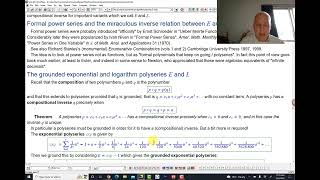
Formal Power Series and the Miraculous Relation Between E (exp) and L (log)
Explore formal power series as a powerful alternative to traditional analysis, focusing on the miraculous inverse relationship between exp and log polyseries variants E and L.
The Impossibility of a Pythagorean Scale and Square Root of 2 in Music Theory
Explores the mathematical challenges in creating a perfect musical scale, linking the cycle of fifths, chromatic scale, and the irrational nature of sqrt(2) to reveal fundamental connections between music theory and arithmetic.
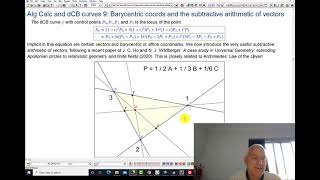
Barycentric Coordinates and Subtractive Arithmetic of Vectors - Algebraic Calculus and dCB Curves 9
Explore barycentric coordinates and vector arithmetic in affine geometry, enhancing understanding of de Casteljau Bezier polygons and curves. Gain insights into advanced mathematical concepts and their applications.
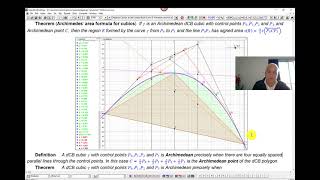
Archimedes' Area Formula for Archimedean de Casteljau Bezier Cubics - Lecture 8
Discover a new cubic version of Archimedes' Parabolic Area Formula for special de Casteljau Bezier curves. Explore the Archimedean condition and its fascinating geometric connections.
Divide Like a Babylonian - Centimal Arithmetic and Old Babylonian Division Techniques
Explore the Old Babylonian approach to division using base 100 arithmetic. Learn about centimal reciprocal tables, regular numbers, and combined multiplication/division tables for a fresh perspective on mathematical operations.
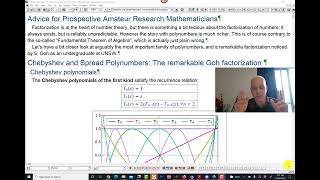
Chebyshev and Spread Polynumbers - Exploring the Goh Factorization
Explore polynomials in number theory, focusing on Chebyshev and spread polynomials. Learn about the Goh factorization and its implications for modern mathematics and computation.
Number Systems Ancient to Modern - Egyptian Mathematics and Fractions - Lecture 1
Explore ancient Egyptian arithmetic, focusing on their unique approach to fractions. Learn how this system simplified division and compare it to Babylonian mathematics.
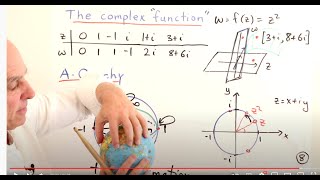
Bernhard Riemann and the Complex Sphere - Geometric Thinking in Mathematics
Explore Riemann's geometrical thinking on the complex sphere, from abstract discussions on mathematical space to practical applications in complex analysis and higher-dimensional geometry.
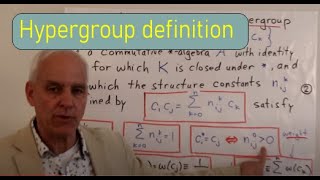
Hypergroup Definition and Five Key Examples - Diffusion Symmetry 4
Explore finite commutative hypergroups through five key examples, including class and character hypergroups, distance-transitive graphs, double cosets, and automorphism orbits. Gain insights for applications in physics and chemistry.
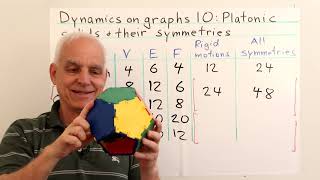
Platonic Solids and Their Symmetries - Dynamics on Graphs 10
Explore Platonic solids' symmetries, focusing on rotations and reflections. Discover connections to exceptional structures in mathematics and physics, laying groundwork for understanding 4D regular solids.
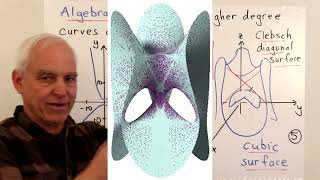
A Brief History of Geometry II: The European Epoch - From Cartesian to Differential Geometry
Explore the European evolution of geometry, from Cartesian to differential, highlighting key developments and their impact on mathematics. Gain insights into this fundamental discipline's historical significance.
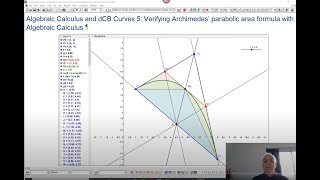
Verifying Archimedes' Parabolic Area Formula with Algebraic Calculus - AC and DCB Curves 5
Explore a novel algebraic approach to calculus, focusing on curves and geometry. Learn how to verify Archimedes' parabolic area formula using quadratic de Casteljau Bezier curves and the Fundamental theorem of Algebraic Calculus.
How to Set Up Fractions III - Canonical Forms via the Euclidean Algorithm
Explore the Euclidean Algorithm's role in creating canonical forms for fractions, connecting ancient Greek geometry to modern arithmetic and improving fraction manipulation skills.