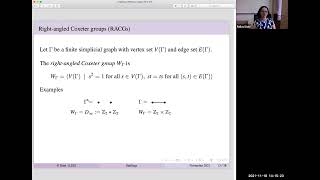
Subgroups of Right-Angled Coxeter Groups via Stallings-like Techniques
Exploration of Stallings-like techniques for subgroups of right-angled Coxeter groups, with applications to hyperbolic groups and algorithmic insights in geometric group theory.
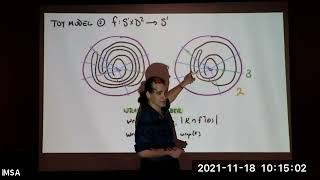
Bounds on Morse-Novikov Numbers of 3-Manifolds
Explore bounds on Morse-Novikov numbers of 3-manifolds, examining circle-valued Morse functions and their critical points, with applications to knot theory and topology.
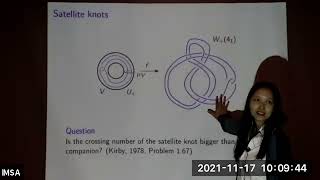
Crossing Numbers of Whitehead Doubles
Explore the connection between colored Jones polynomials and crossing numbers of Whitehead doubles, revealing insights into satellite knots' minimum crossing numbers.
Pencils on Algebraic Surfaces with Prescribed Classes of Irreducible Components
Exploring bounds on reducible fibers in curve pencils on projective surfaces, with focus on irreducible components' classes in Neron-Severi group. Generalizes results on fundamental groups of line arrangement complements.
Links in Math and in Life
Explore the fascinating connections between mathematical links and real-life applications through braids, knots, and topology in this engaging presentation.
Braids and Configuration Spaces
Explore topology, homotopy, and braid groups in this talk on configuration spaces. Discover connections between fundamental groups, loop spaces, and unordered configurations in mathematics.
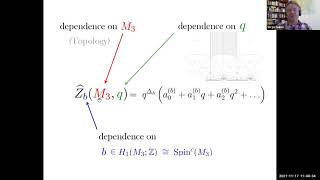
From Turaev to Rokhlin via VOA Characters and Curve Counting
Explore q-series invariants of 3-manifolds, their properties, and connections to topology, vertex algebras, and enumerative problems. Gain insights into recent developments in this mathematical field.
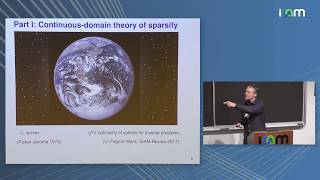
Splines and Imaging - From Compressed Sensing to Deep Neural Networks
Explore splines in imaging, from compressed sensing to deep neural networks. Unser demonstrates spline optimality in inverse problems and their connection to deep learning, offering insights into ReLU architecture and activation optimization.
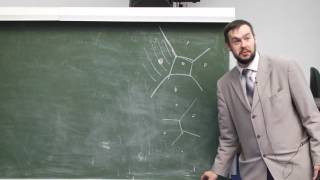
On Knot Theoretical Counterpart of the Groups G^k_n
Explore knot theory's connection to groups G^k_n, covering tetrahedron relations, permutations, and invariants. Gain insights into geometry, topology, and group theory applications.
Picture Valued Invariants, Groups, and Applications of Virtual Knot Theory
Explore picture valued invariants, groups, and applications of virtual knot theory with Professor Vassily Manturov in this advanced mathematics lecture.
Skein Exact Triangles in Equivariant Singular Instanton Theory
Explore knot signatures and singular instanton homology, focusing on skein exact triangles in equivariant theory. Uncover new insights into link invariants and their categorifications.
Regression Analysis in Machine Learning - Linear Regression - Logistic Regression
Comprehensive exploration of regression analysis, covering linear and logistic techniques. Learn to leverage data relationships for informed decision-making in various business contexts.
Graph Theory Basics - Types of Graphs - Components of Graph
Explore graph theory fundamentals, including types, components, and applications. Learn about vertex degrees, handshaking lemma, and various graph classifications. Gain insights into adjacency matrices for network analysis.
Introduction to Probability
Explore fundamental probability concepts, including basic types and their applications in predicting event outcomes and understanding variable behavior in diverse environments.
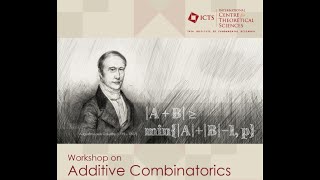
Basic Lower Bounds and Kneser's Theorem by David Grynkiewicz
Explore set addition, basic lower bounds, and Kneser's Theorem in additive combinatorics. Learn key proofs, including Cauchy-Davenport theorem, and applications to field extensions.
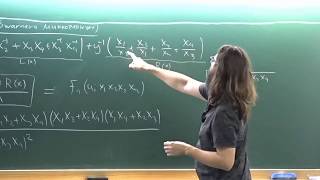
Mirror Symmetry for Character Varieties and Field Theory by Sergey Galkin
Explore mirror symmetry for character varieties, using threespace mirrors to construct SU(2) character variety mirrors on Riemann surfaces, with applications in topological field theory and random walks.
Representations of Fuchsian Groups, Parahoric Group Schemes by Vikraman Balaji
Explore advanced mathematical concepts including Fuchsian groups, parahoric schemes, and root systems. Delve into complex algebraic structures and their representations in this in-depth lecture on geometric group theory.
The Man Who Invented Calculus - The Life and Work of Madhava - Lecture 3
Explore Madhava's groundbreaking mathematical contributions, including calculus foundations, infinite series, and abstract approaches, in this lecture by P P Divakaran on the 14th-century Kerala mathematician's life and work.
The Man Who Invented Calculus: The Life and Work of Madhava - Lecture 2
Explore Madhava's groundbreaking calculus work, including curve length definitions, tangent lines, and integral concepts. Gain insights into his mathematical innovations and their historical significance.
The Man Who Invented Calculus: The Life and Work of Madhava - Lecture 1
Explore Madhava's groundbreaking mathematical contributions, including calculus innovations, and his impact on Kerala's mathematical renaissance. Gain insights into his life and historical context.
Phases to Phases - An Invitation to Topological Phases of Many Particles by Vijay Shenoy
Explore topological phases in many-particle systems, covering quantum condensed matter physics, electronic phases, and the tenfold way. Gain insights into topological insulators and their potential technological applications.