Math4ML Exercises - Getting Started & Linear Algebra
Introduction to Math4ML exercises, focusing on linear algebra fundamentals. Includes autograder demonstrations and hands-on problems to reinforce key concepts like array shapes, dimensions, and matrix operations.
Probability - Math for Machine Learning
Explore core probability concepts for machine learning, including surprises, loss functions, and Gaussians. Gain insights into the mathematical foundations of ML algorithms.
Linear Algebra - Math for Machine Learning
Explore core linear algebra concepts essential for machine learning, including arrays, linear functions, and SVD, with practical applications and programming analogies.
Residual Intersections in Geometry and Algebra by David Eisenbud
Explore geometric questions from the 19th century, including tangent conics and space curves, leading to the theory of residual intersections in geometry and algebra. Open problems discussed.
Commensurators of Thin Subgroups
Explores commensurators of thin subgroups in discrete group theory, discussing key theorems, propositions, and strategies for constructing examples and analyzing group actions.
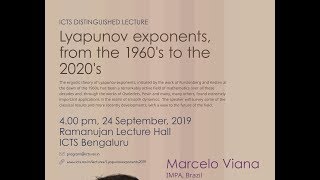
Lyapunov Exponents, From the 1960's to the 2020's by Marcelo Viana
Explore the evolution of Lyapunov exponents in mathematics, from foundational concepts to recent developments, applications in smooth dynamics, and future directions in this comprehensive lecture.
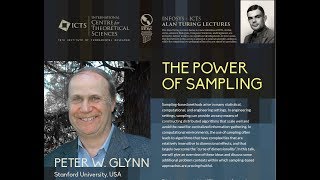
The Power of Sampling by Peter W. Glynn
Explore sampling methods in statistics, computation, and engineering. Learn about their history, applications, and advantages in overcoming dimensional challenges and creating scalable algorithms.
Mathematical and Statistical Modelling in the Fight to Control Tuberculosis by Emma McBryde
Exploring mathematical models to combat tuberculosis, from basic concepts to advanced simulations. Insights on disease dynamics, latency, mortality, and regional applications in the Asia Pacific.
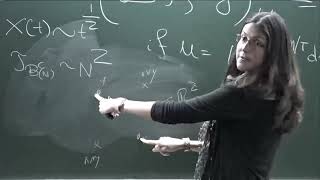
Your Dreams May Come True with MTP2 by Caroline Uhler
Explore multivariate totally positive distributions, their properties, and applications in various fields. Learn about density estimation, ML estimation, and practical uses in portfolio selection and gene networks.
Random Matrix Theory and its Applications - Lecture 4
Explore advanced concepts in Random Matrix Theory, including rotational invariance, correlation functions, spacing distributions, and applications to complex systems stability.
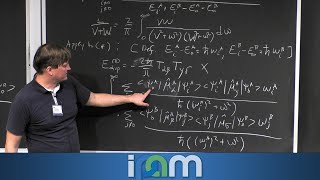
Theory of Molecular Interactions - IPAM at UCLA
Explore advanced quantum mechanics concepts, focusing on molecular interactions, perturbation theory, and frequency-dependent properties in this in-depth tutorial by Alexandre Tkatchenko.
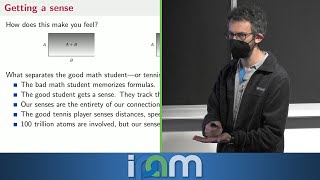
Sense-Making - Accounting for Intelligibility - IPAM at UCLA
Exploring mathematical accounting systems for collective intelligence, focusing on sense-making as a key component in understanding and articulating the phenomenon of intelligence.
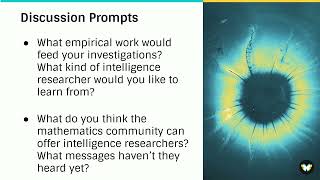
Broadening the Reach of Mathematical Approaches to the Study of Intelligences
Explore mathematical approaches to studying diverse intelligences across fields, discussing strategies for non-mathematicians to adopt these methods and potential funding opportunities for future research.

Categories - The Mathematics of Connection - IPAM at UCLA
Explore the mathematics of connection through category theory, focusing on open systems, their interfaces, and composition. Learn how this approach applies to various fields and collective intelligence.
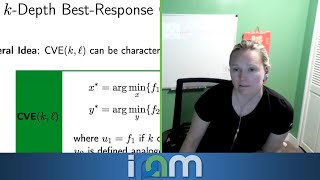
Learning via Conjectural Variations - IPAM at UCLA
Explore learning via conjectural variations, including challenges, equilibrium concepts, experiments, and applications in collective intelligence mathematics.
Collective Intelligence as Collective Computation - Future Directions
Explore collective intelligence as computation, examining principles of information processing, dimension reduction, and emergent phenomena in biological and social systems.
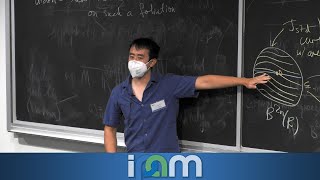
Waists, Widths and Symplectic Embeddings
Explore geometric measures of manifolds and their applications to symplectic embeddings. Discover area estimates for minimal submanifolds and quantitative symplectic camels in this advanced mathematics talk.
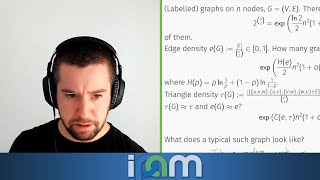
Large Deviations for Triangle Densities
Explore large deviations for triangle densities in graphs, including Borell's inequality, Gaussian noise stability, and applications to quantum ground states approximation.
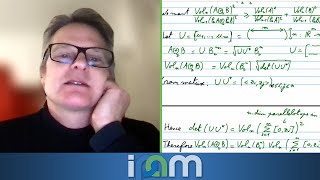
Volume of P-Zonoids and Inequalities for Determinants
Explore new inequalities for 2-zonoid volumes, potential extensions to p-zonoids, and related determinant inequalities. Delve into Minkowski sums, projections, and support functions in this advanced mathematics lecture.
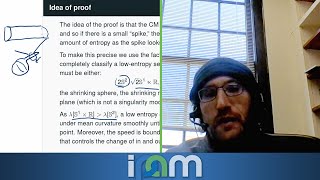
Entropy and C^0 Stability of Hypersurfaces - IPAM at UCLA
Explore entropy's role in hypersurface complexity, focusing on sphere rigidity, stability properties, and generalizations in higher dimensions. Gain insights into cutting-edge research in geometric analysis.
Topological Properties of Hypersurfaces with Low Entropy - IPAM at UCLA
Explore topological properties of hypersurfaces with low entropy, focusing on Colding-Minicozzi entropy, mean curvature flow, and closed hypersurfaces in this advanced mathematics lecture.