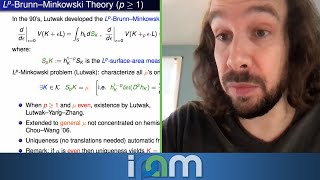
The Log-Minkowski Problem - IPAM at UCLA
Explore the log-Minkowski problem and recent progress in convex geometry, including uniqueness of self-similar solutions and isomorphic resolution, with applications to centro-affine differential geometry.
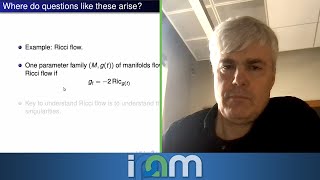
Singularities and Diffeomorphism - IPAM at UCLA
Explore singularities and diffeomorphism in calculus of variations, covering special cases, classification, and applications in probability and geometry.
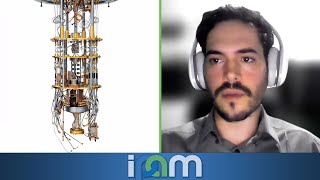
Variational Quantum Architectures for Linear Algebra Applications
Explore variational quantum algorithms for linear algebra applications, including singular value decomposition, linear system solving, and generative models, with focus on NISQ-era implementations and real-world examples.
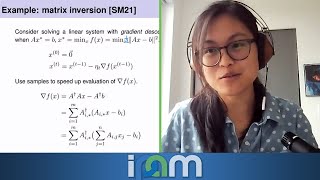
On Quantum Linear Algebra for Machine Learning - IPAM at UCLA
Explore quantum singular value transformation for machine learning, its applications, limitations, and connections to classical algorithms in this technical talk on quantum linear algebra.
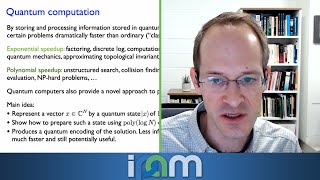
Efficient Quantum Algorithm for Dissipative Nonlinear Differential Equations
Explore efficient quantum algorithms for nonlinear differential equations, overcoming limitations through Carleman linearization. Discover potential applications in biology, fluid dynamics, and plasma physics.
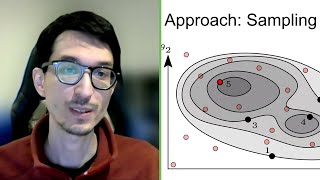
A Brief Introduction to Nested Sampling - IPAM at UCLA
Explore Nested Sampling for Bayesian model uncertainty and selection. Learn its principles, advantages, and recent extensions like Dynamic Nested Sampling for estimating marginal likelihoods and posterior distributions.

Uncertainty Quantification of Quantum Chemical Methods - IPAM at UCLA
Explore uncertainty quantification in quantum chemistry, covering error estimation, benchmarking, and machine learning approaches for improved accuracy in computational methods.
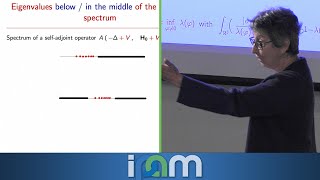
Maria Esteban - Spectral Results and Open Problems for Dirac-Coulomb Operators With Charge Distributions
Explore spectral results and open problems for Dirac-Coulomb operators with general charge distributions, focusing on self-adjoint extensions, eigenvalue characterizations, and electron stability conditions.
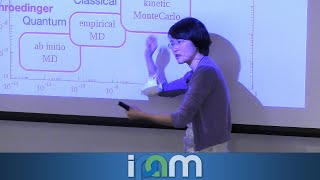
Multiscale Inverse Problem, from Schroedinger to Newton to Boltzmann - IPAM at UCLA
Explore multiscale inverse problems across quantum, classical, and statistical physics, connecting Schroedinger, Newton, and Boltzmann equations to reveal universal mathematical principles in diverse scientific domains.
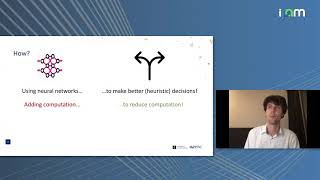
Deep Learning for Combinatorial Optimization - Count Your Flops & Make Your Flops Count
Explores deep learning for combinatorial optimization, focusing on reducing computation through learned models while balancing solution quality. Discusses practical examples, challenges, and future research directions.
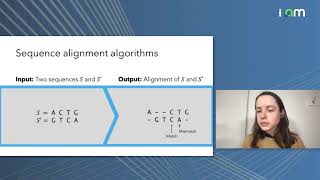
How Much Data Is Sufficient to Learn High-Performing Algorithms?
Explore data-driven algorithm design's impact on performance, focusing on generalization guarantees for combinatorial algorithms with piecewise-structured parameter functions.
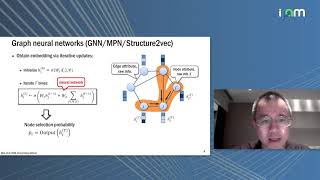
A Framework for Differentiable Discovery of Graph Algorithms
Explore graph algorithm discovery using deep learning and tree decomposition. Learn effective techniques for NP-complete problems with interpretable results and expanded search space.
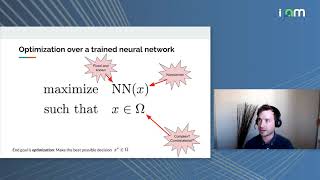
Neural Network Verification as Piecewise Linear Optimization
Neural network verification as piecewise linear optimization: exploring robust methods to prove model reliability against attacks, using LP and MIP formulations for efficient problem-solving in various network types.
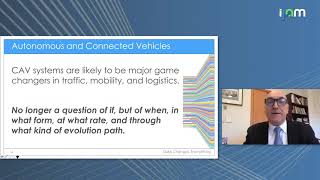
Deployment of Autonomous Fleet Mobility Services at Scale
Explores deployment scenarios and network impacts of autonomous fleet mobility services, discussing optimization challenges, integration with existing transit, and potential societal benefits.
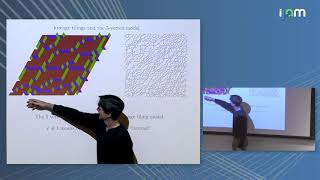
On the 5-Vertex Model
Exploration of the 5-vertex model, a generalization of lozenge tiling, discussing free energy, surface tension, and probabilities. Insights into asymptotic algebraic combinatorics and lattice path models.
Solving High Dimensional HJ Equations Using Generalized Hopf-Lax Formulas vs Using Machine Learning
Explore advanced techniques for solving high-dimensional Hamilton-Jacobi equations, comparing generalized Hopf-Lax formulas with machine learning approaches in control and differential games.
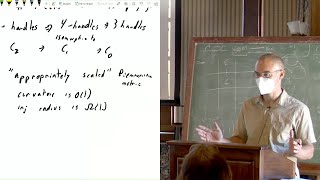
Building Manifolds from Error Correcting Codes - IPAM at UCLA
Explore the intersection of error correcting codes and manifold construction, delving into quantum error correction, topology, and complex mathematical concepts.
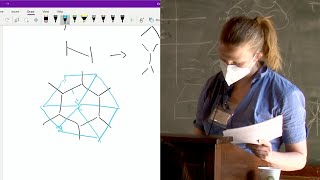
Lattice Topological Phases - IPAM at UCLA
Explore lattice topological phases with Fiona Burnell, covering lattice Hamiltonians, vector spaces, local rules, and gauge choices in this comprehensive lecture on advanced quantum physics concepts.
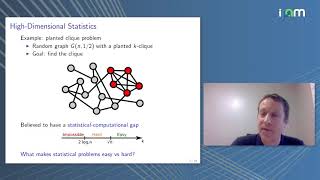
The Kikuchi Hierarchy and Tensor PCA
Explores advanced algorithms for tensor PCA, introducing a new hierarchy inspired by Kikuchi free energy to improve belief propagation performance and match sum-of-squares methods.
Scott Balchin- The Local-to-Global Principle
Explore the local-to-global principle in tensor-triangulated categories, examining its role in object reconstruction and its connection to the Balmer spectrum's pointless topology.
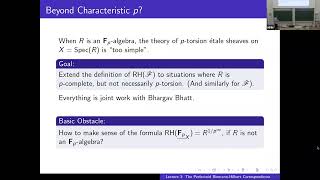
Jacob Lurie: A Riemann-Hilbert Correspondence in P-Adic Geometry
Explore p-adic geometry through Riemann-Hilbert correspondence, covering perfectoid rings, prismatic cohomology, and sheaf theory in characteristic p and beyond.