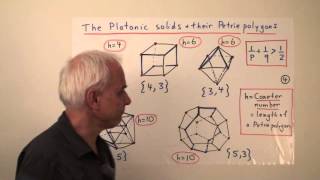
Petrie Polygons of a Polyhedron - Universal Hyperbolic Geometry
Explore Petrie polygons on polyhedra, focusing on Platonic solids. Learn about tesselations, Schlafli symbols, and orthogonal projections in this geometric journey.
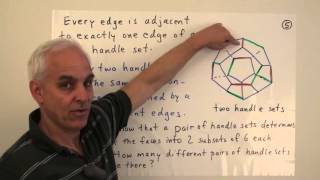
Canonical Structures Inside the Platonic Solids III - Universal Hyperbolic Geometry
Explore the rich symmetries of the dodecahedron through internal structures like handle sets, inscribed cubes, tetrahedra, and face diameters. Discover five-fold and six-fold symmetries in this fascinating Platonic solid.
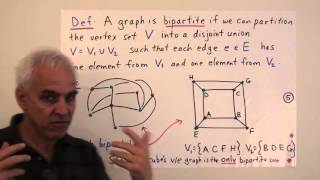
Canonical Structures Inside Platonic Solids II - Universal Hyperbolic Geometry
Explore symmetries and canonical structures within the cube, including 2-fold, 3-fold, and 4-fold symmetries. Gain insights into rigid motions and even/odd symmetries using graph theory concepts.
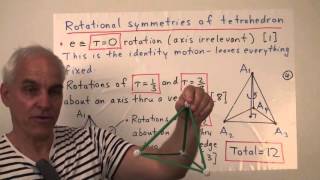
The Remarkable Platonic Solids II- Symmetry - Universal Hyperbolic Geometry
Explore the symmetries of Platonic solids through rigid motions and rotations, examining tetrahedron, cube, and dodecahedron symmetries while connecting rotations to directed edges and discussing duality.
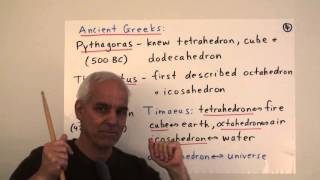
The Remarkable Platonic Solids I - Universal Hyperbolic Geometry
Explore the fascinating world of Platonic solids, their symmetry, history, and mathematical properties. Learn about Euclid's contributions and Euler's fundamental relation for polyhedra.
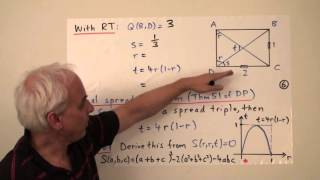
Eight Ninths and the Geometry of A4 Paper - Universal Hyperbolic Geometry
Explore the fascinating geometry of A4 paper, its connection to the spread 8/9, and how Rational Trigonometry provides deeper insights into everyday objects and mathematical concepts.
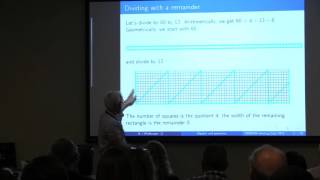
Teaching Connections Between Algebra and Geometry I - A MANSW Presentation
Exploring connections between algebra and geometry, covering topics like Euclidean algorithm, continued fractions, and projective geometry. Aims to revitalize interest in geometry as a core subject for students.
The Rotation Problem and Hamilton's Discovery of Quaternions - Famous Math Problems
Explore complex numbers and their connection to plane rotations, laying the groundwork for understanding quaternions and 3D rotations. Emphasizes a logical, algebraic approach without relying on transcendental functions.

Rational Trigonometry, Generalized Triangle Geometry and Four-Fold Incenter Symmetry
Explores rational trigonometry and generalized triangle geometry, introducing quadrances, spreads, and chromogeometry. Discusses Euler lines, incenters, and various triangle centers, culminating in a novel result on colored incenters.
Euclid's Construction Problems I - Famous Math Problems
Explore Euclid's fundamental geometric constructions using straight-edge and compass, enhancing understanding of mathematical logic and the importance of constructing objects before theorizing about them.
Steiner's Regions of Space Problem - Famous Math Problems
Exploration of Steiner's space division problem, analyzing how many regions n planes can create in space, with insights into the analogous 2D problem and mathematical reasoning.
The Integral of X^n - Famous Math Problems
Algebraic approach to polynomial integration using Binomial theorem and five basic properties, avoiding real numbers and limits. Compares with classical integration theories and their limitations.
The Integral of X^n - Famous Math Problems
Explores the integral of x^n, its historical development, and challenges in modern analysis. Proposes a new 'Algebraic Calculus' approach, addressing issues with continuum, infinite processes, and area theory.
Newcomb's Paradox - Famous Math Problems
Explore Newcomb's paradox, a mathematical-philosophical puzzle involving free will, determinism, and rationality. Learn about expected value and strategies for decision-making in uncertain scenarios.
Archimedes' Squaring of a Parabola - Famous Math Problems
Explore Archimedes' ingenious solution to calculating the area of a parabolic section, a foundational problem in calculus, through geometric insights and elegant proofs.
Omar Khayyam and the Binomial Theorem - Famous Math Problems
Explore the history and applications of the Binomial Theorem, from Omar Khayyam to Pascal's triangle, with insights into its expansion, coefficients, and relevance in modern mathematics.
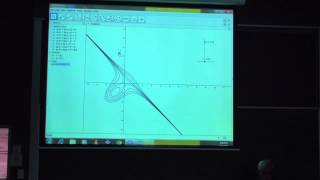
Visualizing the Folium Surface with GeoGebra - Differential Geometry
Explore the folium surface using GeoGebra, developing skills in 3D visualization and understanding tangent planes and quadrics through dynamic geometry.
Tangent Conics and Tangent Quadrics - Differential Geometry
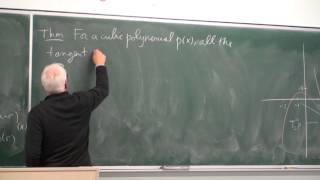
Exploring advanced calculus concepts through algebraic methods, focusing on tangent conics and quadrics. Offers a fresh perspective on polynomial approximations and their geometric applications.
Parametrized Curves and Algebraic Curves - Differential Geometry
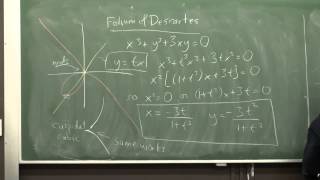
Explore parametrization of curves, from ancient Greek conics to 17th-century algebraic curves. Discover fascinating mechanisms generating curves, including four-bar and Watt's linkages.
Classical Curves - Differential Geometry
Explore classical curves in differential geometry, from conics to advanced constructions. Learn techniques for generating new curves and their applications in various fields.
The Rotation Problem and Hamilton's Discovery of Quaternions - Famous Math Problems
Explore quaternions and their connection to 3D rotations using 2x2 complex matrices. Learn key formulas and visual models for this algebraic structure without relying on transcendental concepts.