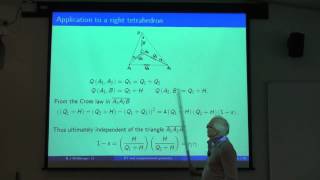
Towards a More Computational Mathematics - Rational Trigonometry and New Foundations for Geometry
Explores a computational approach to mathematics using rational numbers, introducing rational trigonometry and its laws. Covers applications in geometry, spread polynomials, and projective trigonometry.
High-Dimensional Expanders - How I Learned to Stop Worrying and Love Group-Theoretic Constructions
Explore high-dimensional expanders, focusing on 2-dimensional cases, graphs of constant link, and group-theoretic constructions. Gain insights into advanced mathematical concepts and recent research developments.
Goemans-Williamson: Rounding the Max-Cut SDP - Lecture 20a of CS Theory Toolkit
Efficient algorithm for approximating maximum graph cuts using semidefinite programming and randomized rounding, with guaranteed performance ratio of 0.878.
The SDP Relaxation for Max-Cut - Lecture 19b of CS Theory Toolkit
Explore SDP relaxation for Max-Cut, transforming a quadratic program into a semidefinite program solvable by the Ellipsoid Algorithm. Part of CMU's graduate-level CS Theory Toolkit course.
Linear Programming - Bit Complexity - Lecture 17c of CS Theory Toolkit
Explore bit complexity in Linear Programming, feasible solutions, and the implications for NP ∩ coNP. Delve into fundamental concepts for theoretical computer science research.
Expander Graph Application 2: Derandomization - Lecture 16c of CS Theory Toolkit
Explore derandomization techniques using expander graphs to reduce error in randomized algorithms without significantly increasing random bits used.
Expander Graph Constructions - Lecture of CS Theory Toolkit
Explore explicit expander graph constructions, including Gabber-Galil, Ramanujan, and Zig-Zag product expanders. Learn about their properties, applications, and mathematical foundations in theoretical computer science.
Spectral Graph Theory - Eigenvalues at CMU - Lecture 15a of CS Theory Toolkit
Explore eigenvalues of the Laplacian and Markov operator in spectral graph theory, including associated formulas and their applications in theoretical computer science research.
Spectral Graph Theory - Minimizing/Maximizing the Quadratic Form
Explore spectral graph theory, focusing on minimizing and maximizing quadratic forms, with connections to graph components and bipartiteness in this graduate-level lecture.
Spectral Graph Theory - The Quadratic Form
Explores spectral graph theory, focusing on the quadratic form associated with undirected graphs. Covers basic setup and provides examples for graduate-level computer science research.
Factorial Asymptotics, Stirling's Formula - Lecture 3b of CS Theory Toolkit
Explore factorial asymptotics and Stirling's Formula in this graduate-level lecture, covering mathematical techniques for theoretical computer science research.
Big O and Friends - Lecture 2a of CS Theory Toolkit
Explore asymptotic notation in theoretical computer science, covering Big O, Omega, and related concepts. Essential for understanding algorithm efficiency and complexity analysis.
How to Do CS Theory - Lecture 1b: Research Tips for Theoretical Computer Science
Insights and tips for aspiring theoretical computer science researchers, covering research methods, paper writing, presentation skills, and essential resources in the field.
Algebraic Circuit Complexity
Explore algebraic circuit complexity, including models, formulas, and NP connections in computational complexity theory.
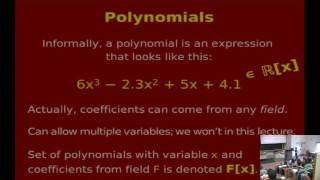
Polynomials
Explore polynomials, from formal definitions to applications in finite fields, interpolation, and error-correcting codes for noisy communication channels.
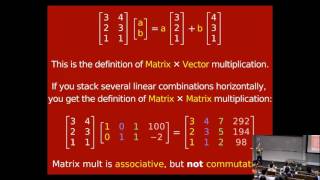
Linear Algebra
Explore vector spaces, linear combinations, and applications in computer science, including Fibonacci sequences and message transmission on noisy channels.
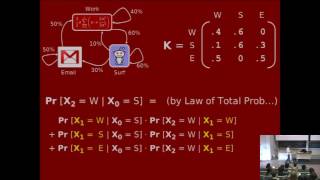
Random Walks
Explore random walks and Markov chains, covering key concepts, theorems, and real-world applications like PageRank. Gain insights into probability theory and graph algorithms.
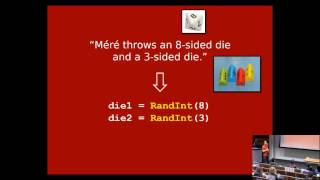
Probability 1
Explore key concepts in probability theory, including events, conditioning, chain rule, and independence, with practical examples and problem-solving techniques.
Great Ideas in Theoretical Computer Science - Polynomials
Explore theoretical computer science through polynomials, covering fields, division, evaluation, interpolation, and error-correcting codes. Gain insights into fundamental concepts and their applications.
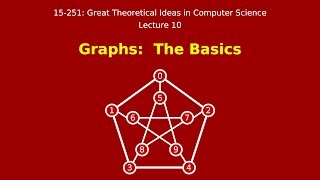
Great Ideas in Theoretical Computer Science - Graphs - The Basics
Explore fundamental concepts of graph theory, including definitions, basic questions, regular graphs, and perfect matching. Gain insights into connecting graphs and equivalence relations.
College Physics 1 - Mathematics Review Part 2
Explore mathematical concepts essential for physics, including relationships, geometry, and trigonometry, to build a strong foundation for understanding physical principles.