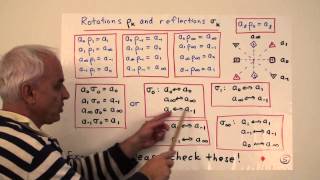
Isometry Groups of the Projective Line - Rational Geometry Math Foundations
Exploring finite field geometry: isometries, rotations, and reflections on the projective line, revealing connections to relativistic geometry and offering a new perspective on Euclidean concepts.
Problems With the Calculus - Math History - NJ Wildberger
Exploring historical controversies in calculus, including debates on derivatives, integrals, and curves, highlighting critiques from notable figures and ongoing mathematical challenges.
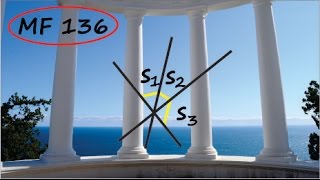
The Projective Triple Quad Formula - Rational Geometry Math Foundations
Explores the projective Triple Quad Formula in rational geometry, relating three projective quadrances formed by projective 1-points. Highlights similarities to the Triple spread formula and its mathematical significance.
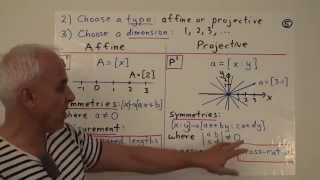
NJ's Pizza Model for Organizing Geometry - Rational Geometry Math Foundations
Explore a systematic approach to organizing metrical geometry using a pizza-making analogy. Learn about various geometries, their interconnections, and key concepts in this comprehensive overview.
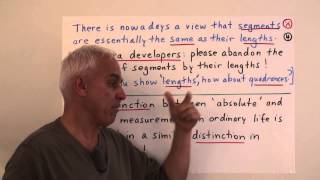
Absolute Versus Relative Measurements in Geometry - Rational Geometry Math Foundations
Explore the distinction between absolute and relative measurements in geometry, focusing on proportions and ratios. Learn about ancient Greek approaches and their relevance to modern mathematics.
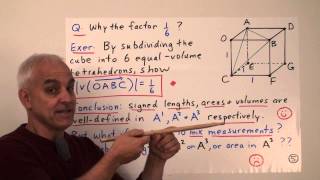
Higher Dimensions and the Roles of Length, Area, and Volume - Rational Geometry Math Foundations
Explore higher dimensions and the fundamental role of squared measurements in geometry. Discover how quadrance, quadrea, and quadrume offer more general and invariant alternatives to traditional length, area, and volume.
Number Systems and Stevin's Decimals - Math History
Explore the evolution of number systems from ancient Greece to Simon Stevin's decimal arithmetic, examining key developments in mathematics, music, and physics along the way.
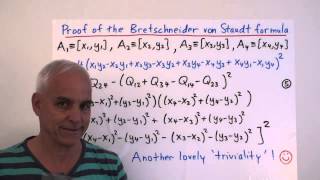
The Bretschneider Von Staudt Formula for a Quadrilateral - Rational Geometry Math Foundations
Explore the Bretschneider von Staudt formula for quadrilateral area, its history, and rational geometric formulations. Learn about generalizations of Archimedes' theorem and the importance of rational expressions in geometry.
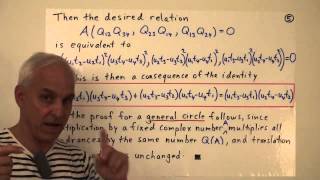
Ptolemy's Theorem and Generalizations - Rational Geometry Math Foundations
Explores Ptolemy's theorem in rational geometry, extending it to finite fields and relativistic planar geometry. Demonstrates how classical results can yield broader insights when formulated without infinite processes.
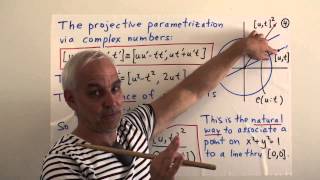
The Projective Line, Circles and a Proof of the CQQ Theorem - Rational Geometry Math Foundations
Explore projective parametrization of the unit circle, derive formulas for areas of triangles and quadrilaterals, and delve into circle geometry with applications to other conics.
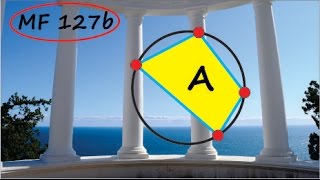
The Cyclic Quadrilateral Quadrea Theorem - Rational Geometry Math Foundations
Explore the Cyclic Quadrilateral Quadrea theorem, combining Brahmagupta's and Robbins' formulas for convex and non-convex cyclic quadrilateral areas. Includes numerical examples and algebraic analysis.
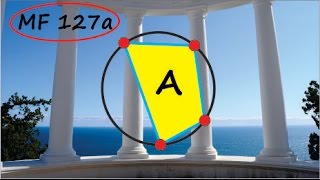
The Cyclic Quadrilateral Quadrea Theorem - Rational Geometry Math Foundations
Explores the Cyclic Quadrilateral Quadrea theorem, combining Brahmagupta's and Robbins' formulas for cyclic quadrilateral areas. Includes examples, tips, and a critical look at real number thinking in geometry.
Brahmagupta's Formula and the Quadruple Quad Formula - Rational Geometry Math Foundations
Explore Brahmagupta's formula and the Quadruple Quad Formula, connecting classical geometry with modern insights. Learn about cyclic quadrilaterals, factorization, and rational number precision in geometry.

Brahmagupta's Formula and the Quadruple Quad Formula - Rational Geometry Math Foundations
Explore Brahmagupta's formula for cyclic quadrilateral areas and the Quadruple Quad Formula, delving into algebraic manipulations and rational geometry concepts for a deeper understanding of quadrilateral properties.
Heron's Formula, Archimedes' Function, and the TQF - Rational Geometry Math Foundations
Explore Heron's formula and Archimedes' theorem for triangle area calculation using rational quantities, revealing connections between one-dimensional and higher-dimensional geometry.

Real Fish, Real Numbers, Real Jobs - Real Numbers and Limits Math Foundations
Humorous critique of modern mathematics' approach to real numbers, exploring historical context, educational implications, and the need for self-reflection in the field.
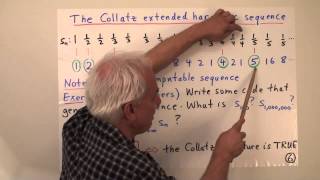
Logical Difficulties With the Modern Theory of Limits - Real Numbers + Limits Math Foundations
Explores logical issues in modern limit theory, examining extended harmonic sequences and the Collatz problem to reveal challenges in defining limits for infinite computations in mathematical analysis.
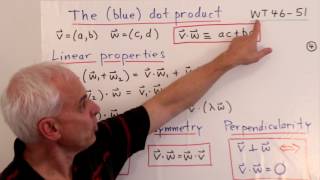
Spreads, Determinants and Chromogeometry - WildTrig: Intro to Rational Trigonometry
Explore spreads, dot products, and chromogeometry in linear algebra. Learn about vector operations, quadrance, perpendicularity, and the fascinating trilogy of blue, red, and green dot products.
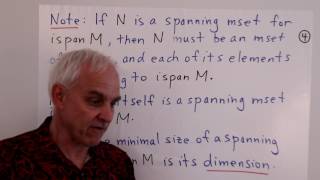
Bases and Dimension for Integral Linear Spaces - Abstract Algebra Math Foundations
Explore spanning sets, bases, and dimensions in integral linear spaces. Learn convenient notations for vexels and discover a multiset-oriented approach to mathematical structures.

An Introduction to Abstract Algebra - Abstract Algebra Math Foundations
Explore fundamental algebraic structures like groups, rings, fields, and vector spaces through intuitive examples, providing a bird's-eye view of abstract algebra's foundational concepts.
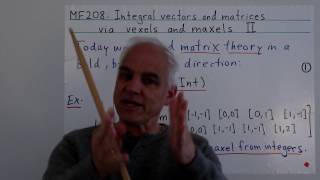
Integral Vectors and Matrices via Vexels and Maxels II - Data Structures Math Foundations
Explores integral vectors and matrices using vexels and maxels, extending the concept to cover the entire plane and its implications for linear algebra and analysis.