Maths Education and Rational Trigonometry - WildTrig: Intro to Rational Trigonometry
Exploring the challenges in trigonometry education and introducing rational trigonometry as a potential solution to improve mathematical understanding for students.
The General Rational Laws of Trigonometry - WildTrig: Intro to Rational Trigonometry
Explore general rational trigonometry laws in a planar setting, deriving elegant algebraic formulas without transcendental functions or real numbers. Learn key mathematical principles efficiently.
Geometry With a General Dot Product - WildTrig: Intro to Rational Trigonometry - N J Wildberger
Exploring advanced geometry using rational trigonometry and general dot products. Extends metrical geometry beyond chromogeometry, introducing new concepts of quadrance, perpendicularity, and spread.
Seminar- Five-Fold Symmetry, Schiffler Points and the Twisted Icosahedron
Explore five-fold symmetry, Schiffler points, and the twisted icosahedron in this advanced geometry seminar. Delve into projective and triangle geometry, dihedral orderings, and remarkable conics arising from five points in the plane.
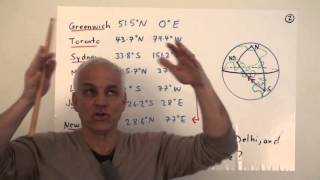
Applications of Rational Spherical Trigonometry II - Universal Hyperbolic Geometry
Explore spherical trigonometry to calculate distance and bearing between two points on Earth, comparing classical and modern rational methods for solving real-world navigation problems.
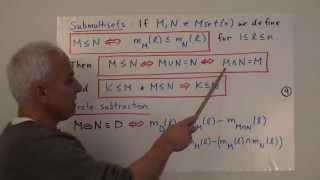
The Realm of Natural Number Multisets - Data Structures in Mathematics
Explore natural number multisets, their operations, and realm laws of arithmetic. Learn about k-msets, addition, union, and intersection in this expanded mathematical framework.
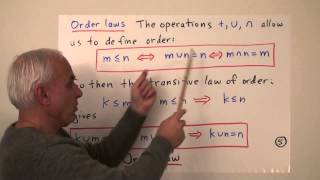
The Realm of Natural Numbers - Data Structures in Mathematics
Explore natural numbers through multisets, examining addition, union, and intersection operations. Discover unique properties, including a new distributive law that forms the basis for tropical calculus.
Fun With Lists, Ordered Sets, Multisets - Data Structures in Mathematics Math Foundations
Explore patterns and structures in k-lists, examining natural questions, operations, and relationships within this concrete data structure built using natural numbers.
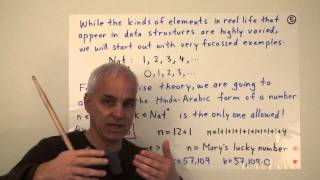
Sets and Other Data Structures - Data Structures in Mathematics
Explore four fundamental data structures in mathematics: lists, ordered sets, multisets, and sets. Learn their characteristics, applications, and a new notation system for easier recognition and distinction.
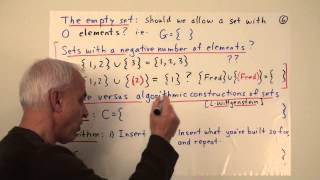
What Exactly Is a Set - Data Structures in Mathematics Math Foundations
Explores the concept of sets in mathematics, discussing definitions, challenges, and criticisms of modern set theory. Examines everyday usage, examples, and foundational issues in mathematical logic.
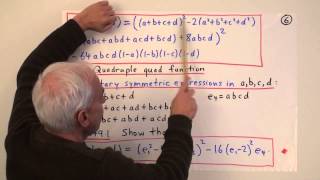
The Circumquadrance of a Cyclic Quadrilateral - Rational Geometry Math Foundations - NJ Wildberger
Explore a rational approach to cyclic quadrilateral geometry, avoiding transcendental quantities and extending to other fields and geometries. Learn Parameshvara's formula and its non-convex counterpart.
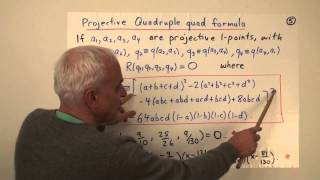
The Projective Quadruple Quad Formula - Rational Geometry Math Foundations
Explore the projective Quadruple quad formula and its connection to cyclic quadrilateral geometry, advancing beyond classical trigonometry to a more powerful approach applicable to general fields.
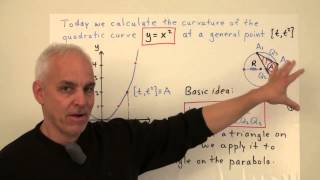
The Curvature of a Parabola, Without Calculus - Rational Geometry Math Foundations
Algebraic approach to calculate parabola curvature without calculus, using circle circumquadrance and triangle properties. Demonstrates wider applicability to various algebraic curves.
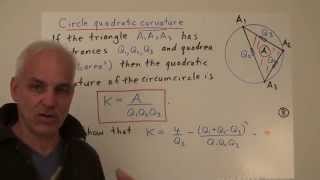
The Triple Spread Formula, Circumcircles and Curvature - Rational Geometry Math Foundations
Explores the Triple spread formula in Rational Trigonometry, relating it to circumcircles and curvature. Connects projective geometry with one and two-dimensional geometries through core circles and quadratic curvature.
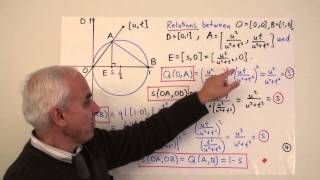
Relativistic Velocity, Core Circles and Paul Miller's Protractor - Rational Geometry
Exploring Paul Miller's protractor for efficient spread measurement in projective geometry, linking projective and affine measurements through core circles and the Triple quad formula.
Seminar - Some Fundamental Formulas from Metrical Algebraic Geometry
Explore fundamental formulas in metrical algebraic geometry, connecting classical theorems to modern discoveries. Gain insights into affine and projective variants applicable across various fields.
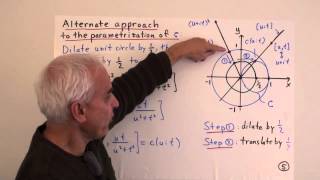
Relativistic Velocity, Core Circles, and Paul Miller's Protractor - Rational Geometry
Explores core circles in rational geometry, connecting projective and Euclidean geometry. Covers parametrization, quadrances, and theorems, bridging abstract concepts with practical applications.
Combinatorics - Math History - NJ Wildberger
Explore combinatorics through historical examples, counting problems, graph theory, and generating functions. Delve into partitions, Fibonacci numbers, Catalan sequence, and famous theorems in this engaging mathematical journey.
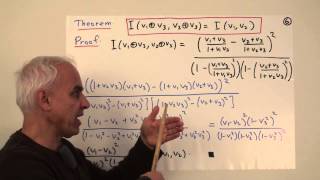
Relativistic Velocity, Core Circles and Paul Miller's Protractor - Rational Geometry
Explore core circles in rational geometry, connecting projective and Euclidean concepts. Learn about relativistic velocity addition and its implications for Einstein's special theory of relativity.
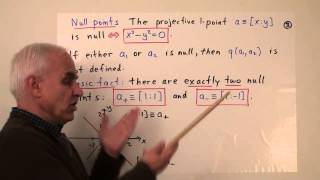
Isometry Groups of the Projective Line III - Rational Geometry Math Foundations
Exploring relativistic geometry in one dimension, extending projective geometry to incorporate Einstein's special theory of relativity and its impact on physics and mathematics.
Sets, Logic and Computability - Math History - NJ Wildberger
Overview of set theory, logic, and computability in late 19th/early 20th century math, covering Cantor's work, Dedekind's constructions, paradoxes, and philosophical schools addressing foundational issues.