Affine and Projective Geometry, and the Problem of Lines
Explore affine and projective geometry, focusing on points, vector spaces, and lines in 2D. Learn to solve geometric problems using projective coordinates and understand curve representation.
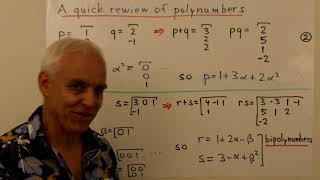
Boole Polynumbers and Equivalent Circuits - Math Foundations - N J Wildberger
Explore Boolean functions and logic circuits through polynumbers, focusing on Boole polynumbers as invariants for equivalent circuits. Learn evaluation techniques and their applications.
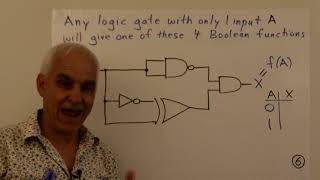
Canonical Forms for Logic Circuits - Math Foundations
Explore canonical forms for logic circuits, Boolean functions, and their geometric interpretations. Learn to express Boolean functions algebraically using Boolean algebra and Boole's original algebra.
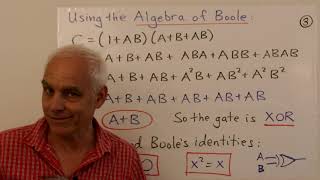
How the Algebra of Boole Simplifies Circuit Analysis - Math Foundations - N J Wildberger
Explore how the Algebra of Boole simplifies circuit analysis, comparing it with traditional Boolean algebra for encoding logic gates and solving engineering problems.
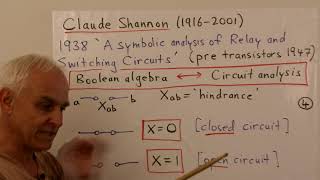
Boolean Algebra and Shannon's Circuit Analysis - Math Foundations - N J Wildberger
Explores Boolean algebra's connection to circuit analysis, focusing on Huntington's formulation and Shannon's groundbreaking 1938 paper linking the two fields.
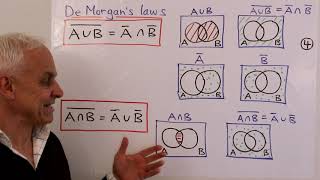
Boolean Algebra and Set Theory - Math Foundations - N J Wildberger
Explore Boolean algebra, set theory, and Venn diagrams. Learn about De Morgan's laws, distributive properties, and their proofs using truth tables and Boole's algebra.
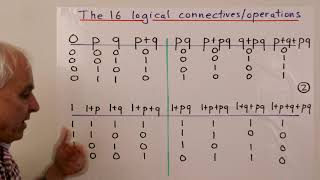
Implication and Logical Operations - Math Foundations - N J Wildberger
Explore 16 logical operations, including AND, OR, XOR, and implication, with applications to Boolean algebra and circuit analysis. Gain insights into Modus Ponens and Boole's algebra for solving electrical engineering problems.
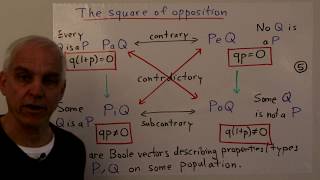
The Algebra of Boole is Not Boolean Algebra - Math Foundations - N J Wildberger
Exploring the Algebra of Boole, its relation to Boolean algebra, and its role in logic and circuit analysis. Discusses syllogisms, the Square of Opposition, and Boole's proofs of Aristotle's arguments.
A Brief History of Logic - Medieval and Arabic Logic - Math Foundations
Explore the evolution of logic from Aristotle through medieval and Arabic periods, highlighting key figures and their contributions to the field's development.
ADE Graphs and Lattices, Weights and Quarks
Explore ADE graphs, lattices, and their connections to mathematics and particle physics. Discover the Numbers game, weights, and the fascinating link between A2 diagrams and quark theory.
Geometric Graph Theory - Weyl Groups, Root Systems and Quadratic Forms
Explore geometric graph theory through the Mutation Game, examining root systems, Weyl groups, and quadratic forms. Discover how graphs generate unique geometrical structures and reflection groups.
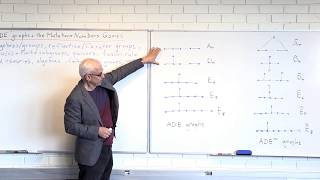
The Ubiquity of ADE Graphs, and the Mutation and Numbers Games - Math Seminars
Explore ADE graphs' mathematical significance, mutation games, and connections to advanced fields like Lie algebra, root systems, and physics in this insightful seminar on combinatorial structures.
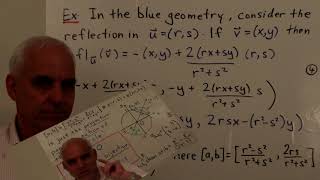
The Group of Blue Planar Isometries - WildTrig: Intro to Rational Trigonometry - N J Wildberger
Explore Euclidean isometries from a rational perspective, focusing on grounded isometries and deriving formulas for projections, reflections, and compositions in planar geometry.
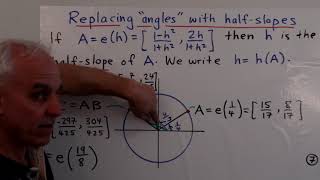
The Euclidean Rotation Group and Complex Number Multiplication - WildTrig
Explore the connection between Euclidean rotations and complex number multiplication, introducing the concept of half-slope for a more rational approach to 2D dynamics and graphics.
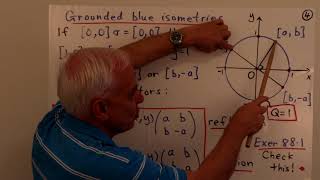
Isometry Groups in Planar Geometry - WildTrig: Intro to Rational Trigonometry - N J Wildberger
Explore isometry groups in Euclidean and relativistic geometries, focusing on grounded isometries, reflections, and rotations using an algebraic approach without infinite operations.
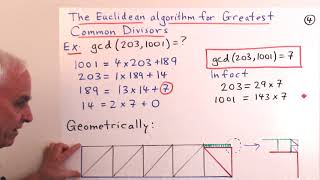
Turn Angles, Continued Fractions and Approximate Geometry - WildTrig: Intro to Rational Trigonometry
Explore turn angles and continued fractions to approximate geometry, using the Euclidean algorithm for angles and circular arcs. Learn about the natural unit of angle and its applications.
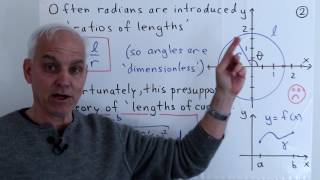
Understanding Uniform Motion - Are Radians Really Necessary? - WildTrig
Explores the concept of radians, questioning their necessity in uniform motion and examining the distinction between pure and applied mathematics in this context.
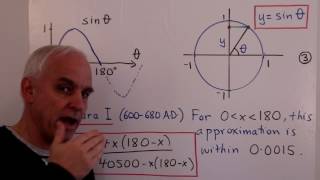
The True Role of the Circular Functions - WildTrig: Intro to Rational Trigonometry - N J Wildberger
Explores the historical and mathematical significance of circular functions, challenging traditional views and offering insights into their true role in trigonometry and uniform circular motion.
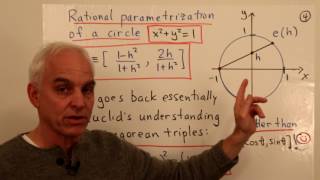
Rational Trigonometry and Mathematics Education - WildTrig: Intro to Rational Trigonometry
Innovative approach to teaching geometry and trigonometry, emphasizing rational methods for Year 9-10 students. Covers shapes, transformations, circle geometry, and challenges traditional concepts.
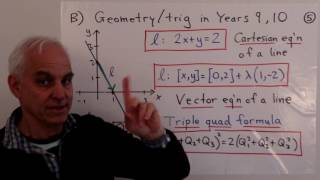
Maths Education and Rational Trigonometry - WildTrig: Intro to Rational Trigonometry
Innovative approach to teaching geometry and trigonometry, emphasizing rational trigonometry for Year 9-10 students. Covers progression from basic shapes to advanced topics, including circle geometry and 'pi'.
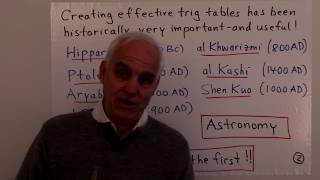
Rheticus and 17th Century Trig Tables - WildTrig: Intro to Rational Trigonometry - N J Wildberger
Explores Rheticus' groundbreaking 17th-century trigonometric tables, highlighting their historical significance and impact on classical trigonometry's development and application.