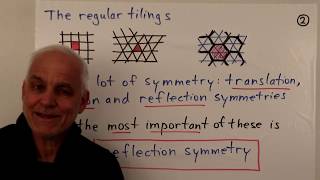
Mirror Symmetry for Young Students - Elementary Mathematics Explained
Explore mirror symmetry through visual mathematics, focusing on regular tilings and their symmetry lines. Ideal for teachers and parents to introduce geometric concepts to young learners.
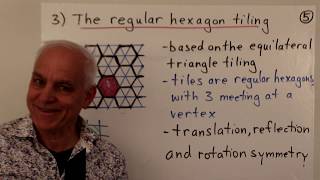
Regular Tilings of the Plane - Elementary Mathematics Explained
Explore the fascinating world of regular tilings, including square, equilateral, and hexagon patterns. Learn their properties, historical significance, and practical applications in various fields.
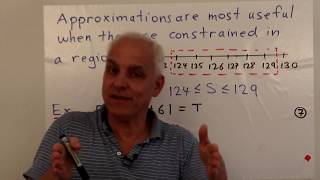
Adding Bigger Sums Using Open Numbers - Elementary Mathematics Explained
Learn a novel approach to adding larger sums using open numbers, focusing on a big end approach. Discover advantages and practice approximating sums by finding ranges for answers.

Polygonal Shapes - Elementary Mathematics Explained
Introduction to polygonal shapes in geometry, covering triangles, rectangles, parallelograms, and pentagons. Explores types of quadrilaterals and triangles, emphasizing the importance of geometry in early mathematics education.
Mesopotamian Mathematics - MathHistory - N J Wildberger
Explore ancient Mesopotamian mathematics, including the remarkable sexagesimal system and advanced arithmetic techniques developed by Sumerians, Akkadians, and Babylonians from 3000-1600 BCE.
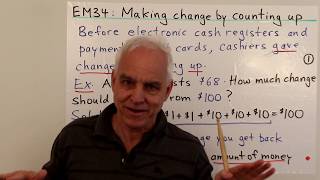
Making Change by Counting Up - Elementary Mathematics Explained
Learn a simple method for making change by counting up, strengthening mental arithmetic skills without subtraction. Ideal for young students and Monopoly players.
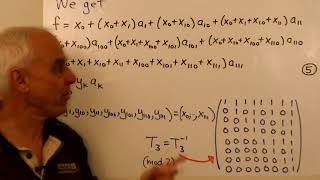
Three Variable Boole - Mobius Transform - N J Wildberger
Exploring the Boole-Mobius transform for three variables, extending from Boolean functions to Boole polynumbers. Introduces binary indexing and reveals a remarkable 8x8 matrix T_3.
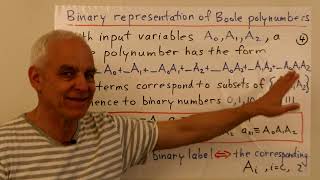
The Boole Mobius Transform - MathFoundations - N J Wildberger
Explore the Boole-Mobius transform, connecting Boolean functions and polynomials through linear algebra. Learn about binary representations and their relation to set theory in this mathematical deep dive.
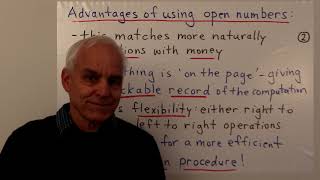
Addition and Cascading With Open Numbers - Elem Mathematics Explained
Explore a novel approach to elementary arithmetic using open numbers, focusing on addition and cascading. Learn a logical, systematic method that simplifies complex calculations and connects to real-world applications.
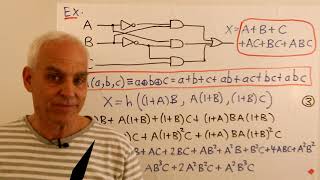
Boole Reduction - A Challenge for Programmers - MathFoundations - N J Wildberger
Exploring challenges in implementing Boole reduction for circuit analysis, including programming strategies and SAT solver development in the Algebra of Boole context.
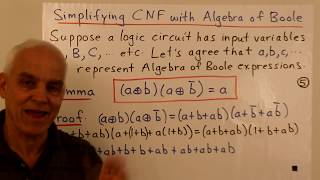
Trying to Sidestep the SAT Problem - N J Wildberger
Explores the SAT problem in Boolean algebra and logic circuits, introducing the Algebra of Boole approach as an alternative for analyzing smaller circuits and potentially addressing larger-scale issues in integrated circuit design.
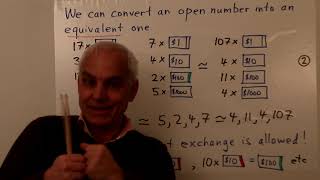
Open Numbers - Elementary Mathematics Explained - N J Wildberger
Explore open numbers, a money-like alternative to Hindu-Arabic numerals. Learn conversion techniques, practice with Monopoly money, and discover simplified addition methods in elementary mathematics.
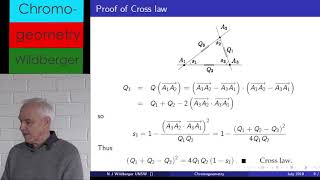
How Chromogeometry Transcends Klein's Erlangen Program for Planar Geometries - N J Wildberger
Discover chromogeometry's three-fold symmetry in planar geometry, unifying Euclidean and relativistic geometries. Explore rational trigonometry, colored Pythagoras theorems, Euler lines, and novel perspectives on conic sections.
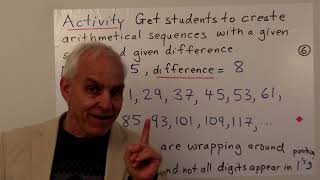
Introducing Arithmetic Sequences - Elementary Mathematics Explained
Explore arithmetic sequences, their patterns, and applications in elementary mathematics. Practice adding sequences systematically to improve number skills and solve interesting puzzles.
Strengthening Addition Skills - Elementary Mathematics Explained
Explore fun puzzles and techniques to strengthen addition skills, focusing on complementary numbers, the addition table, and wrapping around 10. Develop a deeper understanding of arithmetic fundamentals.
Arithmetic with Money - Elementary Mathematics Explained
Explore arithmetic using money to connect math with the real world. Learn a novel number representation system and understand the "Problem of Carrying" in traditional numerals.
Cooking and Baking With Basic Arithmetic - Elementary Mathematics Explained
Explore how basic arithmetic and measurement skills can be developed through cooking and baking activities, while emphasizing kitchen safety and practical applications for young learners.
Volumes and Capacities - Elementary Mathematics Explained
Explore volumes and capacities through hands-on activities, learning both metric and imperial systems while strengthening arithmetic skills and understanding numerical concepts.
Weighing with Grams and Ounces - Elementary Mathematics K-6 Explained
Explore weight measurement using grams and ounces through hands-on activities with household items. Learn about kitchen scales, pan balances, and standardized weights while practicing counting and ordering.
Measuring Weight - Elementary Mathematics Explained
Explore the fundamentals of weight measurement, from ancient techniques to modern systems. Learn about scales, metric units, and practical applications in everyday life and science.
De Casteljau Bezier Curves in Algebraic Calculus - N J Wildberger
Exploring de Casteljau Bezier curves and extending Archimedes' Parabolic Area Formula to cubic curves using Algebraic Calculus, without relying on real numbers or infinite processes.