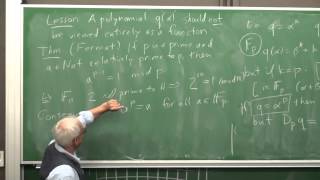
Differential Geometry With Finite Fields - Differential Geometry
Exploring differential geometry in finite fields, introducing arithmetic in prime fields, polynomial operations, and tangent conics to cubics. Highlights unique patterns and combinatorial structures in finite calculus.
Emile Borel - Real Number Enthusiast or Skeptic? - Sociology and Pure Mathematics
Explore Emile Borel's contributions to measure theory and his skepticism about real numbers, including normal numbers and the intriguing concept of a "know-it-all" number.
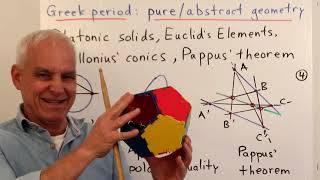
A Brief History of Geometry - Sociology and Pure Mathematics
Explore geometry's evolution from ancient times to 1400 AD, covering key theorems, Platonic solids, and applications in astronomy, surveying, and construction. Highlights include Islamic contributions to spherical geometry.
How to Set Up Fractions IV - The Relation Between Fractions and Other Number Systems
Explore number systems, focusing on rational numbers and their relationships. Challenges traditional views on real numbers, emphasizing the distinction between counting and measuring in mathematics.
Euclid Book 1 Props VI-VIII - A Foundation for Geometry - Sociology and Pure Maths - N J Wildberger
Examines Euclid's Elements Book 1 Propositions VI-VIII, discussing proofs, logical issues, and questioning its suitability as a foundation for modern geometry. Explores alternatives and implications for mathematics.
How to Set Up Fractions II - The Computational Challenge - Famous Math Problems
Explore computational challenges of fractions, including mixed fractions and Euclid's division lemma. Learn strategies to simplify fraction arithmetic and understand its importance in mathematics education.
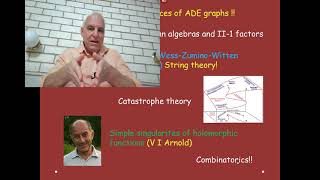
Exceptional Structures in Mathematics and Physics From Dynamics on Graphs
Explore exceptional structures in math and physics through graph dynamics, connecting to Coxeter diagrams, root systems, and Lie algebras. Discover new combinatorial structures and their role in representation theory and modern physics.
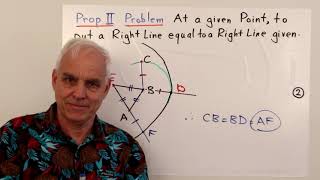
Euclid Book 1 Props I - V - A Critical Review - Sociology and Pure Mathematics - N J Wildberger
Critical review of Euclid's Book 1 Propositions I-V, examining logical foundations and constructions. Explores historical significance and questions modern interpretations of Euclidean geometry.
Infinitesimal Calculus with Finite Fields - Famous Math Problems
Explore infinitesimal calculus in finite fields through the semi-cubical parabola over F_7, challenging traditional real number analysis and emphasizing polynumbers and de Casteljau Bezier curves.
An Algebraic Infinitesimal Approach to Product and Chain Rules - N J Wildberger
Algebraic approach to calculus using dual complex numbers and bi-polynumbers, introducing the Derivative theorem and deriving Product and Chain Rules without limits or real numbers.
John Keil's Preface to Euclid - Sociology and Pure Mathematics
Exploration of John Keil's 1723 preface to Euclid's Elements, discussing its historical context and significance in geometry, including comparisons to Isaac Barrow's version.
Dual Complex Numbers and Leibniz's Differentiation Rules - Famous Math Problems
Explore algebraic infinitesimals, dual complex numbers, and Leibniz's differentiation rules in this advanced mathematics lecture, extending calculus to general and finite fields.
Greek Pure Mathematics and the Infinitude of Primes - Sociology and Pure Maths - N J Wildberger
Exploring Euclid's proof of prime number infinitude, challenging modern interpretations, and emphasizing the historical significance of Greek mathematics in shaping pure mathematical thinking.
How to Develop a Proper Theory of Infinitesimals I - Famous Math Problems
Explore the history and development of infinitesimals in mathematics, from Archimedes to modern approaches, with a focus on the Dihedron algebra and dual complex numbers.
The True Algebra of Complex Numbers - Via Dihedrons
Exploring complex numbers through Dihedron algebra, offering a fresh perspective on their structure and geometry. Highlights include quadratic inverse algebras and comparisons to Quaternions.
Sociology and Pure Mathematics - Pure Mathematics Relies on a Fake Arithmetic
Challenges modern pure mathematics' reliance on "fake arithmetic," proposing alternative approaches to calculus without infinite processes and calling for sociological analysis of mathematical practices.
The Geometry of the Dihedrons and Quaternions - Famous Math Problems
Explore the geometry of Dihedrons and Quaternions, comparing their properties and connections to relativity, linear algebra, and complex numbers. Gain insights into fundamental mathematical structures.
The Remarkable Dihedron Algebra - Famous Math Problems
Explore the Dihedron algebra, a key to constructing complex numbers. Learn its basis, properties, and connections to group theory in this comprehensive mathematical exploration.
How to Construct the True Complex Numbers I - Famous Math Problems
Exploring the construction of true complex numbers using field theory and linear algebra, challenging traditional approaches and introducing novel concepts for a modern understanding.
Computing Cyclotomic Polynumbers - Famous Math Problems
Explore cyclotomic polynomials, their factorization, and applications in algebra and number theory. Learn about Mersenne primes and the Schoenemann-Eisenstein criterion for irreducibility.
The Perspective Image of a Square III - The Solution
Explore the solution to projecting a square onto a quadrilateral, delving into geometry, perpendicularity, and perspective. Gain insights into mathematical problem-solving and related concepts.