Modelling Genes
Explore genetic variation patterns through mathematical models, examining inheritance, natural selection, and population dynamics to interpret DNA data and understand evolutionary mechanisms.
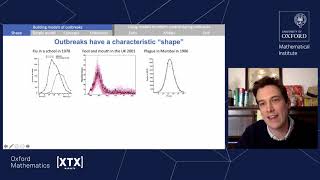
How Do Mathematicians Model Infectious Disease Outbreaks?
Explore mathematical modeling of infectious diseases, including outbreak shapes, compartmental modeling, and using models to inform control strategies and vaccination efforts.
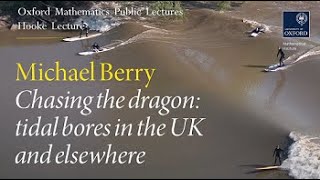
Chasing the Dragon - Tidal Bores in the UK and Elsewhere
Explore tidal bores through physics, mathematics, and cultural perspectives. Discover analogies with tsunamis, rainbows, and quantum concepts in this insightful lecture by Michael Berry.
Scaling the Maths of Life
Explore mathematical links between biological scales, from developmental biology to ecology and neuroscience, through real-life examples, games, and elegant mathematical concepts.
Mathematical Modelling in Biology - Infectious Disease Modelling - Lecture 3
Explore infectious disease spread using the Kermack McKendrick model, deriving the 'R' number and its significance in epidemiology. Gain insights into mathematical biology applications.
Mathematical Modelling in Biology - Neuronal Signalling
Explore Nobel Prize-winning neuronal signalling models, including Hodgkin-Huxley and Fitzhugh-Nagumo, to understand how neurons generate and propagate electrical signals vital for bodily communication.
Mathematical Modelling in Biology - Enzyme Kinetics and Perturbation Theory - Lecture 2
Explore enzyme-substrate reactions using separation of timescales and perturbation analysis to derive solutions and simplify complex biological systems.

Advanced Green Manufacturing Systems
This course provides an overview of realizing Green Manufacturing Systems. Compared to conventional manufacturing process that is purely productivity driven; various strategies and applicationsare necessary to improve the ecology first focus of green man…
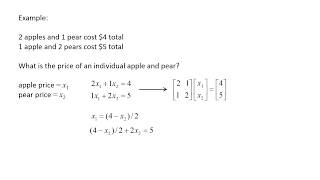
Numerical Modeling
Learn to solve linear and nonlinear algebraic equations using various numerical methods and MATLAB, including Gaussian elimination, Newton-Raphson, and secant methods for practical engineering applications.
Mechanics I
Comprehensive introduction to mechanics principles, covering fundamental concepts and applications over 15 weeks of in-depth lectures by Prof. Dr. Altuğ Özpineci.
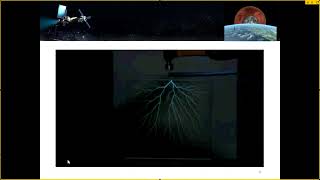
Spacecraft Charging - Hazard Causes, Hazard Effects, Hazard Controls
Explore spacecraft charging hazards, effects, and controls in various space environments. Learn about ISS charging measurements, modeling, and management strategies applicable to future human spaceflight beyond LEO.
How Is the Landscape Upon Which Life Evolves Selected - Spontaneous Emergence of Modularity
Explore the emergence of modularity in biology, its impact on evolution, and connections to environmental variability through advanced physics concepts and experimental insights.
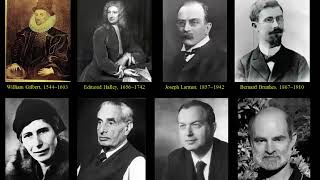
Planetary Dynamos
Explore planetary magnetic fields, their generation through internal dynamos, and the mathematical models used to study these phenomena in various celestial bodies.
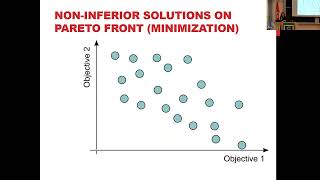
Guiding Model-Driven Combination Dose Selection Using Multi-Objective Synergy Optimization
Explore a 26-minute conference talk by Jana Gevertz from The College of New Jersey on model-driven combination dose selection using multi-objective synergy optimization. Delivered as part of the Frontiers in Computational and Mathematical Medicine series…
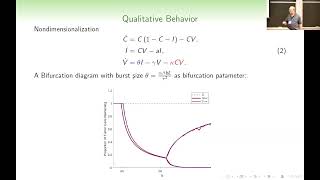
Mathematical Modelling of Oncolytic Virotherapy
Explore the intricacies of mathematical modeling in oncolytic virotherapy through this 48-minute lecture by Thomas Hillen from the University of Alberta. Delve into advanced concepts at the intersection of computational and mathematical medicine, with a…
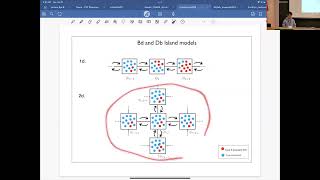
Continuum Limit of Moran Birth-Death and Death-Birth Process - Fisher-Waves Speeds
Explore the continuum limit of Moran birth-death and death-birth processes, focusing on Fisher-wave speeds in this 28-minute lecture by Kamran Kaveh from Harvard University. Delve into advanced concepts in mathematical oncology and computational medicine…
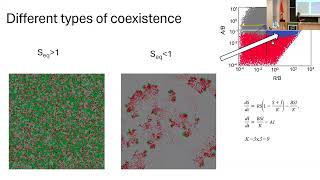
Mutant Fixation in the Presence of a Natural Enemy and Other Stories
Explore a 30-minute conference talk on mutant fixation in the presence of a natural enemy and related topics. Delve into cutting-edge research presented by Natalia Komarova from the University of California, San Diego, as part of the Frontiers in Computa…
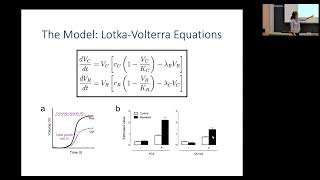
Curing Cancer with Calculus - Lecture 3
Explore the intersection of mathematics and cancer research in this 58-minute distinguished lecture by Helen Byrne from the University of Nottingham and University of Oxford. Delve into the innovative application of calculus in oncology as part of the Fr…
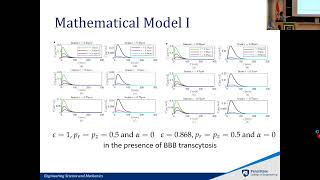
Modeling Transport and Neuronal Effects of Alzheimer's Drug Donepezil Hydrochloride
Explore a conference talk on the mathematical modeling of transport and neuronal effects of the Alzheimer's drug Donepezil Hydrochloride. Presented by Corina Drapaca from The Pennsylvania State University, this 18-minute lecture is part of the Frontiers…
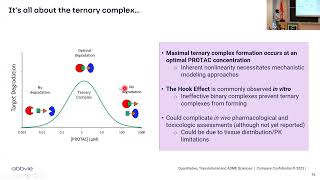
Translational PK/PD Modeling for Oncology - Focus on Targeted Protein Degradation
Explore a 17-minute conference talk on translational pharmacokinetic/pharmacodynamic (PK/PD) modeling in oncology, with a specific focus on targeted protein degradation. Delivered by Colin Phipps from AbbVie Inc. on September 23, 2024, this presentation…
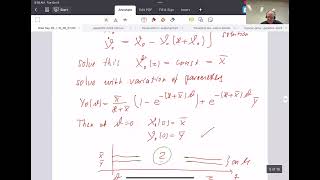
Tumor Growth Paradox
Explore the intriguing concept of the tumor growth paradox in this 1-hour 25-minute lecture presented by Dr. Thomas Hillen from the University of Alberta. Delve into the complex world of mathematical oncology as part of the Frontiers in Computational and…