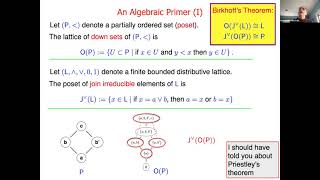
Nonlinear Dynamics in an Age of Heuristic Science
Explore nonlinear dynamics through combinatorial topology, offering efficient computational methods and new perspectives for multiscale systems and data-driven science in biology and engineering.
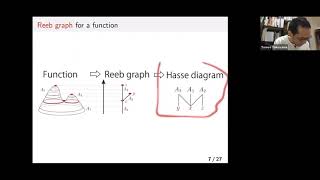
Tomoo Yokoyama - Generalizations of Morse Graph of Flows and Reeb Graph of Hamiltonian Flows
Generalizations of Morse and Reeb graphs for flows, exploring connections between dynamical systems, topological structures, and abstract orbit spaces. Insights into Conley theory and topological invariants.
Pawel Dlotko - A Few Simple Stories on Topology in Action
Explore practical applications of computational topology in material science, dynamical systems, and brain research. Learn how theory and algorithms work together to solve real-world problems.

SRB Measures and Young Towers - Lecture 3 of 4
Explore SRB measures and Young towers in dynamical systems, focusing on nonuniformly hyperbolic systems and their statistical properties. Learn about recent advances in this field of mathematics.
Symbolic Dynamics for Nonuniformly Hyperbolic Systems - Lecture 4
Explore advanced techniques in nonuniformly hyperbolic dynamics, focusing on symbolic coding and statistical properties of complex systems using Markov Partitions and Young Towers.
Symbolic Dynamics for Nonuniformly Hyperbolic Systems - Lecture 3 of 5
Explores advanced techniques in nonuniformly hyperbolic systems, focusing on symbolic dynamics and Markov partitions. Covers key concepts, challenges, and recent developments in the field of dynamical systems.
Symbolic Dynamics for Nonuniformly Hyperbolic Systems - Lecture 2 of 5
Explores advanced techniques in symbolic dynamics for nonuniformly hyperbolic systems, focusing on graph transforms, recurrence properties, and Markov partitions to analyze complex dynamical behaviors.
Fractal Dimensions in Nature and Mathematics - 2019
Explore fractal dimensions in nature and math, from intuitive integer dimensions to non-integer fractals. Learn alternative definitions, simple examples, and applications in dynamical systems.
Rotations of the Circle and Renormalization
Explore circle rotations, renormalization, and dynamical systems with Corinna Ulcigrai. Learn key concepts, proofs, and applications in this advanced mathematics lecture.
Taylor McAdam- Almost-Prime Times in Horospherical Flows
Explore effective results in horospherical flows, their applications to number theory, and connections to Sarnak's Mobius disjointness conjecture in this advanced mathematics lecture.
Michael Baake - A Cocycle Approach to the Fourier Transform of Rauzy Fractals
Explore Fourier transforms of Rauzy fractals and their role in analyzing spectra of Pisot inflation tilings, with applications to diffraction theory and dynamical systems.
The Dynamical Systems Approach to Spatially Homogenous Einstein-Vlasov Cosmology
Explore spatially homogenous Einstein-Vlasov cosmology using dynamical systems analysis. Investigate asymptotic solutions near singularities and expanding futures, focusing on Kantowski-Sachs models with Vlasov matter.
Antonio Esposito: Nonlinear Degenerate Cross Diffusion Systems with Nonlocal Interaction
Explores nonlinear degenerate cross-diffusion systems with nonlocal interaction, proving global existence of weak solutions using a semi-implicit JKO scheme for applications in social sciences, finance, and biology.
Helmut Abels - Diffuse and Sharp Interface Models for Two Phase Flows
Overview of analytic results for diffuse and sharp interface models in two-phase flow, discussing asymptotic limits as interfacial thickness approaches zero and exploring rigorous analytic results for sharp interface limits.
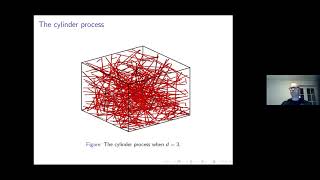
Erik Broman- Higher Dimensional Stick Percolation
Explore higher dimensional stick percolation, its applications in physics and chemistry, and the scaling of critical parameters as stick length increases in arbitrary dimensions.
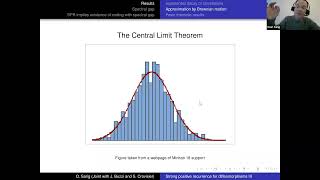
Dynamics of Smooth Surface Diffeomorphisms - Spectral Gap and Stochastic Properties
Explore surface diffeomorphisms, spectral gaps, and stochastic properties in smooth dynamics. Gain insights into symbolic models, entropy continuity, and hyperbolic systems.
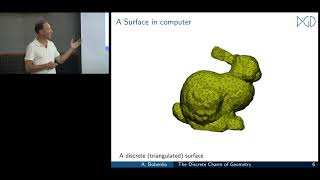
The Discrete Charm of Geometry by Alexander Bobenko
Explore the fascinating world of discrete geometry and its applications in architecture, computer graphics, and physics. Discover structure-preserving discretizations through simple examples and stunning visuals.
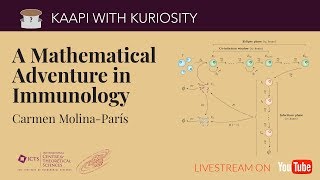
A Mathematical Adventure in Immunology by Carmen Molina-Paris
Explore the immune system's complexity through mathematical modeling, examining cell interactions, disease prevention, and quantifying pathogen infectivity.
Chance and Chaos - How to Predict the Unpredictable by Jens Marklof
Explore chaos theory, unpredictability, and mathematical tools for analyzing chaotic systems. Discover applications in weather forecasting, statistical physics, and everyday phenomena like coin tosses and bread kneading.
Phylogenetic Algebraic Geometry
Explore phylogenetic algebraic geometry, its applications in species history reconstruction, and the use of algebraic and geometric perspectives to solve phylogenetic problems.
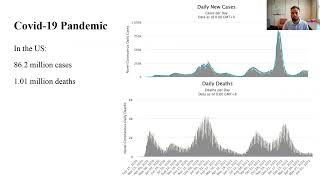
Mathematical Modeling of Diseases Spread - The Dextrous Use of Simple Machine-Learning Tools
Explore machine learning techniques for modeling disease spread, focusing on data preparation, model training, and interpreting results to inform public health policies.