Commensurators of Thin Subgroups
Explores commensurators of thin subgroups in discrete group theory, discussing key theorems, propositions, and strategies for constructing examples and analyzing group actions.
Mathematical and Statistical Modelling in the Fight to Control Tuberculosis by Emma McBryde
Exploring mathematical models to combat tuberculosis, from basic concepts to advanced simulations. Insights on disease dynamics, latency, mortality, and regional applications in the Asia Pacific.
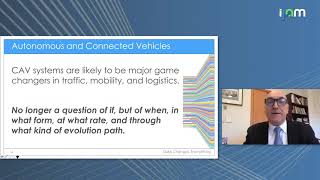
Deployment of Autonomous Fleet Mobility Services at Scale
Explores deployment scenarios and network impacts of autonomous fleet mobility services, discussing optimization challenges, integration with existing transit, and potential societal benefits.
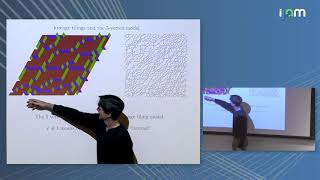
On the 5-Vertex Model
Exploration of the 5-vertex model, a generalization of lozenge tiling, discussing free energy, surface tension, and probabilities. Insights into asymptotic algebraic combinatorics and lattice path models.
Asymmetry in Dynamics
Explore symmetries in dynamical systems and progress on Smale's conjecture about generic smooth systems having only trivial symmetries. Delve into complex analytic, Hamiltonian, and smooth dynamics.
Branching Random Walks - Two Conjectures and a Theorem by Parthanil Roy
Explore branching random walks, their applications, and long-term behavior. Delve into conjectures and theorems with mathematician Parthanil Roy in this engaging lecture on probability theory.
Introduction to Dynamical Systems - Lecture 2
Explore non-smooth dynamical systems, bifurcations, and complex networks. Learn about border collision, switched systems, and applications in engineering and natural phenomena.
Introduction to Dynamical Systems - Lecture 1
Explore dynamical systems, from linear ODEs to nonlinear chaos. Learn about equilibrium points, eigenvalues, attractors, and bifurcations. Gain insights into Lorenz systems, Poincaré maps, and iterative methods.
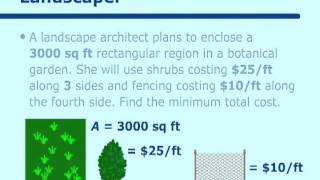
Optimization and Modeling in AP Calculus
Learn techniques for solving optimization and modeling problems in calculus, including practical applications and step-by-step solutions for various real-world scenarios.
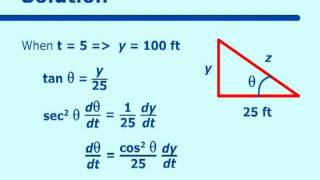
Related Rate Problems in AP Calculus
Learn strategies for solving related rate problems, including soap bubbles, cylindrical tanks, right triangles, conical tanks, and street light scenarios using similar triangles.
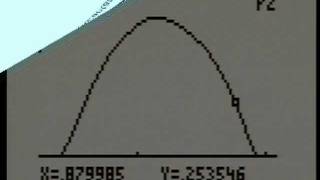
Measuring Speed - Average and Instantaneous Velocity - Part 1
Explore average and instantaneous velocity concepts through practical examples and data analysis techniques in this engaging calculus lesson.
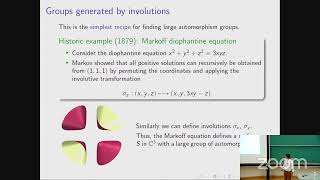
Random Algebraic Dynamics in Complex Dimension 2
Explore dynamics of automorphism groups on projective surfaces, covering measure classification, orbit closures, and finite orbits. Techniques from geometry and dynamical systems are discussed.
Kathryn Mann- Groups Acting at Infinity
Explore rigidity in group actions, lattices, and infinity, with applications to surface groups, boundaries, and Anosov flows. Gain insights into mathematical concepts and their interconnections.
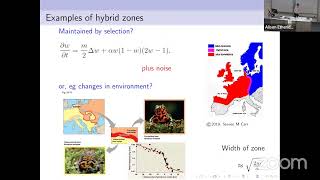
The Motion of Hybrid Zones - And How to Stop Them
Explore mathematical models of hybrid zones in population genetics, including deterministic approximations, curvature flow, and probabilistic proofs, with applications to invasions and blocking.
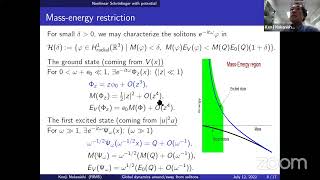
Kenji Nakanishi - Global Dynamics Around and Away From Solitons
Explore global dynamics of nonlinear dispersive PDEs, focusing on solitons in Klein-Gordon and Schrödinger equations. Analyze stability, multi-soliton interactions, and open questions in soliton behavior.
The Box Problem: Optimizing Volume in Rectangular Cardboard Boxes - Grades 8-9
Explore volume optimization through 'The Box Problem'. Investigate using models, tables, and graphs. Learn to define variables, write functions, and use graphing calculators for advanced analysis.
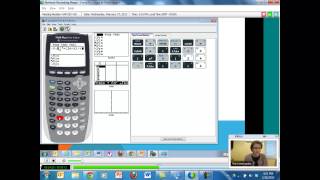
Using Functions to Build Models - Math Teacher Professional Development
Hands-on exploration of mathematical modeling using real-world problems, connecting concepts across Math I to Calculus. Focuses on function creation, domain analysis, and student engagement techniques.
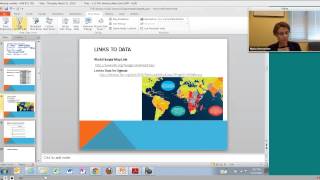
Distinguishing Between Linear and Exponential Growth in Mathematics - Real-World Applications
Explore real-world applications of linear and exponential growth through population and food production data, using calculators for analysis and modeling in mathematics.
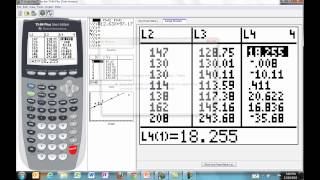
Linear Data Analysis for Math Common Core Standards - Part 3
Explore linear functions for real-world data modeling, focusing on slope and intercept interpretation, linear regression, and residual analysis using interactive tools and practical examples.

Convex Sunflower Theorems and Neural Codes
Explore convex sunflower theorems and neural codes, connecting neuroscience with discrete geometry to understand place cell encoding and cognitive mapping in rat hippocampus.
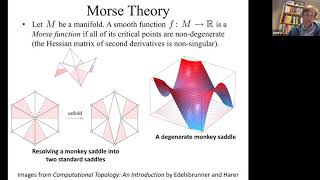
Henry Adams and Enrique Alvarado - An Introduction to Morse Theory
Explore Morse theory's applications in topology, including CW complexes, key theorems, and simplification techniques, with real-world examples in material science.