
Generating YARA Rules by Classifying Malicious Byte Sequences
Explore an interpretable ML model for generating optimized malware detection signatures, balancing high detection rates with minimal false positives in ELF executables.

The Devil is in the GAN - Defending Deep Generative Models Against Adversarial Attacks
Exploring vulnerabilities in Deep Generative Models, this talk introduces a threat model for training-time attacks and demonstrates backdooring techniques, while proposing effective detection methods through static and dynamic inspections.

This is Your Brain On Neuroprosthetics
Explore the cutting-edge field of neuroprosthetics, its potential to restore function in disabilities, and the ethical implications of enhancing human capabilities through brain-computer interfaces.

Moral Math of Robots - Can Life and Death Decisions Be Coded?
Experts debate ethical challenges in AI decision-making, exploring topics like self-driving cars, autonomous drones, and machine morality. Discusses key AI concepts, real-world applications, and future implications.

Wizards of Odds - The Power of Probability
Experts explore probability's subtle nature and its crucial role in science, technology, medicine, and daily life, offering insights into common misconceptions and its powerful applications.

Predicting the World with Math
Explore how mathematical algorithms and big data are revolutionizing predictions in various fields, from medicine to social behavior, with insights from leading scientists on the future of data-driven decision-making.
Mind and Machine - The Future of Thinking
Explore the future of thinking as experts discuss the intersection of human cognition and technology, examining potential benefits, risks, and implications for society and individual minds.
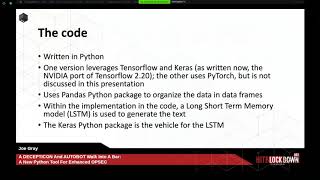
Python for Enhanced OPSEC
Python-based tool for enhancing OPSEC by autonomously posting on social media, using NLP and ML to mimic user behavior. Ideal for those needing to abandon targeted accounts without alerting adversaries.
IPv666 - Address of the Beast
Explore IPv6 security implications, addressing schemes, and potential vulnerabilities. Learn about honeypot servers, machine learning applications, and techniques for identifying aliased networks in IPv6 environments.

Adversarial Attacks on Autonomous Cars - The Missed Gap
Explore adversarial attacks on autonomous vehicles, examining the gap between academia and industry, and discussing potential vulnerabilities in AI-driven transportation systems.
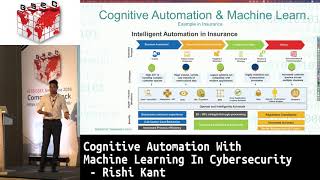
Cognitive Automation With Machine Learning In Cybersecurity
Explore cognitive automation and machine learning in cybersecurity, covering risk analytics, threat detection, and incident management. Learn how ML enhances fraud detection and security operations.

Generic and Static Detection of Mobile Malware Using ML
Explore machine learning techniques for generic, static detection of mobile malware, focusing on Android but applicable to iOS. Learn about the research methodology, workflow, and results.
Applying Machine Learning to User Behavior Anomaly Analysis
Explore advanced machine learning techniques for user behavior anomaly detection in cybersecurity, covering feature selection, data quality, behavioral whitelisting, and neural network predictions.
Unstructured Data Is the New Gold - ML + NLP Is the New Shiz
Explore machine learning and natural language processing for cybersecurity intelligence, leveraging unstructured data from social media and online sources to gain an edge in threat identification.
Duplicating Black Box Machine Learning Models
Exploración de técnicas avanzadas para duplicar modelos de aprendizaje automático de caja negra, destacando vulnerabilidades en servicios en la nube y proponiendo un nuevo método de ataque más eficiente.

Doppelgangers Unlimited
Explore how cybercriminals bypass anti-fraud systems by stealing digital fingerprints, with insights on advanced techniques and potential mitigations from a Kaspersky security researcher.
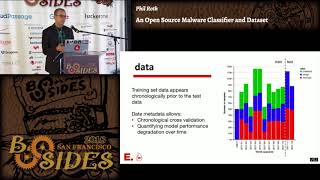
An Open Source Malware Classifier and Dataset
Explore open-source malware classification using machine learning, featuring a diverse Windows PE file dataset, pre-trained models, and reproducible code for enhanced static malware detection research.
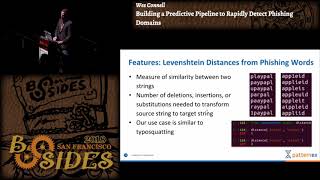
Building a Predictive Pipeline to Rapidly Detect Phishing Domains
Learn to build a predictive pipeline using Python and machine learning to detect phishing domains in real-time, leveraging Certificate Transparency logs and supervised learning techniques.
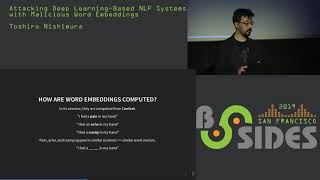
Attacking Deep Learning-Based NLP Systems
Explore vulnerabilities in deep learning NLP systems, focusing on word embeddings. Learn to manipulate training data and inject into real-world applications, with emphasis on security implications.

Sniffing the Metaverse
Explore electronic noses, AI-powered scent detection, and their applications in healthcare, industry, and everyday life. Learn about integrating sensors with the Metaverse using IoT and AR technologies.
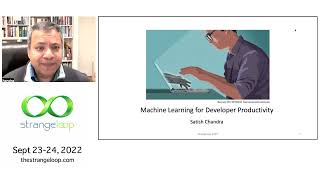
Machine Learning for Developer Productivity
Explore innovative ML-driven software productivity tools, their impact on developer efficiency, and industry experiences. Gain insights into code prediction, autocomplete advancements, and future possibilities.