Implementing a Neural Network for Music Genre Classification
Implement a music genre classifier using TensorFlow and MFCC features. Learn key deep learning concepts like binary/multiclass classification, ReLUs, batching, and overfitting while building the neural network.
How to Implement a Simple Neural Network With TensorFlow 2
Learn to implement a simple neural network using TensorFlow 2 and Keras for arithmetic sum, covering model building, training, testing, evaluation, and prediction.
Training a Neural Network - Implementing Backpropagation and Gradient Descent from Scratch
Implement backpropagation and gradient descent from scratch in Python, training a neural network to perform arithmetic sum. Includes step-by-step coding and explanations.
Training a Neural Network - Backward Propagation and Gradient Descent
Explore the theory and mathematics behind neural network training, focusing on backpropagation and gradient descent algorithms for deep learning enthusiasts.
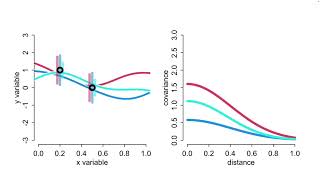
Statistical Rethinking 2023 - Gaussian Processes
Explore Gaussian processes and their applications in statistical analysis, including oceanic spatial confounds and phylogenetic regression, for advanced data modeling techniques.
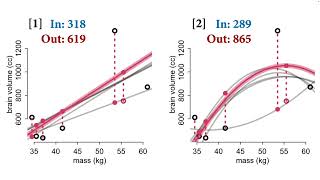
Statistical Rethinking 2023 - Fitting Over & Under
Explore advanced statistical concepts including cross-validation, regularization, and robust regression to enhance model fitting and selection techniques in data analysis.
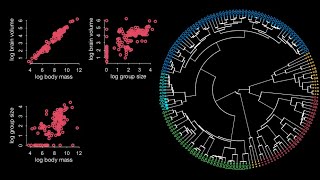
Statistical Rethinking 2022 - Gaussian Processes
Explore Gaussian processes, spatial confounding, and phylogenetic inference in statistical modeling. Learn to apply these concepts to real-world examples like oceanic covariance and primate phylogeny.
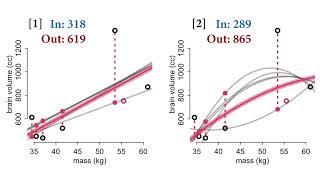
Statistical Rethinking 2022 - Overfitting
Explore overfitting in statistical modeling, covering cross-validation, regularization, information criteria, and robust regression techniques for improved predictive accuracy.
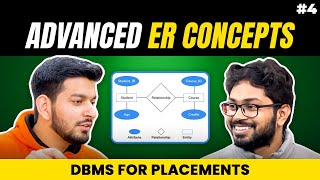
Extended ER Features - Abstraction in ER Model
Explore extended ER features and abstraction in ER modeling, covering specialization, generalization, inheritance, and aggregation concepts for enhanced database design.
Designing Robust Learners
Explore robust machine learning techniques to handle data perturbations and improve model resilience, focusing on TV estimation, modulus examples, and arbitrary loss scenarios.

Better Learning from the Past - Counterfactual - Batch RL
Explore counterfactual and batch reinforcement learning for improved decision-making under uncertainty, with focus on generalization bounds and policy optimization techniques.

How to Fail Interpretability Research
Explore common pitfalls in AI interpretability research, including misconceptions about user trust, model understanding, and evaluation methods.
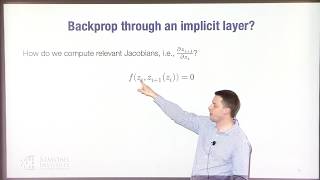
Integrating Constraints into Deep Learning Architectures with Structured Layers
Explore integrating constraints into deep learning using structured layers, covering deep equilibrium models, implicit layers, and weight-tied networks for enhanced architecture design.
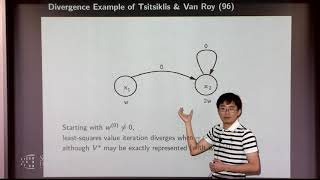
Reinforcement Learning via an Optimization Lens
Explore reinforcement learning through an optimization lens, covering MDPs, Bellman equations, and novel approaches to solving RL problems using linear programming and primal-dual formulations.

Reinforcement Learning in Recommender Systems - Some Challenges
Explore challenges in applying reinforcement learning to recommender systems, including scale, stochastic action sets, and user learning over long horizons. Gain insights on addressing these issues.

Off-Policy Policy Optimization
Explore advanced reinforcement learning techniques, focusing on off-policy optimization, batch methods, and sequential decision-making in deep learning contexts.
Optimality and Approximation with Policy Gradient Methods in Markov Decision Processes
Explore policy gradient methods in Markov Decision Processes, covering optimality, approximation, and key concepts like entropy regularization and natural policy gradient.
On the Hardness of Reinforcement Learning With Value-Function Approximation
Explore challenges in reinforcement learning with value-function approximation, focusing on batch learning in large MDPs and the limitations of realizability assumptions.
Reinforcement Learning in Feature Space: Complexity and Regret
Explore reinforcement learning in feature space, focusing on complexity, regret analysis, and innovative approaches like MatrixRL. Learn about state feature mapping and its applications in real-world scenarios.

Machine Learning-Based Design of Proteins and Small Molecules
Explore machine learning techniques for designing proteins and small molecules, covering directed evolution, model-based optimization, and challenges in deep learning applications.

Knowledge Is Embedded in Language Neural Networks but Can They Reason?
Explore language models' reasoning capabilities, from n-grams to transformers, and discuss future research directions in neural state machines for improved natural language understanding.