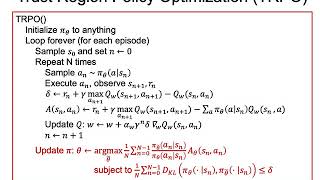
Trust Region & Proximal Policy Optimization
Explore trust region methods and proximal policy optimization in reinforcement learning, focusing on policy gradients, KL divergence, and practical implementations like TRPO and PPO.
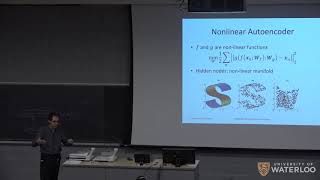
Autoencoders
Explore autoencoders, from basic concepts to advanced applications, covering compression, PCA, deep architectures, sparse representations, and denoising techniques.

Support Vector Machines - Continued
Explore advanced concepts of support vector machines, including soft margins, slack variables, and multi-class classification techniques.
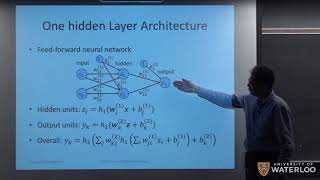
Deep Neural Networks
Explore deep neural networks, activation functions, and optimization techniques. Learn about gradient vanishing and solutions like rectified linear units.
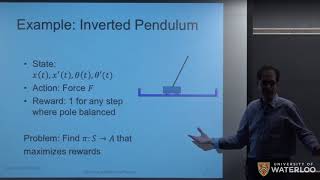
Introduction to RL
Learn key concepts of reinforcement learning including Markov decision processes, policy optimization, and model-free evaluation through lectures and examples like the inverted pendulum and toy maze.
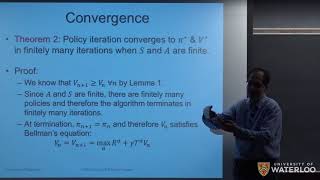
Policy Iteration
Learn about policy iteration in reinforcement learning, covering optimization, monotonic improvement, convergence, and complexity analysis.

MIT Introduction to Deep Learning
Comprehensive introduction to deep learning fundamentals, covering perceptrons, neural networks, loss functions, gradient descent, backpropagation, and regularization techniques.

Recent Progress in Predictive Inference - Emmanuel Candes, Stanford University
Emmanuel Candes discusses novel calibration techniques for machine learning predictions, addressing issues like false discovery rate control and adaptive conformal inference to handle distribution shifts.

Deep Learning for Scientific Computing - Two Stories on the Gap Between Theory & Practice - Ben Adcock
Explores deep learning in scientific computing, highlighting limitations and recent theoretical advancements in high-dimensional function approximation and inverse problems for imaging, aiming to bridge the gap between theory and practice.
Kuzushiji Recognition Smartphone Application with AI
Explore AI-powered kuzushiji recognition with the miwo app, revolutionizing the study of premodern Japanese documents through innovative technology and user-friendly mobile application.

Visual and Spatial Digital Humanities Research for Japanese Culture
Explore visual and spatial digital humanities research for Japanese culture, focusing on innovative projects using computer vision, machine learning, and geographic information science to analyze historical data.
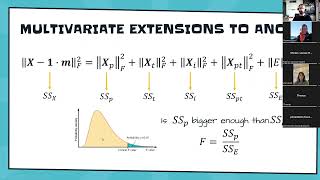
Statistical Inference of Omics Data with Variable-Selection
Learn statistical inference techniques for omics data analysis, focusing on variable selection methods to enhance spectral matching and predict molecular structures from LC-MS/MS spectra using chemometrics and deep learning approaches.
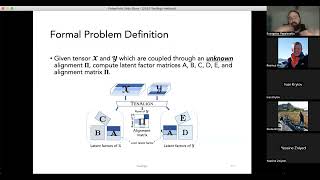
Joint Tensor Alignment and Coupled Factorization
Explore joint tensor alignment and coupled factorization for analyzing coupled datasets with unknown entity correspondence, outperforming multi-stage approaches in data mining applications.

Getting Machine Learning Models into Use
Practical guide to deploying bioinformatics machine learning models, focusing on scalability, user-friendliness, data security, and maintainability for real-world impact.
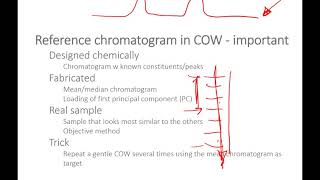
Preprocessing - Warping Data
Learn about Correlation Optimized Warping (COW) for aligning misaligned data, including its principles, parameters, and applications in bilinear models and data preprocessing.
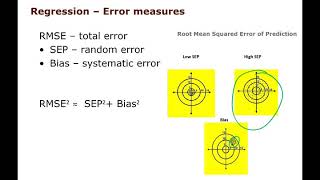
PLS Number of Components
Learn validation techniques for PLS models, including outlier detection, error measures, cross-validation, and practical tips for selecting the optimal number of components.
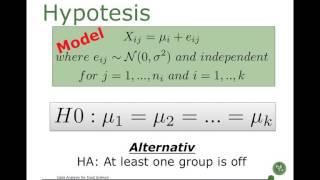
Oneway ANOVA
Explore variation splitting using ANOVA, covering model specification, ANOVA tables, and practical applications in food science data analysis.
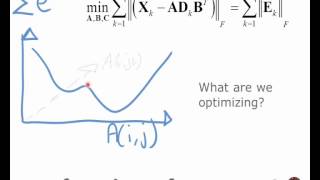
Multi-Way Analysis - The Algorithm
Explore the alternating least squares algorithm for multi-way analysis, focusing on PARAFAC modeling in chemometrics. Learn about notation, potential problems, and alternative approaches.
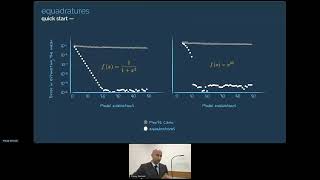
AIUK 2022 Workshop - Equadratures: The Open Source Model Development Platform
Explore Equadratures, an open-source platform for model development. Learn about polynomials, variable projection, and applications in this interactive workshop from the Alan Turing Institute.

Scoring Systems - At the Extreme of Interpretable Machine Learning - Cynthia Rudin - Duke University
Explore interpretable machine learning for high-stakes decisions. Learn about optimal scoring systems, their applications in healthcare and criminal justice, and the importance of transparency in AI models.
Solving Overfitting in Neural Networks
Learn techniques to identify and prevent overfitting in neural networks, including early stopping, audio data augmentation, dropout, and L1/L2 regularization, with practical implementation in a music genre classifier.