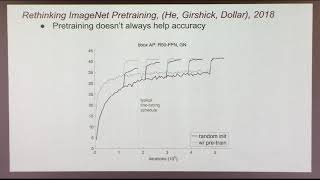
Towards Understanding Transfer Learning with Applications to Medical Imaging
Explore transfer learning in medical imaging, focusing on deep learning applications, performance evaluation, and feature similarity analysis using CCA. Insights on ImageNet models and chest X-rays included.
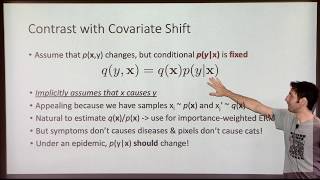
Robust Deep Learning Under Distribution Shift
Explore deep learning challenges under distribution shift, covering adversarial attacks, label shift detection, and domain adaptation techniques for robust model performance in real-world scenarios.

Interpretability - Now What?
Explore machine learning interpretability methods, focusing on Testing with Concept Activation Vectors (TCAV) and its applications in image prediction and medical diagnosis.
Alternatives to Reinforcement Learning for Real-World Problems
Explore alternatives to Reinforcement Learning for real-world problems, focusing on Contextual Bandits and Imitation Learning. Learn their applications, limitations, and how they differ from full RL.
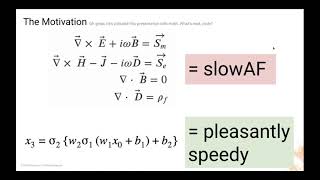
Inversion of 2D Remote Sensing Data to 3D Volumetric Models Using Deep Dimensionality Exchange
Innovative deep learning approach for inverting 2D remote sensing data to 3D models, reducing computation time from months to milliseconds. Explores unique embedding strategies and model architectures for efficient volumetric space reconstruction.
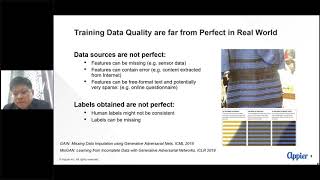
Machine Learning as a Service- Challenges and Opportunities
Explore challenges and opportunities in deploying ML models as long-term services. Learn about data health, model robustness, objective-goal alignment, and managing bias for sustainable ML solutions.
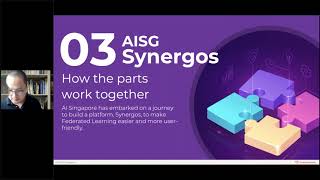
AI Singapore's Journey into the World of Federated Learning
Explore AI Singapore's Synergos system for federated learning, a privacy-preserving technique that trains models across decentralized parties without exchanging data, addressing privacy concerns and regulatory compliance.
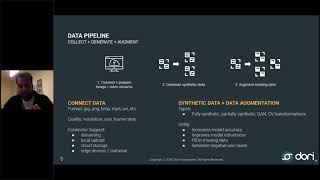
Building Scalable AI Computer Vision Applications
Standardized workflow for building scalable AI computer vision applications, covering data preparation, annotation, model selection, benchmarking, deployment, and monitoring for efficient development.
The Hamiltonian Monte Carlo Revolution Is Open Source - Probabilistic Programming with PyMC3
Explore Bayesian statistical computation and Hamiltonian Monte Carlo algorithms using PyMC3, an open-source probabilistic programming package. Learn to apply these advanced techniques to complex models in Python.
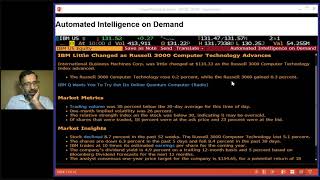
Automated Insights in Finance Using Machine Learning & AI
Explore AI and ML techniques for extracting actionable insights from alternative data sources in finance, leading to profitable trading strategies and robust portfolio construction.
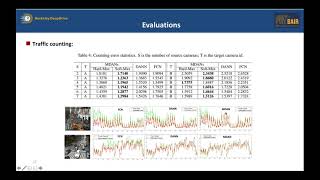
Learning with Limited Labels - ODSC West 2020
Explore advanced techniques for machine learning with limited labeled data, including domain adaptation, few-shot learning, and self-supervised learning to enhance model performance across diverse domains and novel categories.
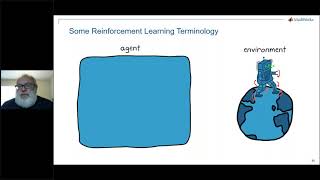
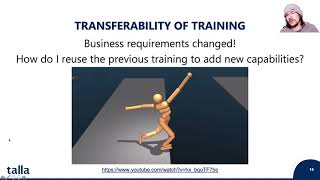
How to Train Your Robot - An Introduction to Reinforcement Learning
Explore reinforcement learning for robotics, covering key concepts, workflow, and practical applications. Learn to define environments, create agents, and deploy policies to hardware platforms.
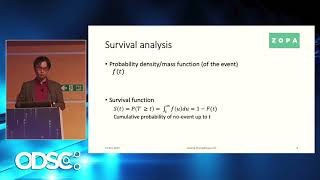
Deep Learning Survival Analysis for Consumer Credit Risk Modelling
Explore deep learning survival analysis for precise credit risk prediction in consumer lending, combining traditional methods with advanced techniques for improved time-to-event forecasting.
Machine Learning for Continuous Integration - Andrea Frittoli & Kyra Wulffert - ODSC Europe 2019
Explore machine learning techniques for analyzing CI/CD pipeline data, extracting insights, and automating failure identification using open-source tools like TensorFlow and Pandas with real-life OpenStack community data.
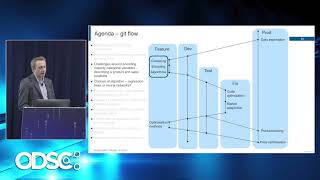
Price Optimisation - From Exploration to Productionising - David Adey, PhD & Alexey Drozdetskiy, PhD
Explore dynamic price optimization using machine learning, from data analysis to cloud deployment. Learn about feature encoding, model selection, efficiency improvements, and practical implementation strategies for revenue growth.
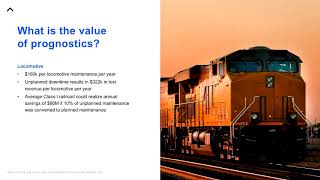
Recent Advances in Machine Learning with Applications to Internet of Things - Adam McElhinney
Explore machine learning advancements in IoT, covering failure prediction, data challenges, and real-world applications. Learn about deep learning, transfer learning, and future opportunities in this rapidly evolving field.
Towards Deep Learning Models Resistant to Adversarial Attacks
Explore deep learning model vulnerabilities and defense strategies against adversarial attacks, examining research findings and experimental results.
Learning the Depths of Moving People by Watching Frozen People
Explore depth prediction techniques for moving subjects using static images, enhancing 3D modeling and computer vision applications in various fields.

End-to-End Object Detection with Transformers
Learn about cutting-edge object detection using Transformers, exploring architecture, bipartite matching, oppositional encoding, and attention scores in this comprehensive tutorial.
Overly Optimistic Prediction Results on Imbalanced Data - Flaws and Benefits of Over-sampling
Explore flaws and benefits of over-sampling in imbalanced datasets, examining prediction results and comparing studies to improve machine learning model performance.
MAST - A Memory-Augmented Self-Supervised Tracker
Learn about MAST, a novel memory-augmented self-supervised tracker that enhances video tracking and segmentation using attention mechanisms and innovative algorithms.