Exploring Physical and Machine Learning Approaches for Stochastic Modeling and Ensemble Prediction of Weather and Climate
Explores innovative approaches combining physical principles and machine learning for stochastic modeling and ensemble prediction in weather and climate systems, addressing challenges in multi-scale processes and future projections.
Data-Driven Subgrid-Scale Modeling - Stability, Extrapolation, & Interpretation
Explores data-driven subgrid-scale modeling in climate science, focusing on stability, extrapolation, and interpretation. Discusses advancements in theoretical understanding and the potential of machine learning to address complex climate processes.
Practical Integrability - David Weiss
Explores universal aspects of non-equilibrium many-body physics, focusing on novel phases and universality classes beyond equilibrium paradigms. Bridges statistical, AMO, condensed matter, and high-energy physics.
Nonreciprocity as a Generic Route to Traveling and Oscillatory States - Zhihong You
Explores nonreciprocity in many-body physics, focusing on traveling and oscillatory states. Discusses universal aspects of non-equilibrium systems across various fields of physics.
Integrable Sigma Models at RG Fixed Points - Quantisation as Affine Gaudin Models
Explores recent advances in integrable models, focusing on quantization as affine Gaudin models. Covers topics from mathematical physics, condensed matter, and string theory, offering insights for researchers across various backgrounds.

Turbulence and Mixing - Why Diffusion Seems Easy
Explore turbulence and mixing in ocean dynamics, unraveling the complexities of diffusion processes and their impact on climate-scale phenomena. Gain insights into fluid dynamics and its role in shaping our planet's systems.

Turbulence in Geophysical Fluid Dynamics
Explore turbulence in geophysical fluid dynamics, focusing on atmospheric and oceanic processes. Gain insights into complex fluid behaviors and their impact on climate systems.
Improved Machine Learning Algorithm for Predicting Ground State Properties
Efficient ML algorithm predicts ground state properties of quantum systems using geometric locality, requiring minimal data and scaling favorably for large systems.
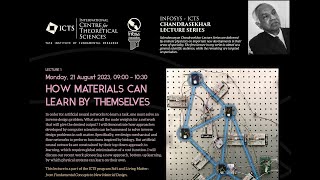
Glassy Dynamics and Plasticity - Building ML-Based Theories - Lecture 3
Explore ML-based theories for glassy dynamics and plasticity, focusing on bottom-up learning approaches in soft matter physics and their applications in designing functional materials.
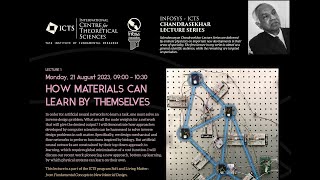
Materials that Learn by Themselves - Fundamental Concepts for New Material Design - Lecture 2
Explore fundamental concepts of self-learning materials, focusing on bottom-up learning approaches in soft matter physics and their applications in designing mechanical and flow networks.

Large-Scale Ocean Circulation and Climate - Interannual Climate Variability by Anand Gnanadesikan
Explore interannual climate variability and its connection to large-scale ocean circulation. Gain insights into the complex interactions between oceans and climate systems, enhancing understanding of global climate patterns.

The Role of Convection and Turbulence in Melting of Polar Ice-Shelves
Explores convection and turbulence in polar ice-shelf melting, discussing fluid dynamics of oceans and their impact on climate processes. Aimed at students, no prior background required.

The Inconstant Nature of Climate Feedback and Climate Sensitivity by Angshuman Modak
Explore climate feedback mechanisms and sensitivity, examining their variable nature and impact on climate modeling and predictions in this insightful lecture by Angshuman Modak.

Assessment of Regional and Global Climate Models in Simulating Wind Speed by Manasa Behera
Evaluation of climate models' accuracy in wind speed simulation, focusing on regional and global scales. Insights into model performance and implications for climate predictions.

Large-Scale Ocean Circulation and Climate - High-Latitude Climate Variability by Anand Gnanadesikan
Explore high-latitude climate variability and its impact on large-scale ocean circulation, examining the intricate relationship between oceanic processes and global climate systems.

Basics of Ocean Climate Models by Nairita Pal
Explore ocean climate modeling fundamentals, including fluid dynamics, turbulence, and convection. Learn about their impact on climate processes and monsoon dynamics.

Climate Change - Climate System, Energy Balance, Climate Models
Explore climate systems, energy balance, and climate models in this comprehensive lecture on climate change, offering insights into atmospheric and oceanic processes.

The Role of Convection and Turbulence in the Ocean Circulation and Modelling by Bishakhdatta Gayen
Explores convection and turbulence in ocean circulation, focusing on their impact and modeling techniques. Discusses fluid dynamics and its influence on climate processes.

Possible Influences of External Factors on the Indian Summer Monsoon by Suvarna Fadnavis
Explore external factors influencing the Indian Summer Monsoon, including climate dynamics, atmospheric processes, and potential impacts on regional weather patterns and precipitation.

Simple Models of Monsoon Variability
Explore simple models of monsoon variability, examining key factors influencing seasonal weather patterns and their impact on climate dynamics in this insightful lecture.

Large-Scale Ocean Circulation and Climate - Deep Convection and Overturning by Anand Gnanadesikan
Explore deep ocean convection and overturning circulation, their impact on large-scale ocean dynamics, and their crucial role in regulating global climate patterns.