
Basics of Clouds and Convection by Vishal Dixit
Explore the fundamentals of cloud formation and atmospheric convection processes, gaining insights into their role in weather patterns and climate dynamics.

Internal Gravity Waves - Ocean
Explore ocean internal gravity waves: their generation, propagation, and impact on ocean dynamics and mixing. Gain insights into this crucial phenomenon shaping marine environments and climate systems.

Basics of Geophysical Fluid Dynamics by Jim Thomas
Explore fundamental principles of geophysical fluid dynamics, examining atmospheric and oceanic processes crucial for understanding climate systems and environmental phenomena.
Artificial Intelligence in Medical Imaging for Precision Medicine by Vaanathi Sundaresan
Explore AI applications in medical imaging for precision medicine, covering deep learning techniques, image analysis, and their impact on diagnosis and treatment planning.

Large-Scale Ocean Circulation and Climate - High-Latitude Climate Variability by Anand Gnanadesikan
Explore high-latitude climate variability and its connection to large-scale ocean circulation, examining the intricate relationship between oceanic processes and global climate systems.

Global Overturning Circulation - How We Know About the Large-Scale
Explore the global overturning circulation and large-scale ocean dynamics with insights from Anand Gnanadesikan. Gain understanding of climate-scale processes and their impact on ocean and atmospheric systems.
Machine Learning in High Energy Physics by Michael Kagan
Explore applications of deep machine learning in high energy physics, covering classification, identification, and estimation strategies for analyzing LHC data and searching for new physics.
Playing Dirty - Excavating New Particles by Jessica N. Howard
Explore how machine learning and dirt-moving math aid in discovering fundamental particles, unraveling the universe's building blocks and their interactions. Gain insights into cutting-edge particle physics research.
Statistical Methods and Machine Learning in High Energy Physics - Project Presentation Session 2
Explore cutting-edge statistical methods and machine learning applications in high energy physics through expert presentations, fostering collaboration and innovation in data-driven research.
Quantitative Uniform Propagation of Chaos for Maxwell Molecules
Explores propagation of chaos in Kac's N-particle system for Maxwell molecules, using probabilistic coupling techniques and recent stabilization results to establish uniform-in-time estimates.

Mean Field Limit by Gamma Convergence
Explores mean-field limit for λ-convex potentials using variational methods, focusing on gradient flows and Γ-convergence in interacting particle systems.
Monte Carlo and Machine Learning Approaches in Quantum Mechanics - IPAM at UCLA
Explore Monte Carlo and machine learning techniques in quantum mechanics with Andrea Tirelli, covering advanced computational methods for solving complex quantum systems.
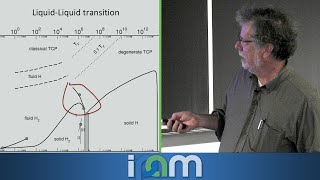
Quantum Monte Carlo and Machine Learning Simulations of Dense Hydrogen
Explore advanced quantum simulations of dense hydrogen using Quantum Monte Carlo and machine learning techniques, focusing on electronic energies, proton distributions, and novel solid structures.
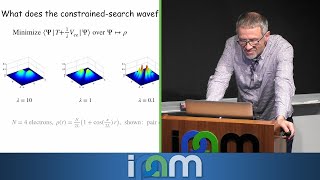
Fast Algorithm for the Strong-Interaction Limit of Density Functional Theory
Explore a novel algorithm for computing the strong-interaction limit in density functional theory, enhancing accuracy in modeling strongly correlated systems and overcoming computational challenges.
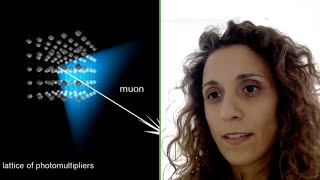
A Machine Learning Application in Multi-Messenger Astrophysics
Explore machine learning techniques for detecting gravitational waves from supernovae, connecting multiple messengers like neutrinos and electromagnetic signals for improved signal identification and classification.
Machine Learning for Gravitational Wave Astronomy - Concepts & Terminology
Explore machine learning concepts and terminology for gravitational wave data analysis, enhancing your understanding of this cutting-edge field in astronomy and physics.
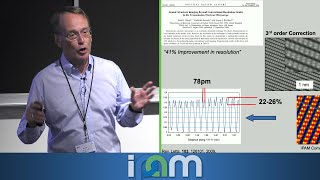
Strategies for Quantitative Imaging and Reconstruction from High Speed-Low Dose Data
Explore quantitative imaging techniques using AI/ML for analyzing large datasets of electron microscopy images, focusing on defect mapping in graphene and industrial catalyst studies.
Reconstructed Rhythm-Generation by Neural Circuits in Two Sea Slugs
Explore biologically plausible models of swim center pattern generators in sea slugs, examining network-level bursting, stability mechanisms, and resilience to perturbations using dynamical systems and machine learning.
AI-Driven Workflows for the Discovery of Novel Superconductors
Explore AI-driven methods for discovering novel superconductors, including data augmentation, ultra-fast machine-learning potentials, and symbolic regression to improve predictive equations for superconducting transition temperatures.
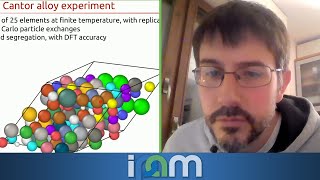
Machine Learning for Atomic-Scale Modeling - Potentials and Beyond - IPAM at UCLA
Explore machine learning techniques for atomic-scale modeling, addressing challenges in chemical diversity and integrating functional properties beyond interatomic potentials for advanced materials simulation.
High-Dimension Perspective on Extracting & Encoding Information in Chemical Systems
Explore high-dimensional data extraction and encoding in complex chemical systems, focusing on exascale computing opportunities, multiscale correlations, and challenges in feature selection and interpretability.