Climate Tipping Points by Tim Lenton
Explore climate tipping points, their global impact, and early warning systems. Gain insights into critical transitions in complex systems like monsoons, ocean circulation, and rainforests.
Tutorial for Juan Maldacena Lectures by Yiming Chen
Comprehensive tutorial on advanced topics in theoretical physics, including the Unruh effect, black hole information paradox, and quantum field theory in curved spacetime. Covers key concepts and calculations for graduate-level researchers.
Machine Learning the Landscape - Lecture 1
Explore machine learning in string theory landscape, covering Calabi-Yau manifolds, cohomology, and string phenomenology. Gain insights into complex geometries and their applications in theoretical physics.
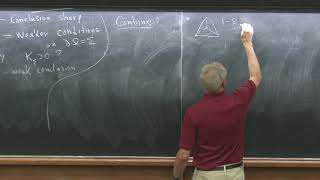
Some Geometric Properties of Spacetime - Lecture 3
Explore geometric properties of spacetime, including minimal hypersurfaces, stability, and boundary integrals. Gain insights into linear and nonlinear models in this advanced mathematics lecture.
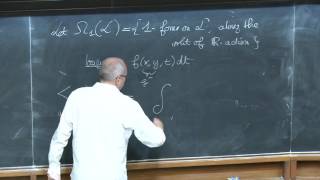
The Liouville Current and Complex Structures for Hitchin Representations - F. Labourie
Explore Hitchin representations, Liouville currents, and complex structures in this advanced mathematics lecture, covering theorems, symplectic manifolds, and modular space vibrations.
Bits and Atoms - Exploring the Intersection of Machine Learning and Microscopy
Explore the intersection of machine learning and microscopy, focusing on AI models for active learning in materials discovery, automated experiments, and physics discovery through advanced microscopy techniques.
OpenFold - Lessons and Insights From Rebuilding and Retraining AlphaFold2
Insights from rebuilding AlphaFold2: OpenFold's optimized implementation, training process analysis, and implications for protein structure prediction and broader applications in structural biology.
Detection of Objects in Cryo-Electron Micrographs Using Geometric Deep Learning
Explore geometric deep learning techniques for object detection and segmentation in cryo-electron micrographs, focusing on unsupervised methods and graph-based transformers for complex structures.
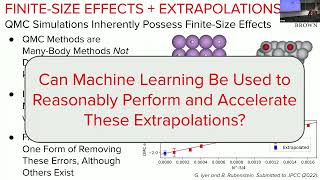
Extending the Reach of Quantum Monte Carlo Methods via Machine Learning
Explore how machine learning enhances quantum Monte Carlo methods for electronic structure modeling, improving force calculations and scaling to larger systems in molecular simulations.
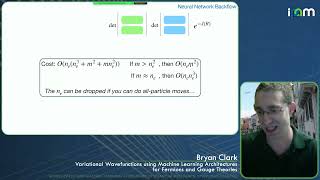
Variational Wavefunctions, Machine Learning Architecture for Fermions and Gauge Theories
Explore machine learning architectures for variational wavefunctions in fermion and gauge theory systems, focusing on preserving symmetries and achieving accurate results in quantum mechanics.
Machine Learning to Improve the Exchange and Correlation Functional in DFT
Explore machine learning approaches to improve exchange and correlation functionals in density functional theory, discussing physically informed methods and their advantages in quantum mechanics.
Learning to Untangle Genome Assembly Graphs - IPAM at UCLA
Explore deep learning techniques for untangling genome assembly graphs, improving accuracy and efficiency in DNA sequencing without manual intervention.
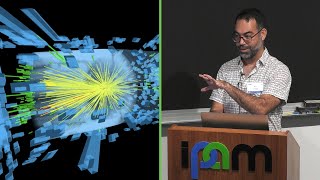
Simulation-Based Inference for Gravitational Wave Astronomy - IPAM at UCLA
Explore simulation-based inference techniques for gravitational wave astronomy, covering frequentist vs. Bayesian approaches, summary statistics, and the role of neural networks and inductive bias.
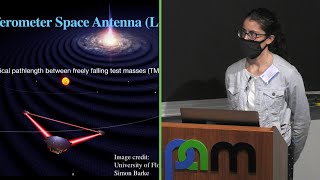
LISA and the Global Analysis of Galactic Binary Gravitational Wave Signals
Explore LISA's role in detecting galactic binary gravitational waves, including data analysis challenges, global fitting techniques, and future prospects for multi-source gravitational wave detection.
Message Passing Neural Networks for Atomistic Systems - Materials - IPAM at UCLA
Explore message passing neural networks for atomistic systems, focusing on thermal transport simulations and diffusion in materials science, with practical examples and convergence tests.
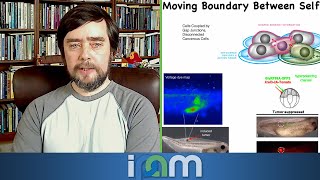
Plasticity Without Genetic Change - Bioelectric Embryos & Synthetic Proto-Organisms
Explore bioelectric embryos and synthetic organisms, delving into morphogenetic control, AI-driven tissue reconfiguration, and collective behaviors challenging traditional biological distinctions.
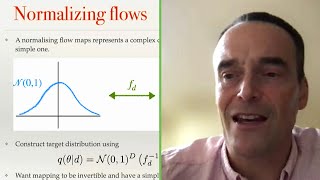
Rapid and Robust Parameter Estimation for Gravitational Wave Observations
Explore rapid parameter estimation techniques for gravitational wave observations, focusing on machine learning approaches like DINGO that use normalizing flows to efficiently analyze data from future detectors.
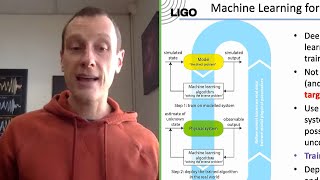
Machine Learning and Gravitational Wave Detectors
Explore machine learning applications in gravitational wave detector science, focusing on noise subtraction and advanced control systems to enhance sensitivity and robustness in astrophysical research.

Machine Learning in Low-Latency Electromagnetic Counterpart Inference
Explore machine learning applications in electromagnetic counterpart inference from gravitational waves, focusing on low-latency data products for efficient follow-up of gravitational wave candidates.
Physically Inspired Machine Learning for Excited States - IPAM at UCLA
Explore machine learning applications in photochemistry, focusing on excited state predictions and light-matter interactions. Discover innovative techniques for overcoming data limitations and enabling accurate photodynamics simulations.
High Accuracy Wavefunctions Using Deep-Learning-Based Variational Monte Carlo
Explore deep learning-based variational Monte Carlo for high-accuracy wavefunctions in computational chemistry, featuring novel architecture and improved methods for ground state energy calculations.