Non-Analytic Non-Equilibrium Field Theory - Camille Aron
Explore non-equilibrium many-body physics, focusing on universal aspects and novel phases of matter beyond equilibrium paradigms. Discover connections between statistical physics, AMO, condensed matter, and high-energy physics.
Non-Equilibrium Dynamics in Dipole- and Higher-Moment Conserving Systems - Frank Pollmann
Exploring non-equilibrium dynamics in dipole- and higher-moment conserving systems, focusing on universal behaviors, fractal excitations, and novel phases of matter far from equilibrium.
An Optical Lattice with Sound - Benjamin Lev
Explore quantum simulators and non-equilibrium many-body physics in optical lattices using sound. Discover novel phases of matter, universality classes, and connections between diverse fields of physics.
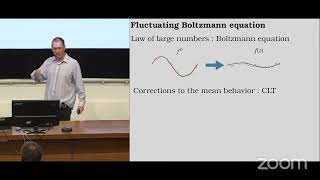
Convergence of a Dilute Gas to the Fluctuating Boltzmann Equation
Explore the convergence of a dilute gas to the fluctuating Boltzmann equation, examining empirical measure fluctuations and their convergence to a Gaussian process for short and long time periods.
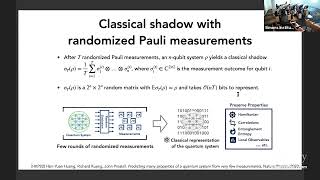
Provably Efficient Machine Learning for Quantum Many-Body Problems
Explore efficient machine learning techniques for solving quantum many-body problems, focusing on provable methods and their applications in computational physics and quantum computing.
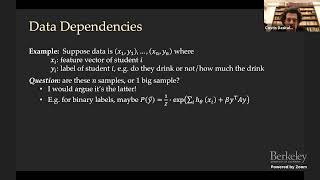
Learning Ising Models from One, Ten or a Thousand Samples
Explore statistical learning theory and Ising models, focusing on sample complexity and efficient algorithms for learning in high-dimensional settings.
Inferring Single-Trial Neural Population Dynamics Using Sequential Auto-Encoders
Explore cutting-edge techniques for analyzing neural population dynamics using sequential auto-encoders, with insights from Google researcher David Sussillo.
Cortical Areas Interact through a Communication Subspace
Explore how cortical areas communicate through subspaces, examining neural population dynamics and inter-area interactions in visual processing using advanced data analysis techniques.
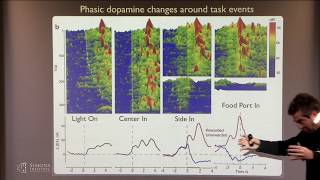
Basal Ganglia Architecture for Reinforcement Learning
Explore the neural circuitry of basal ganglia and its role in reinforcement learning, focusing on representation, coding, and computation in neural networks.
Alloys - Artificial Intelligence and Scientific Computing for Fluid Mechanics
Explore the fusion of AI and scientific computing for predicting and controlling complex fluid systems, with insights on novel algorithms and the importance of interdisciplinary expertise.
Machine Learning for Determining Protein Structure and Dynamics from Cryo-EM Images
Explore machine learning techniques for analyzing cryo-EM images to determine protein structure and dynamics, focusing on the cryoDRGN algorithm and its applications in structural biology.
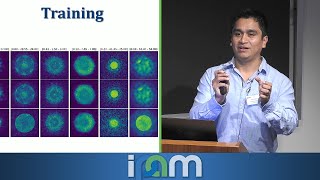
Application of Machine Learning to Electron Microscopy Data - IPAM at UCLA
Explore machine learning applications in electron microscopy, focusing on data modeling and neural networks for distortion compensation in experimental datasets.
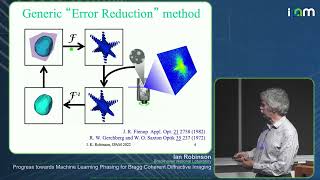
Progress Towards Machine Learning Phasing for Bragg Coherent Diffractive Imaging
Explores machine learning approaches for solving the phase problem in Bragg Coherent Diffractive Imaging, discussing current methods, challenges, and potential ML solutions for 2D and 3D data inversion.
Nonlinear Reduced Basis Methods and Transport in Electronic Structure Calculation
Explore nonlinear reduced basis methods and optimal transport for efficient electronic structure calculations, focusing on a 1D toy model with potential extensions to larger systems.
Uncertainty-Aware Machine Learning Models of Many-Body Atomic Interactions
Explore symmetry-aware machine learning models for atomic interactions, focusing on E(3)-equivariant neural potentials and Bayesian force fields for improved accuracy in materials modeling.
Fully Quantum (Bio)Molecular Simulations: Dream or Reality?
Explore the convergence of quantum mechanics and machine learning in molecular simulations, addressing challenges and future developments for complex (bio)molecular systems.
Machine Learning for Scientific Discovery, with Examples in Fluid Mechanics
Explore machine learning for nonlinear dynamical systems modeling, focusing on the SINDy algorithm and its applications in fluid dynamics, with emphasis on interpretable and physics-respecting solutions.
Nuclear Matter EOS Constraints from Gravitational Waves by Wolfgang Kastaun
Explore gravitational wave observations as a tool for understanding nuclear matter equation of state, focusing on measurable aspects, model-agnostic studies, and implications for neutron star properties.
S. Chandrasekhar's Fluid Dynamics by Katepalli Raju Sreenivasan
Explore S. Chandrasekhar's contributions to fluid dynamics, scaling in physics, and turbulent mixing through lectures by Katepalli Raju Sreenivasan, covering theoretical concepts and their applications.
Turbulence Energy Spectrum by Jayanta K. Bhattacharjee
Explore turbulence energy spectrum, from homogeneous isotropic turbulence to stably stratified fluids. Covers universal range, stochastic models, eddy viscosity, perturbation theory, and Bolgiano-Obukhov scaling.
Soft and Biological Matter - Introduction to States and Structures in Living Systems - Lecture 1
Explore the intersection of biology and physics, covering topics from molecular evolution to ecology. Learn about physical constraints, evolutionary outcomes, and mathematical models in living systems.