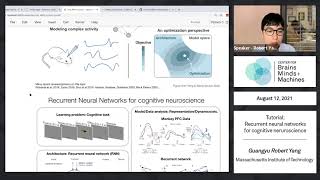
Recurrent Neural Networks for Cognitive Neuroscience
Hands-on tutorial exploring RNNs in cognitive neuroscience through coding exercises. Learn to train and analyze RNNs for various tasks, with lecture and workshop components using Google Colab Notebooks.
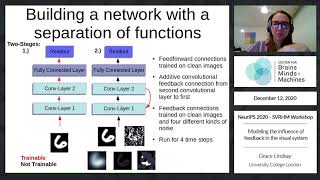
Modeling the Influence of Feedback in the Visual System
Explore how feedback influences visual processing, using masking studies and network modeling to understand its impact on classification accuracy and neural activity.
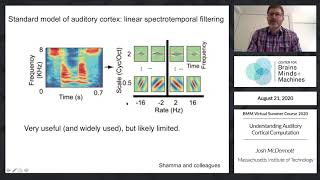
Understanding Auditory Cortical Computation
Explore auditory processing through computational models, comparing AI and human performance in speech recognition, sound localization, and pitch perception.

Toward Brain Computer Interface - Deep Generative Models for Brain Reading
Explore deep generative models for brain reading, covering GAN implementation, image reconstruction from brain signals, and evolving latent codes using genetic algorithms.
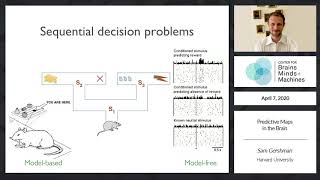
Predictive Maps in the Brain
Explore reinforcement learning theory using predictive maps, bridging model-based and model-free approaches. Discover insights into hippocampal spatial representation and entorhinal grid cells.
High Throughput Connectomics
Explore cutting-edge techniques in connectomics, from crowdsourcing to machine learning, for mapping neural connections and understanding brain function at scale.
AGI Alignment Experiments - INSTRUCT vs Foundation and Agent Models
Explore AI alignment experiments comparing INSTRUCT vs foundation and agent models, focusing on interpretability, system-level alignment, and stability in complex AI systems.
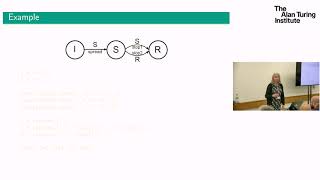
Integrating Inference with Stochastic Process Algebra Models - Jane Hillston, Edinburgh
Explore probabilistic programming for continuous-time systems using ProPPA, an extension of Bio-PEPA. Learn parameter inference methods and applications in biology, ecology, and urban transport.
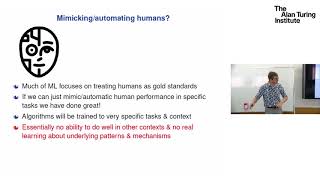
Beyond Tech - Machine Learning in Science & Policy - Professor David Dunson, Duke
Exploring machine learning applications beyond tech, highlighting challenges in science and policy. Discusses fair algorithms, interpretable models, and the need for targeted methods in complex domains.
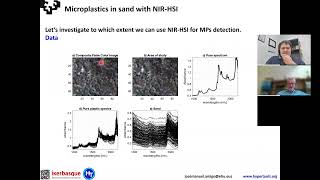
Classical and Generalized Least Squares
Explore advanced least squares techniques for analytical chemistry, including applications in microplastics detection and spectral analysis of biological samples.
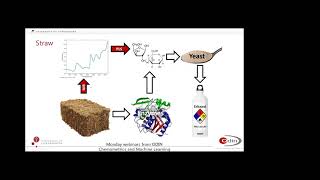
The Cage of Covariance
Explore strategies for handling correlated variables in data analysis, including orthogonalization techniques and predictive component methods.
Fusing Calibration Models
Explore techniques for merging multiple calibration models to improve efficiency and robustness in quality control, with a focus on balancing simplicity and prediction accuracy.
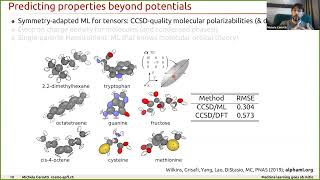
Machine Learning in Condensed Matter and Materials Physics
Explore machine learning applications in condensed matter physics, from electronic simulations to material engineering. Discover how ML enhances computational methods and enables new physical insights for exotic materials.
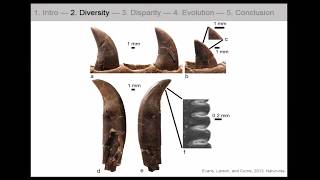
Morphology, Disparity, and Evolution of Theropod Teeth in the Late Cretaceous in Alberta
Explore theropod tooth evolution in Late Cretaceous Alberta through morphology and disparity analysis, revealing patterns across formations and time periods.

DeepMind AlphaFold - A Gift to Humanity
Explore DeepMind's AlphaFold, a revolutionary AI system for protein structure prediction, and its potential impact on biology, medicine, and scientific research.

Embracing Complexity: Integrating Data for Predictive Disease Models
Explore how supercomputing and biology integration revolutionizes disease research, breaking linear thinking to uncover complex pathways and innovative treatments.
Artificial Intelligence for Accelerating Materials Discovery
Explore how AI accelerates materials discovery through machine learning, high-throughput methods, and autonomous systems. Learn about crystal structure mapping, phase mapping, and future opportunities in materials research.
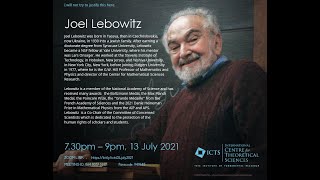
Statistical Mechanical Ensembles and Typical Behavior of Macroscopic Systems by Joel Lebowitz
Explore the foundations of statistical mechanics and its ability to predict macroscopic system behavior with renowned physicist Joel Lebowitz. Gain insights into Gibbs ensembles and their applications.
Machine Learning for Ocean Closures - Advances and Lessons - Laure Zanna - Climate-C21
Machine learning techniques for ocean modeling, exploring advances in subgrid closures, turbulent closures, and stochastic parameters to improve climate predictions and understand ocean dynamics.

Correlation Functions from Hydrodynamics Beyond the Boltzmann-Gibbs Paradigm - Benjamin Doyon
Explores correlation functions in hydrodynamics beyond traditional paradigms, focusing on integrable models, hyperbolic scaling, and novel approaches to non-equilibrium many-body physics.
Superdiffusion, Subdiffusion, Integrability - Sarang Gopalakrishnan
Explores non-equilibrium many-body physics, focusing on superdiffusion, subdiffusion, and integrability in quantum systems. Discusses the XXZ spin chain and integrability-breaking, providing insights into transport phenomena and diffusion.