Beyond Mamba AI: Vector Fields and Fluid Dynamics in Transformer Models - Session 6
Explore the intersection of fluid dynamics and AI transformers, examining mathematical frameworks and theoretical physics concepts to enhance understanding of advanced neural network architectures.
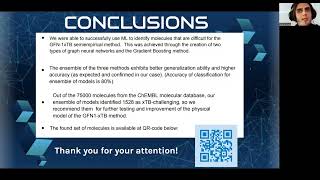
Revealing Inaccuracies of the GFN1-xTB Semi-Empirical Method with Machine-Learning Toolset
Explore machine learning applications in identifying limitations of GFN1-xTB semi-empirical calculations for computational chemistry and molecular modeling.
ML for the Theory Frontier - Jesse Thaler
Explore machine learning applications in theoretical physics, from lattice field theory to collider geometry, and its potential impact on various aspects of high-energy physics research.
Oceans in a Warming Climate - Understanding Sea Level Rise and Climate Projections
Explore ocean physics in climate change, focusing on sea level patterns and improving climate simulations through machine learning and physics integration for more accurate projections.
Architectures of Rotating Star-Planet Systems - Rafael Garcia
Explores rotating star-planet system architectures using data analysis, machine learning, and modeling techniques. Covers hot stars, masking, decision trees, random forests, and orbital period observations.
Debiasing Coarse-Scale Climate Models Using Statistically Consistent Neural Networks
Explores using neural networks to improve coarse-scale climate models, addressing unresolved scales and enhancing predictions. Discusses framework, wavelet analysis, and multi-model architecture for more accurate climate simulations.
Earth System Emulation - Duncan Watson-Parris #CLIMATE-C21
Explore Earth system emulation for climate projections, uncertainty analysis, and machine learning applications in weather and climate science. Gain insights into advanced modeling techniques and data-driven approaches.
Contained Chaos - Ensemble Consistency Testing for the Community Earth System Model
Explore ensemble consistency testing for climate models, focusing on the Community Earth System Model. Learn about statistical methods to evaluate model changes and ensure software quality in climate simulations.
Data-Driven and Data-Assisted Modeling for Applications in Fluid Dynamics and Geophysics
Explores data-driven and data-assisted modeling techniques for fluid dynamics and geophysics, focusing on machine learning applications in climate science and high-resolution forecasting.
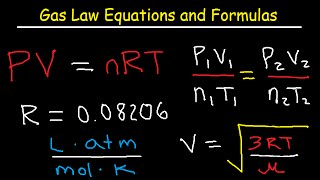
Gas Laws - Equations and Formulas
Comprehensive overview of gas laws, equations, and formulas in chemistry, covering pressure, temperature, volume relationships, kinetic energy, and molecular behavior of gases.

How Your Brain Organizes Information
Explore cognitive maps and how the brain organizes information for flexible behavior. Learn about hippocampal neurons, non-spatial mapping, graph theory, latent spaces, and factorized representations in neuroscience.
Karl Friston – Deep Inference
Karl Friston explores the connection between perceptual inference and decision-making in cognitive neuroscience, examining whether these seemingly different processes share underlying information theoretic principles.
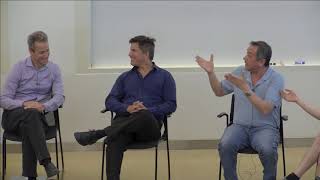
Differences Between Neural Networks and the Brain
Explore the similarities and differences between neural networks and the brain in this panel debate featuring leading experts in neuroscience and artificial intelligence.
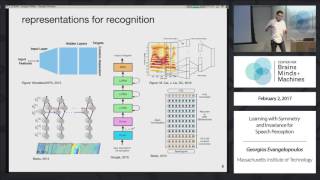
Learning with Symmetry and Invariance for Speech Perception
Explore symmetry and invariance in speech perception, focusing on acoustic variability, feedforward models, and invariant representations. Learn about word orbits, phone representations, and acoustic modeling techniques.
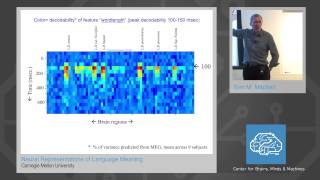
Neural Representations of Language Meaning
Explore neural representations of language meaning through fMRI and MEG brain imaging, machine learning, and experiments on word and sentence comprehension in the human brain.
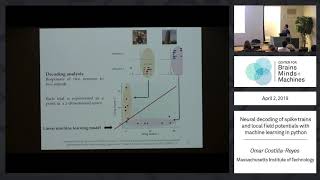
Neural Decoding of Spike Trains and Local Field Potentials with Machine Learning in Python
Learn Python-based machine learning techniques for neural decoding, focusing on preprocessing, model selection, and optimization for spike trains and local field potentials from macaque cortical areas.
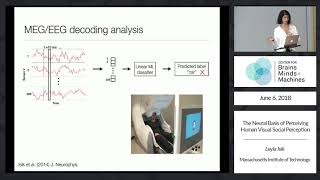
The Neural Basis of Perceiving Human Visual Social Perception
Explore neural mechanisms of visual object recognition and social perception using MEG, fMRI, and computational modeling. Discover how the brain processes visual scenes, objects, and social interactions over time.
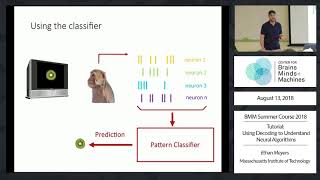
Using Decoding to Understand Neural Algorithms
Explore neural decoding techniques to uncover algorithms in the brain's visual processing, focusing on information representation, invariance, and attention in neural networks.

Classical Shadows of Quantum States - Quantum Colloquium
Explore quantum state representation, shadow tomography, and machine learning applications in quantum many-body problems with John Preskill's insightful lecture on classical shadows.
Automated Reconstruction of Synaptic-Resolution Neural Wiring Diagrams
Explore automated reconstruction of neural wiring diagrams using advanced techniques like generative adversarial networks and crowdsourcing, with applications in connectomics and targeted brain data discovery.
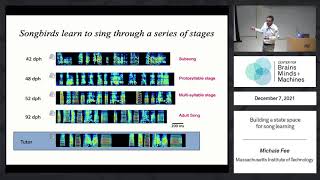
Building a State Space for Song Learning
Explore how songbirds develop neural sequences for vocalizations, examining the role of auditory memory in shaping motor circuits and facilitating song learning through reinforcement mechanisms.