Building the Largest Working Set of AppArmor Profiles
Discover how to build an extensive set of AppArmor profiles for enhanced Linux security. Learn about challenges, security architecture, and integration testing in this comprehensive project.

systemd and TPM2 Features in Linux - Current State and Future Developments
Explore systemd's TPM2 features for enhanced Linux security, including disk unlocking, PCR policies, and system credentials, with insights on future developments and implementation challenges.
Advanced Tracing Features to See What Your Application is Waiting On
Explore new Linux kernel tracing enhancements to identify application bottlenecks, I/O blocks, mutex contentions, and scheduling behavior. Learn to optimize task grouping and performance using real-world examples.
Reducing the Kernel's Slab Allocators - Progress Report
Progress report on reducing Linux kernel slab allocators to SLUB, discussing differences, benefits, and potential challenges in accommodating workloads currently performing better with SLAB.
Empathetic Approach to Containerized Deployments - Making Products Available for Everyone
Explore diverse containerized deployment approaches, from one-click solutions to customizable options, enhancing user adoption and product accessibility for various technical skill levels.
LTTng - Beyond Ring-Buffer Based Tracing
Explore advanced LTTng features: triggers and aggregation maps. Learn efficient system monitoring, event-based notifications, and statistical data extraction for enhanced troubleshooting and performance analysis.
Lessons Learned When Updating Userspace ABIs
Explore the challenges and solutions in updating Linux userspace ABIs, focusing on I2C and SMBus protocols. Learn about careful planning to improve functionality without breaking existing applications.
A New CPU Frequency Control Mechanism on Linux
Explore AMD's new fine-grain CPU frequency control mechanism for Linux, improving power efficiency on Zen2+ processors. Learn design, implementation, and future optimizations.
Livepatch in Userspace Based on Uprobe
Explore userspace livepatch techniques for CVE and bug fixes, covering compiler modifications, patch generation, process recognition, and code injection using Uprobe.
How to Report Your Linux Kernel Bug
Learn effective techniques for reporting Linux kernel bugs, avoiding common mistakes, and understanding which issues are likely to be addressed by developers.
Monitoring for File System Errors in Data Centers - A Guardian Angel Approach
Explore advanced techniques for monitoring and detecting file system errors in data centers, enhancing reliability and preventing data loss.
Unravelling How Firmware Interacts with the Linux Subsystem
Explore the intricate relationship between firmware and the Linux subsystem, gaining insights into their interaction and its implications for system performance and functionality.
Trust and the Linux Kernel Development Model
Explore the trust model and development process behind the Linux kernel with insights from a leading maintainer on community collaboration and reliability.
Hardening Linux for Confidential Cloud Computing - Deep Dive and Results
Explore techniques for hardening Linux guest systems in confidential cloud computing environments, focusing on security mechanisms, kernel subsystem treatments, and results from fuzzing and code audits.
Improving Container Security with System Call Interception
Explore advanced container security using system call interception, focusing on unprivileged containers, selective action monitoring, and practical applications in LXD.
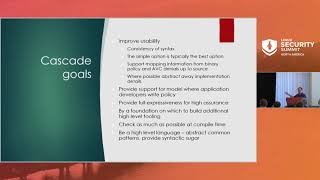
Cascade - A New High Level SELinux Policy Language
Explore Cascade, a new SELinux policy language designed to improve usability and simplify application policy writing for developers with minimal SELinux experience.
BPF LSM - Updates and Future Developments
Explore BPF LSM's latest updates, real-world applications, and future developments. Learn about new features, case studies, and challenges in building advanced security policies.
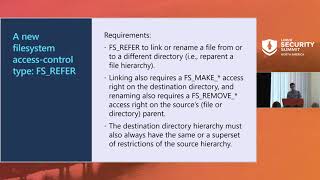
Landlock Update: File Reparenting and Network Rules Support
Explore Landlock's latest updates: file reparenting improvements and new network access controls for enhanced app and container security in Linux systems.
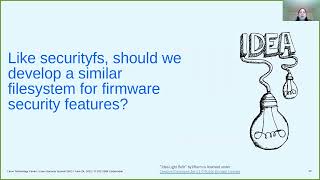
PowerVM Platform Keystore - Securing Linux Credentials Locally
Explore PowerVM's Platform Keystore for secure Linux credential storage, focusing on boot-time security, kernel interfaces, and challenges in developing unified interfaces for diverse platforms.
Establishing Trust in Linux Keyrings - Built-in, Imputed, or Transitive Trust
Explore Linux keyrings, trust models, and key management in firmware, kernel, and user space. Learn about trust domains, scope, usage constraints, and security implications for different systems.
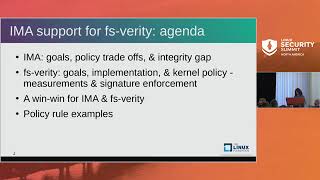
IMA Policy Support for fs-verity - A Win-win for Linux Integrity and File System Verification
Explores Linux Integrity subsystem's new fs-verity support, enhancing file integrity detection and verification. Discusses system-wide policy benefits and closing existing integrity gaps.