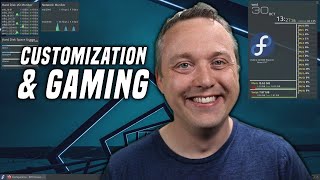
Setting Up Fedora - Customization, Gaming, and Tweaks
Customize Fedora for enhanced aesthetics, gaming performance, and system efficiency with expert tips on KDE setup, RPM Fusion, and Steam optimization.

Understanding Linux Distros
Demystifies Linux distribution types, focusing on Debian, SUSE, Red Hat, and Arch. Guides viewers in choosing the right distro based on their needs and preferences.
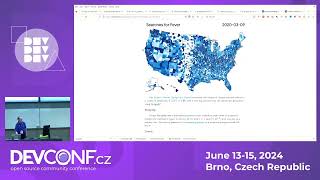
Preserving Anonymity in Data Collection - The Story of Differential Privacy
Explore differential privacy techniques for collecting user data while preserving anonymity. Learn key concepts, historical development, and potential applications in software telemetry.
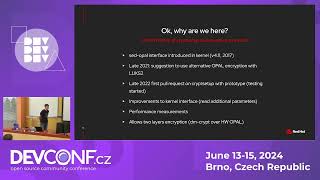
Unlocking Security: Integrating Self-Encrypting Drives with LUKS2 Format
Explore LUKS2 integration with OPAL2 self-encrypting drives for enhanced full disk encryption. Learn about Linux kernel improvements and benefits for personal and enterprise users.
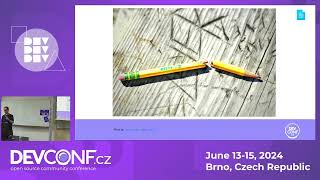
FOSS Action: Engaging Communities with Open Source Software
Discover strategies for building open-source communities through workshops, interactive sessions, and documentation initiatives. Learn from real-world examples and gain insights into effective community engagement techniques.

Setting Up a Rails Server and Deploying with Capistrano on Fedora
Learn to set up a Rails server on Fedora, configure PostgreSQL, and automate deployments with Capistrano. Covers Apache, Passenger, and remote task management for efficient Rails application hosting.
Reproducible Builds - The First Ten Years: Evolution and Future of Software Verification
Explore the evolution of reproducible builds over a decade, from its Debian origins to widespread adoption, and learn about its future implications for software security and verification.
Fedora Automated Testing - Progress Towards CI for Distributions
Overview of Fedora's automated testing system, highlighting progress from manual to automated testing for critical changes across releases. Explores collaboration with openSUSE and strategies to maintain system stability.
Python Compiler Optimization: Improving Performance with -O3 Flag
Explore Python compiler optimization techniques, including function inlining and SIMD, to potentially improve performance by up to 1.16x, with trade-offs in binary size and benchmark results.
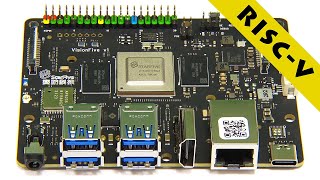
VisionFive RISC-V Linux SBC
Explore the VisionFive RISC-V Linux SBC: hardware specs, Fedora Linux demo, desktop app compatibility, and its role in advancing open computing architecture.
Exploring Hacker Operating Systems - Fedora
Explore Fedora, a secure Linux distribution with SELinux, ideal for security-aware developers. Learn installation, setup, package management, and even WiFi hacking in this comprehensive guide.
Run ILP32 on RV64 ISA - RV64ILP32
Exploring RV64ILP32: advantages, performance comparisons, and implementation across platforms. Demonstrates potential for improved RISC-V hardware performance and cost-effectiveness.
Creating a Secure IoT Platform Using Common Linux Distributions
Explore creating a secure IoT platform using Fedora, focusing on maintenance, updates, and security measures for robust edge-to-cloud solutions and large-scale device management.
35 Fedora Releases in 30 Minutes
Explore Fedora's evolution through 35 releases, covering key milestones, community initiatives, and technological advancements in Linux distribution development.
How Our Mainframe-Focused Working Group Solved Linux Distribution Maintainer Isolation - s390x Architecture
Collaboration among s390x port maintainers for Linux distributions, addressing isolation and technical challenges through shared resources and expertise.
RHEL 11 - Keeping the Flywheel Turning
Explore RHEL 11's development, lessons from current release cycles, and future feedback mechanisms in the Fedora ecosystem.
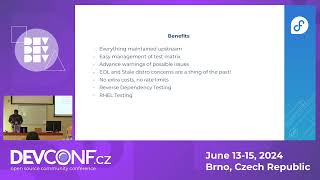
Shifting Left in Podman with Copr, Packit and TMT
Explore Podman's CI workflow evolution using Packit, CoPR, and TMT for efficient development and testing across Red Hat distributions.
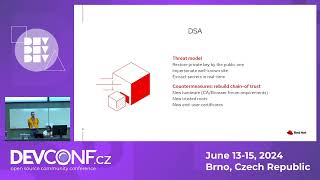
Deep Dive into PQ Transition
Explore post-quantum cryptography transition, its relevance to open-source, and the QUBIP project's role in engineering this shift. Learn about current implementations and future plans.
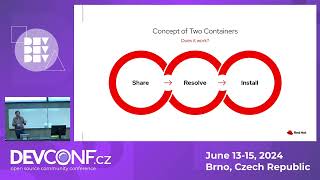
Managing Micro-Containers Without DNF or Microdnf
Explore alternative methods for managing micro-containers without DNF or Microdnf, focusing on servicing containers and efficient package management for Fedora and RHEL.
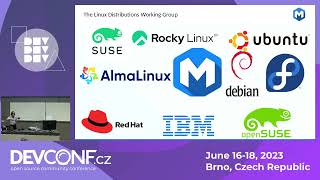
Linux Distributions Collaboration on the Mainframe
Explore collaboration efforts among Linux distributions for improved mainframe architecture support and future goals of the Linux Distributions Working Group.
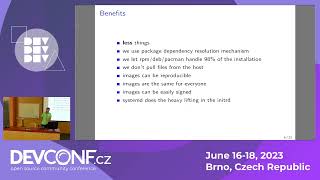
mkosi-initrd in Fedora - Redesigning Initrd Building and Contents
Explore mkosi-initrd, a project redesigning initrd content and build process in Fedora, emphasizing declarative configuration, reproducibility, and systemd-based functionality.