Zero-Copy Video Streaming on Embedded Systems the Easy Way
Efficient video streaming on embedded systems using open-source components: capturing, encoding, streaming, decoding, compositing, and displaying with hardware acceleration on i.MX6 SoC.
Cameras in Embedded Systems - Device Tree and ACPI Implementation
Explore camera integration in embedded systems using Device Tree and ACPI, covering V4L2 framework, media controllers, and driver implementation for sensors, ISPs, and flashes.
Exporting Virtual Memory as DMAbuf - Challenges and Solutions
Explore challenges and solutions for integrating legacy drivers and RTOS applications with Linux, focusing on exporting virtual memory as dmabuf for efficient buffer sharing across drivers.
Cheap Complex Cameras - Challenges and Solutions in Embedded Linux
Explore the complexities of cheap camera hardware in phones, including resolution switching, bit depth, and software support for auto-exposure, auto-gain, and auto-focus.
Embedded Cameras in Linux - Challenges and Solutions
Explore challenges of embedded cameras in Linux and learn about new open-source solutions. Discover how device vendors and developers can leverage the emerging camera stack for improved functionality.
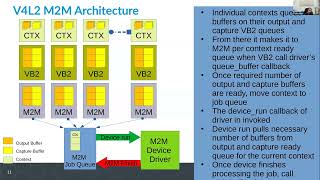
How I Used Yocto for an ELC 2022 Talk and Demo
Explore building a V4L2 mem2mem driver and test application using Yocto for QEMU-based virtual hardware, showcasing powerful features for rapid demo development.
2017 - The Year of Linux Video Codec Drivers
Explore recent V4L2 additions enabling standard Linux kernel API support for video codecs, eliminating the need for proprietary solutions in embedded systems.
libcamera: The Future of Cameras on Linux
Explore libcamera, the future of Linux camera technology. Learn about CMOS sensors, image processing algorithms, and integrating libcamera into applications.
Stateless HEVC Decoding in Mainline Linux - The Rocky Road to Becoming a Stable API
Explore the journey of implementing stateless HEVC decoding in Linux, covering API design challenges, hardware requirements, and the path to stability in the mainline kernel.
Application Support with Libcamera - Ubuntu Summit 2022
Explore libcamera's evolution, its impact on Ubuntu platforms, and strategies for adapting applications to this new camera stack. Learn about desktop integration, security enhancements, and various access methods for developers.
Supporting Video Serializers and Deserializers in Linux - Challenges and Works in Progress
Explore challenges and progress in Linux support for video serializer/deserializer chips, focusing on V4L2 limitations, Device Tree issues, and I2C address translation.
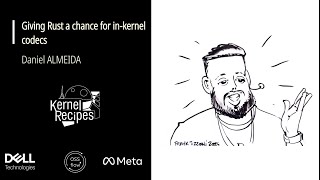
Giving Rust a Chance for In-Kernel Codecs - Kernel Recipes 2024
Explore Rust integration in kernel development for V4L2 codec drivers, focusing on minimal abstractions and ABI compatibility strategies.