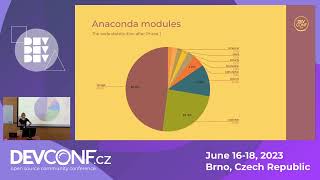
The Story of the Anaconda Backend - Modularizing a Legacy System Installer
Explore the journey of modularizing Anaconda, the Linux system installer, and learn about the challenges faced in implementing a D-Bus backend for a new web UI.
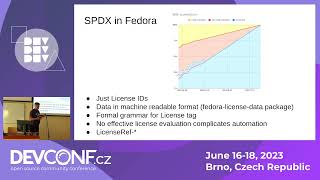
Software Bill of Materials (SBoM) for Dummies
Explore Software Bill of Materials (SBoM), its importance, and implementation in Fedora. Learn about US government mandates, hidden pitfalls, and the SPDX migration.
Being an Open-Source Newbie: From Newcomer to Experienced Contributor
Discover how to navigate open-source communities as a newcomer. Learn from personal experiences in RDO, CentOS, and Fedora projects to successfully contribute and grow within the ecosystem.
Packit, Testing Farm, and tmt Success Stories - User Experiences
Discover real-world applications of Packit, Testing Farm, and tmt through user success stories. Gain insights into seamless test integration, automated RPM pipelines, and versatile test definitions across systems.
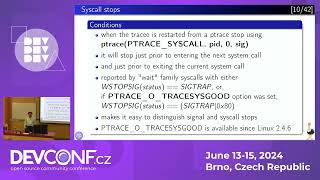
Evolution of ptrace from strace's Perspective
Explore ptrace API evolution through strace's lens, examining its usage, missing features, and potential kernel improvements for diagnostic utilities.
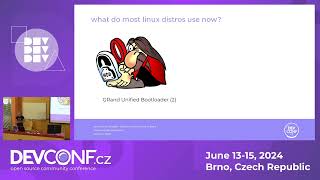
No More Boot Loader: Using the Linux Kernel as a Bootloader
Explore a new Linux-based solution replacing GRUB bootloader with a faster, more secure user-space alternative. Learn about unified kernel images and their benefits for system booting.
Agama: Next Generation of Linux Installer
Explore Agama, the future web-based installer for openSUSE and SUSE. Learn about its features, technical details, and why it's replacing the current installer. Discover automatic installation, advanced partitioning, and more.
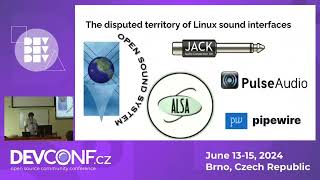
Music Production on Linux Desktops
Explore Linux-based music production tools, workflows, and software ecosystem. Discover viable alternatives for audio workstations and experience live signal processing demonstration.
OpenScanHub - Static Analysis of a Linux Distribution
Explore OpenScanHub's journey from internal Red Hat tool to open-source static analysis service, its key features, and integration with Fedora-related services.
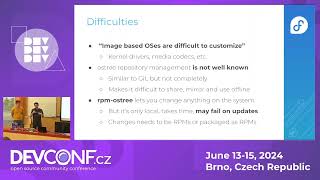
Customizing OS Images Using Container Technology
Explore customizing OS images using container technology, enabling modifications without creating a new distribution. Learn about Fedora variants and innovative projects leveraging this approach.
The New Era of Packaging Parallel Streams in Fedora
Explore innovative approaches to packaging parallel streams in Fedora post-modules, focusing on database components. Includes live demo of new techniques.
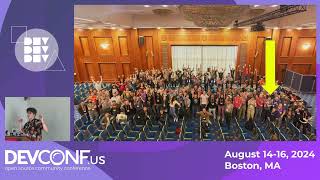
Gotta Go Fast: How We Started the Ubuntu High-Performance Computing Team
Explore the formation of Ubuntu's HPC community team, their collaborative efforts in developing Charmed HPC, and strategies for addressing challenges in open-source HPC ecosystem engagement.
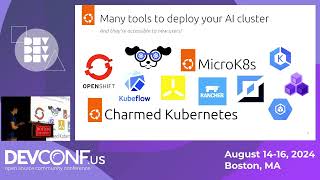
Charmed HPC: Your Own Personal Supercomputer Within 15 Minutes
Deploy a personal supercomputer in 15 minutes using Charmed HPC, an open-source infrastructure stack for cloud and on-premises. Explore integrated services, automated lifecycle events, and multi-cloud deployment options.
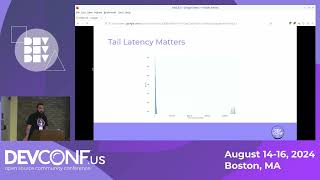
UKELELE: Optimizing Event Handling for Modern Server Applications
Explore UKELELE, a high-performance event handling system for modern server applications. Learn about its optimizations, improved throughput, and reduced tail latency compared to current Linux solutions.
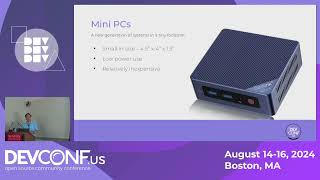
Learn About Linux, Containers, and Networking Through Self-Hosting
Explore self-hosting to gain hands-on experience with Linux, containers, and server operations. Set up personal cloud services for photo, music, and video sharing while maintaining data control.
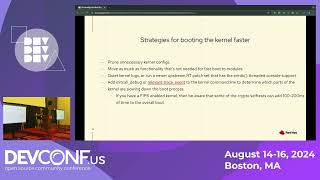
Accelerating Linux Boot Time: Techniques and Strategies for Optimal Performance - Lecture
Explore strategies to accelerate Linux boot time, from measuring performance to optimizing systemd, kernel, and filesystem configurations. Gain comprehensive understanding of achieving faster boot times.
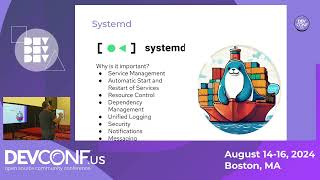
Container Life Cycle Management in Automotive and Edge Deployments
Explore Podman Quadlet's systemd integration for efficient container management in automotive projects, enhancing resource utilization.

Shared Libraries in Windows and Linux - Linking and Loading Deep Dive
Dive deep into linking and loading operations, exploring binary structures, static vs dynamic linkage, and Linux vs Windows differences. Gain clarity on opaque linker error messages.

The Hidden Performance Price of C++ Virtual Functions
Dissect virtual functions in C++, understand their performance impact, and learn optimization techniques to enhance program speed while utilizing this core concept.
Observability Tools in C++: Beyond GDB and printf
Explore advanced observability tools for C++ beyond GDB and printf to gain deeper insights into program behavior and performance on Linux systems.
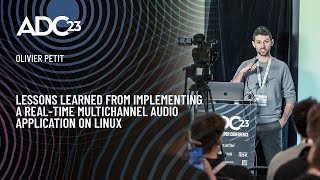
Running High Channel Count Audio Applications on Linux RT
Explore Linux kernel features for real-time audio processing, focusing on performance control and glitch-free output in high channel count applications. Learn from commercial product examples.