
Newton's Laws of Motion - Fundamentals of Physics
Explore Newton's Laws of Motion: inertia, force and acceleration relationships, and action-reaction principles. Gain insights into fundamental physics concepts and their real-world applications.
Law of Conservation of Energy in Higher Dimensions - Fundamentals of Physics
Explore conservation of energy in higher dimensions, covering calculus concepts, work in 2D, conservative forces, and applications to gravitational potential energy.

Vectors in Multiple Dimensions - Fundamentals of Physics
Explore vector motion in multiple dimensions, covering properties, transformations, velocity vectors, and applications to circular and projectile motion. Gain a solid foundation in vector physics.
Virtual Reality
Explore virtual reality fundamentals, from historical perspectives to cutting-edge technologies. Gain hands-on experience in geometric modeling, optical systems, and sensory perception for immersive VR development.

Abstract Algebra
Explore fundamental concepts of abstract algebra, including groups, rings, fields, and vector spaces, with a focus on definitions, examples, and key theorems.
Engineering Mathematics
Explora matemáticas avanzadas en ingeniería mecánica, desde ODEs y sistemas dinámicos hasta transformadas de Fourier y Laplace, con aplicaciones prácticas en Matlab y análisis de sistemas no lineales.
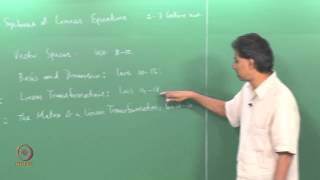
Linear Algebra
In this course, you will learn systems of linear equations, Matrices, Elementary row operations, Row-reduced echelon matrices. Vector spaces, Subspaces, Bases and dimension, Ordered bases and coordinates.
Quantum Mechanics and Applications
Explore quantum mechanics fundamentals, including wave-particle duality, Schrödinger equation, and applications in atomic physics. Develop problem-solving skills for quantum systems.
Dynamics of Ocean Structures
Explore ocean structure dynamics, from types and environmental forces to vibration analysis and stochastic dynamics. Learn about platforms, fluid-structure interaction, and response control methods.

Engineering Mechanics
In this course, we would be studying mechanical interaction between different bodies when they interact through the forces applied on each other. This would consist of 2 parts: statics and dynamics.
Engineering Mechanics
In this course, we would be studying mechanical interaction between different bodies when they interact through the forces applied on each other. This would consist of 2 parts: statics and dynamics.
Basic Linear Algebra
Linear Algebra is a basic course for students intended to go for Engineering studies and higher studies in Mathematics. We will cover the basic tools needed in these branches.
Computer Algorithms - 2
The course discusses efficient algorithms from a large number of domains. This course assumes the knowledge of data structures, the knowledge big-O notation and the concept of time and space complexity of an algorithm.
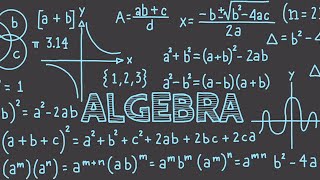
Learn Algebra
Master algebra fundamentals to advanced concepts, including equations, matrices, polynomials, functions, logarithms, and conic sections. Develop problem-solving skills for real-world applications.
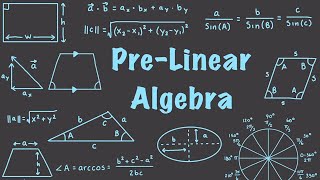
Linear Algebra
Comprehensive exploration of linear algebra concepts, from basic operations to advanced topics like eigenvalues, with practical applications and problem-solving techniques.
Linear System Theory
We will cover time invariant, time varying, continuous and discrete time systems. This course will cover concepts of stability, controllability, observability, and design and serve as a necessary foundation for further study in the area of systems and co…

An Introduction to Smooth Manifolds
The course will start with a brief outline of the prerequisites from topology and multi-variable calculus. After that a large class of examples, including Lie groups, will be presented. The course will culminate with proof of Stokes' theorem on manifolds.
Differential Calculus in Several Variables
This is part of a standard course contents in Several Variable Calculus. The idea of the course is to provide students with different backgrounds a common platform to take up further topics in Mathematics, Physics and Engineering.
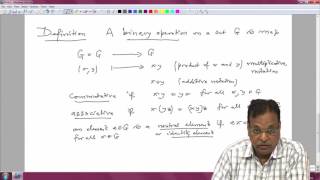
Linear Algebra
The main purpose of this course is the study of linear operators on finite dimensional vector spaces. The idea is to emphasize the simple geometric notions common to many parts of mathematics and its applications.

Linear Algebra
Comprehensive exploration of linear algebra fundamentals, covering matrices, linear systems, vector spaces, transformations, and inner product spaces, with a focus on theoretical concepts and practical applications.
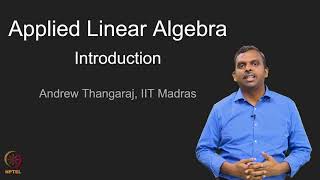
Applied Linear Algebra
Explore vector spaces, linear maps, eigenvalues, and applications in systems, algorithms, and optimization. Gain practical skills in linear algebra for various fields.