
Modular Language Models: Addressing Limitations of Dense Training
Explore modular language models: specialized components for distinct domains, enabling customization, parallelization, and sparse activation. Discover a new approach to collaborative LM development.

Designing and Evaluating Language Models for Human Interaction
Explore language model design and evaluation for human interaction, covering text infilling, collaborative writing analysis, and a new framework for assessing human-AI language interaction.

Scaling Unlocks Emergent Abilities in Language Models
Explore emergent abilities in large language models, including chain-of-thought prompting and instruction finetuning, and their potential impact on AI capabilities.
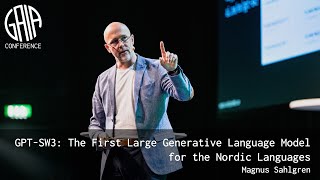
GPT-SW3: The First Large Generative Language Model for Nordic Languages
Explore the development and applications of GPT-SW3, the pioneering large generative language model for Swedish, with insights on data challenges and future directions.

Is AI Alignment Even Necessary? Thoughts on OpenAI's Uncensored Internal Chain of Thought Approach
Explore critical perspectives on AI alignment necessity and OpenAI's uncensored internal Chain of Thought approach. Gain insights into evolving AI ethics debates.
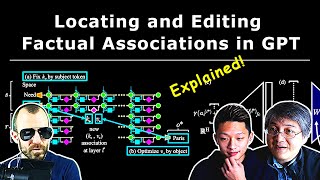
ROME - Locating and Editing Factual Associations in GPT - Paper Explained & Author Interview
Explores mechanisms for storing and editing factual knowledge in GPT models, revealing key roles of mid-layer feed-forward modules and proposing targeted editing techniques with implications for model understanding and control.

Author Interview - Typical Decoding for Natural Language Generation
Interview exploring typical sampling, a new decoding method for language models that balances generating high-probability and high-information samples, aiming to produce more diverse and interesting text while reducing repetitive outputs.
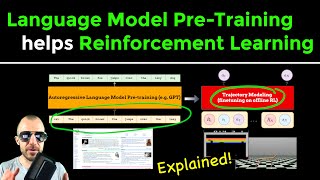
Can Wikipedia Help Offline Reinforcement Learning? - Paper Explained
Exploring how pre-training on Wikipedia improves offline reinforcement learning models, enhancing performance, reducing parameters, and revealing connections between language and RL domains.
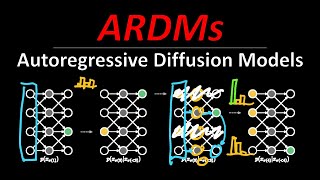
Autoregressive Diffusion Models - Machine Learning Research Paper Explained
Explore Autoregressive Diffusion Models, a novel approach combining autoregressive and diffusion models for efficient, order-agnostic generation and compression of text and image data.
Is GPL the Future of Sentence Transformers - Generative Pseudo-Labeling Deep Dive
Explore Generative Pseudo-Labeling for training high-performance sentence transformers using unlabeled text data. Learn implementation techniques, potential applications, and future implications for NLP and semantic search.
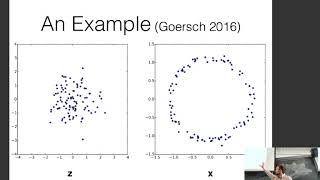
CMU Neural Nets for NLP - Models with Latent Random Variables
Explore neural network models with latent random variables for NLP, covering VAEs, generative models, and techniques for discrete latent variables and controllable text generation.
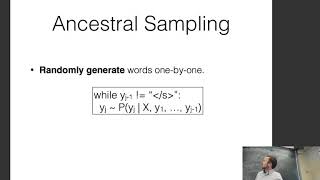
CMU Neural Nets for NLP 2018 - Conditioned Generation
Explore advanced techniques in neural language models, including conditioned generation, sampling methods, ensembling, and evaluation paradigms for natural language processing tasks.
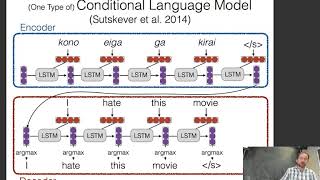
Neural Nets for NLP 2017 - Conditioned Generation
Explore encoder-decoder models, conditional generation, ensembling, and evaluation techniques for neural networks in natural language processing. Gain insights into advanced NLP concepts and practical applications.
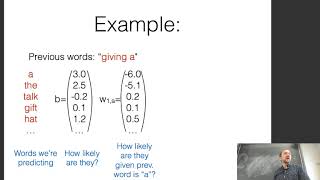
Neural Nets for NLP 2017 - A Simple Exercise - Predicting the Next Word in a Sentence
Explore word prediction techniques, including skip-grams, CBOW, and advanced word vector methods. Learn to describe, count, predict, evaluate, and visualize word relationships in natural language processing.
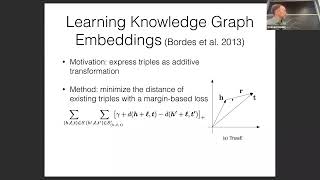
CMU Advanced NLP: Information Extraction and Knowledge-Based QA
Explore advanced NLP techniques for knowledge extraction, relation modeling, and question answering. Learn to leverage embeddings, knowledge graphs, and language models for information retrieval and analysis.
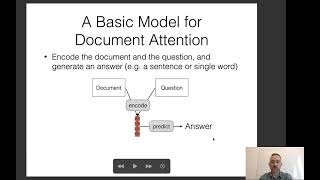
Neural Nets for NLP 2021 - Machine Reading with Neural Nets
Explore machine reading techniques for NLP, covering datasets, context encoding, multi-hop reasoning, and dataset limitations. Gain insights into advanced neural network applications in natural language processing.
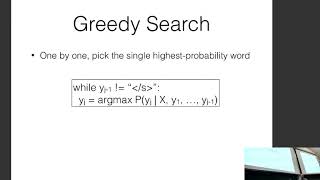
Neural Nets for NLP 2020: Conditioned Generation
Learn about encoder-decoder models, conditional generation, search techniques, and evaluation methods for neural networks in natural language processing.

GPT-2 and Transformers
Explore text-based AI models, focusing on GPT-2 and Transformers. Learn about their architecture, capabilities, and potential applications in natural language processing.

OpenAI ChatGPT - The Future Is Here
Explore ChatGPT's capabilities in writing, design, problem-solving, and creative tasks. Learn about its potential applications and limitations in this comprehensive overview of the AI language model.

AI Storytelling and Narrative - Personalized Stories for Children
Explore AI-driven storytelling, personalization, and product development with insights on creating child-friendly AI content and navigating the transition to the Age of Intelligence.
What's Next? - LLM Bootcamp
Explore the future of AI: multimodal robots, scaling limits, AGI possibilities, and safety concerns. Gain insights into key questions shaping the next era of language models and artificial intelligence.