
LangChain Demo and Q&A with Harrison Chase
Explore LangChain, a framework for building LLM applications, through a demo and Q&A with its creator. Learn about its features, benefits, and potential applications in AI development.
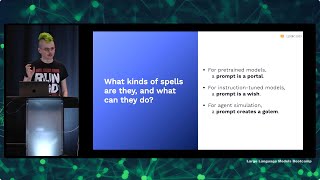
Learn to Spell - Prompt Engineering
Explore intuitions and techniques for effective prompt engineering, including decomposition, reasoning, and reflection, to unlock the full potential of language models.

Phi 1.5 - The Small Model Getting Big Results
Explore Phi 1.5, a small yet powerful language model. Learn about its development, capabilities, and potential applications through in-depth analysis and hands-on coding examples.

PaLM2 from Scratch
Explore Google's PaLM2 AI model: improvements, specialized versions, and practical applications in the Vertex AI platform. Hands-on demonstrations of various prompting techniques and code examples included.

Testing GPT-3's Ability to Solve Complex Riddles and Logical Problems
Explore GPT-3's ability to solve complex riddles and logical problems in this engaging video, testing the limits of AI's reasoning capabilities across 10 challenging puzzles.

OPT-175B Language Model Tutorial - GPT-3 Alternative Using Hugging Face
Learn about Meta AI's OPT-175B language model, including a live demo and hands-on coding for text generation using Hugging Face Transformers. Explore this open-source alternative to GPT-3.

GPT 4 - Superpower Results With Search
Enhance GPT-4's capabilities with retrieval augmentation, using Pinecone vector database to provide up-to-date information and reduce hallucinations in AI-generated responses.
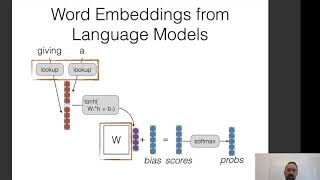
Neural Nets for NLP 2021 - Distributional Semantics and Word Vectors
Explore distributional semantics and word vectors in NLP, covering techniques like skip-grams, CBOW, and advanced methods. Learn to evaluate, visualize, and apply word embeddings effectively.
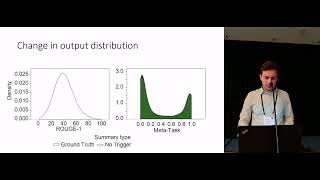
Spinning Language Models: Risks of Propaganda-as-a-Service and Countermeasures
Explore risks and countermeasures of using language models for propaganda, including classification vs sequence-to-sequence models, spin techniques, and defense strategies.

GPT-Whale Language Models at Tools for Structure Discovery and Hypothesis Generation
Explore innovative applications of GPT-Whale models for uncovering patterns and generating hypotheses in nonhuman species communication research.

Using LangChain Output Parsers to Get What You Want Out of LLMs
Explore LangChain Output Parsers to enhance LLM results. Learn structured, comma-separated, Pydantic, fixing, and retry parsers for improved model outputs.
Building a RCI Chain for Agents with LangChain Expression Language
Learn to build a Recursive Criticism and Improvement (RCI) chain for AI agents using LangChain Expression Language. Explore multi-chain implementation and combined chain approaches for enhanced agent performance.

Language Models as Statisticians, and as Adapted Organisms
Exploring language models as statistical tools and adapted systems to understand their behavior, capabilities, and potential for improvement in various applications.

How to Use Self-Play for Language Models to Improve at Solving Programming Puzzles
Explore how language models can generate and solve programming puzzles, improving their own performance through self-play and interpreter-verified solutions.

A Theory for Emergence of Complex Skills in Language Models
Explores statistical framework linking LLM cross-entropy loss to language skill competence, analyzing scaling laws' implications for efficient learning and emergence of complex abilities.

Scaling Data-Constrained Language Models
Explore strategies for scaling language models in data-constrained environments, addressing data repetition, compute optimization, and mitigating scarcity challenges.
Introduction to Natural Language Processing
Explore NLP fundamentals, including language models, part-of-speech tagging, and word embeddings. Learn real-world applications and core technologies in this AI and linguistics subfield.
Vector Search and Embeddings in Organizations - Harnessing Language Models and Vector Indexing
Explore vector search, embeddings, and indexing with experts. Learn to leverage large language models for NLP tasks and implement solutions using vector databases in various environments.

Extracting Training Data from Large Language Models - Paper Explained
Explores a method to extract training data from large language models, discussing security implications, risks, and mitigation strategies for models like GPT-3. Covers technical aspects and ethical considerations.

Did Google's LaMDA Chatbot Just Become Sentient?
Explore the controversy surrounding Google's LaMDA chatbot and its alleged sentience. Analyze claims, examine language models, and delve into the philosophical questions of AI consciousness and recognition of machine sentience.
Understanding Unstructured Data with Language Models - Alex Peattie
Explore language models for unstructured data analysis, covering classification, predictive modeling, and information retrieval. Learn key concepts and practical applications in various fields.