Propositions as Types
Explore the profound connection between logic and computation, delving into the Propositions as Types principle and its impact on theorem provers, programming languages, and computing frontiers.
The Road to Akka Cluster, and Beyond
Exploring distributed computing landscape, from early computer architecture to modern challenges. Covers key theories, protocols, and technologies, with insights into Akka Cluster's design and future developments.
From Javascript to Haskell - Functional Programming Made Simple
Demystifying functional programming concepts through live coding, transforming imperative code to functional. Explore key principles like higher-order functions, closures, and currying for clearer, more efficient code.
Fun with the Lambda Calculus
Explore the lambda calculus through hands-on exercises using Vim and CLI. Learn to build computing structures from basic lambda functions in this engaging presentation.
Thinking Outside the Synchronisation Quadrant
Explore concurrency, architecture, and software development challenges with Kevlin Henney. Gain insights on system properties, code execution states, and functional programming approaches to improve performance and maintainability.
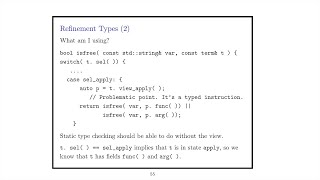
Trees for Logic and Parsing in C++
Explore efficient implementation of recursive tree-types in C++ for logic and parsing, with insights on construction, inspection, and replacement of subtrees.
Mary Had a Little Lambda
Explore lambda calculus: from simple Python functions to powerful abstractions. Learn to create booleans, integers, operators, and data structures using only lambda functions.
Functional Programming Essentials
Explore functional programming's origins, principles, and practical applications in Scala. Learn about pure functions, immutability, and how to apply FP concepts in everyday work without complex abstractions.
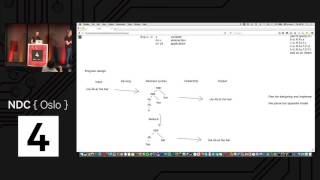
Live Lambda Calculus
Explore lambda calculus through live coding, building an interpreter in F# and demonstrating its practical applications in functional programming.
Dependency Injection Revisited
Explore functional programming approaches to Dependency Injection, examining non-deterministic behavior control and its application in both functional and object-oriented paradigms.
Dependency Injection Revisited
Explore alternative approaches to Dependency Injection, examining functional programming concepts and their applicability to object-oriented programming. Gain insights into controlling non-deterministic behavior in software development.
Turing's Toy - The Story of a Mathematical Idea That Changed the World
Explore Turing's revolutionary 'universal machine' concept, its historical context, and far-reaching impact on computer science and technology in this engaging talk.
Unboxed Data Constructors: Efficient and Safe Big Number Handling in ML Languages
Explore unboxed data constructors in ML languages, enhancing efficiency without compromising safety. Learn static analysis techniques and their implementation in OCaml, including termination detection algorithms.
Explicit Refinement Types - A Type Theory with Embedded Proofs
Explore λert, a type theory with explicit proof refinement types. Learn about its soundness, denotational semantics, and formalization in Lean 4.
Probabilistic Programming with Stochastic Probabilities
Explore a novel approach to probabilistic programming languages using stochastic probability estimation, enabling unrestricted stochastic control flow and programmable inference with custom proposals.
Operational Game Semantics for Generative Algebraic Effects and Handlers
Explore operational game semantics for generative algebraic effects and handlers in a typed call-by-value λ-calculus, focusing on dynamic allocation and first-class effect instances.
Hashing Modulo Context-Sensitive Alpha-Equivalence - PLDI 2024
Explore efficient hashing for lambda-terms with context-sensitive alpha-equivalence. Learn about improved algorithms for subterm comparison and structure sharing in mathematical knowledge graphs.
Stream Types - A Foundational Theory of Typed Data Streams and Stream Transformers
Explore a foundational theory of typed data streams and transformers, covering complex sequential patterns, parallel structure, and programming idioms like punctuation and windowing.
La-La-Lambda Calculus: A Functional Musical Journey
Explore lambda calculus through a musical journey, discovering its power to represent programs as pure functions and its role in functional programming.
Operational Game Semantics for Generative Algebraic Effects and Handlers
Explore operational game semantics for generative algebraic effects and handlers in a typed call-by-value λ-calculus with dynamic allocation of effect instances.
A History of Subtyping
Explore the evolution and significance of subtyping in programming languages with Benjamin C. Pierce's comprehensive historical overview.