The Training Gap - GLAM and The Carpentries
Bridging the digital skills gap in GLAM and research through training initiatives, focusing on Jupyter Notebooks and SWAN to enhance digital literacy and encourage curiosity in working with digital collections.
Interactive C++ in a Jupyter Notebook Using Modules for Incremental Compilation
Explore interactive C++ in Jupyter notebooks using modules for incremental compilation, addressing limitations of existing tools and enabling a more robust computational chain for experimentation.

Geospatial Public Policy Analysis with GeoPandas
Analyze US higher education institutions using GeoPandas, exploring education deserts and equity implications through hands-on data analysis with NCES and IPEDS datasets.
Datos, Python y Humanos
Explorando retos y oportunidades de la ciencia de datos en Latinoamérica: historias reales, obstáculos comunes y visión de futuro para científicos de datos y empresas en la región.
Extending the Python Ecosystem to Xilinx
Explore PYNQ: Python-based platform integrating microprocessors, microcontrollers, and FPGAs. Learn to leverage programmable system-on-chips for embedded development using familiar Python ecosystem and Jupyter notebooks.
What We Learned from Papermill to Operationalize Notebooks
Explore notebook automation with Papermill, learning parameterization techniques and execution strategies to enhance troubleshooting pipelines and empower on-call developers.
A Hands-On Introduction to Multi-Objective Optimization
Hands-on Python tutorial exploring multi-objective optimization using Pareto Fronts. Learn to balance conflicting objectives like quality and cost, with practical applications in various fields including supply chain and therapeutics development.

Dock Your Jupyter Notebook
Learn to containerize Jupyter Notebooks with Docker for reproducible and shareable machine learning projects, enabling smooth execution on remote machines.
Enhancing Code Collaboration with Conflict Free Replicated Data Types
Explore conflict-free replicated data types (CRDTs) and their potential to enhance Jupyter notebooks, enabling real-time collaboration, synchronous editing, and improved version control in data science workflows.
Documenting Your Code From Docstrings to Automated Builds
Learn to create effective documentation, from docstrings to automated builds. Explore best practices, tools like Sphinx and JupyterBook, and automate with GitHub Actions for maintainable, user-friendly project documentation.
Assessing and Mitigating Unfairness in AI Systems
Learn to assess and mitigate fairness issues in AI systems, focusing on healthcare disparities. Hands-on practice with Fairlearn library to evaluate and improve ML model performance across racial groups.
Skynet 101 - How to Keep Your Machine Learning Code From Getting Away From You
Discover how to apply Test-Driven Development to machine learning projects, from data analysis to building recommendation engines, using Python libraries and Jupyter Notebooks.
Transforming a Jupyter Notebook into a Reproducible Pipeline for ML Experiments
Learn to transform Jupyter Notebooks into reproducible ML pipelines using Git and DVC. Explore techniques for experiment tracking, modularization, and result comparison in a text2image project with Stable Diffusion.
Write Your First Package Using Literate Programming
Aprenda a criar um pacote Python usando programação literária, combinando explicações em linguagem natural com código. Explore ferramentas como Jupyter Notebooks e Nbdev para desenvolvimento eficiente e documentação integrada.
Brainwaves for Hackers 3.0
Explore brain secrets using Python and EEG devices. Interactive Jupyter experiments demonstrate evoked response potentials and neurofeedback training for hands-on brain wave analysis.
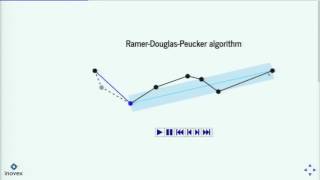
Handling GPS Data with Python
Learn to handle GPS data in Python, from reading/writing tracks to visualizing on OpenStreetMap. Explore libraries, add elevation data, and understand algorithms like Douglas-Peucker and Kalman filters for track simplification and smoothing.
Jupyter for Everything Else
Explore unconventional uses of Jupyter beyond scientific exploration, including command-line tutorials, interactive presentations, and web technology experimentation.
NetworkX Visualization Powered by Bokeh
Interactive network visualization using NetworkX and Bokeh in Jupyter Notebooks. Learn to create, manipulate, and update network structures with Python, enhancing data exploration and analysis of social networks.
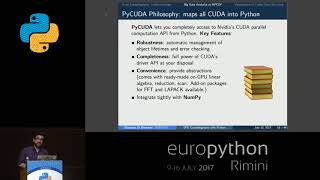
Big Data Analytics at the MPCDF - GPU Crystallography with Python
Explore GPU-accelerated Python for big data analytics in atom probe crystallography, focusing on Fourier spectral analysis, scalability across multiple GPUs, and interactive visualization techniques.
Scientific Computing Using Cython - Best of Both Worlds!
Explore Cython for scientific computing, combining Python-like syntax with C speed. Learn to build native extensions, use static typing, and integrate with C code for optimal performance.
Pandas - Not Just for Data Scientists
Discover how Pandas can enhance Python performance and overcome limitations, with practical examples for experienced developers beyond data science applications.