
Households in Early Modern England: Structures, Priorities, and Roles
Explore household structures, roles, and strategies in early modern England, focusing on gender dynamics, children's experiences, and survival priorities in different social classes.

Weber's Theory of Class - Foundations of Modern Social Thought
Explore Weber's theory on the shift from status to class in determining life chances, comparing feudal and modern capitalist eras, and examining the interplay between class and status in society.

Marx's Theory of History - Foundations of Modern Social Thought
Explore Marx's evolving theory of historical change, focusing on property relations and multi-linear development as presented in the Grundrisse, challenging his earlier uni-linear view of history.

Marx's Theory of Historical Materialism - Lecture 11
Explore Marx's historical materialism, dialectics, and theories of truth. Examine the evolution of his ideas and their impact on understanding social structures and historical development.
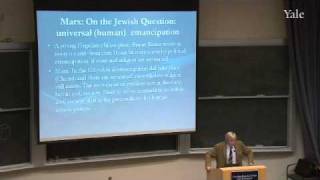
Marx's Theory of Historical Materialism - Lecture 1
Exploración profunda de la teoría de alienación de Marx, su materialismo histórico y su crítica a Hegel, enfatizando la transición del joven Marx al Marx maduro y su visión del cambio social.

Marx's Theory of Alienation - Foundations of Modern Social Thought
Explore Marx's theory of alienation, its roots in Hegelian thought, and how material conditions shape social critique. Understand Marx's intellectual journey and its impact on revolutionary ideas.

John Stuart Mill's Utilitarianism and Social Thought - Lecture 8
Explore John Stuart Mill's influential ideas on utilitarianism, justice, liberty, and women's rights, examining their impact on modern social thought and contemporary debates.

Utilitarianism and Liberty - John Stuart Mill's Philosophy - Lecture 7
Explore Adam Smith's moral philosophy and economic theories, and John Stuart Mill's utilitarianism and views on liberty in this lecture on foundational social thought concepts.

Rousseau on State of Nature and Education - Foundations of Modern Social Thought
Rousseau's ideas on general will, education, and human nature explored. Discusses "Emile," negative education, and the corruption of individuals by society. Examines social transformation and gender roles.

Rousseau - Popular Sovereignty and General Will - Lecture 5
Explore Rousseau's influential ideas on popular sovereignty, general will, and social contract, shaping modern political thought and the French Revolution.

The Division of Powers - Montesquieu's Theory of Separation of Powers
Explore Montesquieu's influential ideas on separation of powers, government classification, and the impact of environment on society in this Yale lecture on modern social thought foundations.

John Locke's Political Theory - Equality, Freedom, Property, and Dissent
Explore Locke's political philosophy, focusing on equality, freedom, property rights, and government by consent. Contrasts with Hobbes' views and examines separation of powers in state governance.

Hobbes - Authority, Human Rights and Social Order in Modern Social Thought
Explore Hobbes's political philosophy, examining his views on human nature, social contracts, and the role of sovereign power in maintaining social order and individual security.
Don Quixote, Part II - Chapters XII-XXI: Engaño, Desengaño, and the Cervantean Style
Explore Cervantes' literary techniques in Don Quixote Part II, focusing on themes of deception, disillusionment, and self-discovery through character interactions and narrative structure.

Don Quixote Part II - Front Matter and Chapters I-XI Analysis
Análisis profundo de Don Quijote Parte II, explorando temas barrocos, desengaño, religión y teatro. Examina la evolución de personajes y la influencia del contexto histórico en la obra de Cervantes.
Interpreting Scripture - The Letter to the Hebrews
Explore ancient and modern methods of biblical interpretation, focusing on the Letter to Hebrews and its unique approach to understanding Hebrew Bible passages.
The Acts of Paul and Thecla: Asceticism and Female Heroism in Early Christianity - Lecture 20
Explore the Acts of Paul and Thecla, examining its ascetic message, cultural context, and potential feminist interpretation through the lens of early Christian literature and Greco-Roman novels.

Sites of Memory and Mourning in Post-World War I Europe - Lecture 18
Explore how Europe commemorated World War I through memorials, media, and ceremonies, shaping a unique understanding of war and its lasting impact on society and politics.

War in the Trenches - World War I Stalemate and Its Cultural Impact
Explore WWI's trench warfare, its impact on soldiers and society, and key events like French mutinies, Russian Revolution, and US involvement. Understand the war's unprecedented scale and cultural legacy.

Russian Formalism - Introduction to Theory of Literature
Explore Russian Formalism's key concepts: defamiliarization, poetic vs. practical language, plot vs. story, and literature's unique qualities in this Yale lecture on literary theory.

The Postmodern Psyche - Exploring Deleuze, Guattari, and Žižek
Explore postmodern psyche through Deleuze, Guattari, and Žižek. Examine rhizomatic thinking, film criticism, and the interplay of desire and need in relation to Lacan's theories.