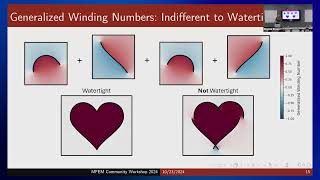
Robust Containment Queries over Collections of Parametric Curves via Generalized Winding Numbers
Discover advanced geometric containment query techniques for 2D regions using rational Bezier curves and generalized winding numbers, enabling efficient multiphysics simulations without expensive refinement processes.
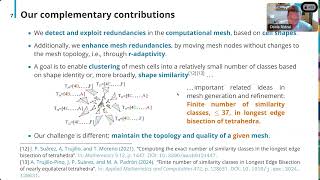
R-Adaptive Mesh Optimization to Enhance Finite Element Basis Compression
Explore advanced techniques for optimizing finite element mesh compression through dictionary-based schemes and r-adaptive mesh optimization to reduce memory usage while maintaining performance.
Enabling Fault Tolerance for GPU Accelerated AI Workloads in Kubernetes
Discover strategies for implementing fault tolerance in GPU-accelerated AI workloads on Kubernetes, covering hardware error handling, fault detection, and automated remediation techniques.
Accelerating the Next Generation of Multimedia with GPUs
Discover how to build high-performance live streaming services using the Babit Multimedia Framework (BMF), leveraging GPU acceleration and multi-language support for advanced video processing and broadcasting.

Building an Auto-scaling AI Inference Service - From Setup to Deployment
Master the fundamentals of building and scaling AI inference services, from GPU utilization to auto-scaling implementation, Docker configuration, and API endpoint setup for optimal performance.

Easy Monochrome Effect with GLSL in TouchDesigner
Master GLSL shader programming by creating a monochrome effect in TouchDesigner, leveraging GPU optimization for enhanced performance and parallel processing capabilities.
Distributed Training Methods and Parallelization Techniques - Lecture 19
Explore advanced distributed training concepts, from data parallelism and communication primitives to pipeline, tensor, and sequence parallelism methods for efficient machine learning systems.
Distributed Training: Hybrid Parallelism and Gradient Optimization - Lecture 20
Delve into advanced distributed training concepts, covering hybrid parallelism, gradient compression techniques, and strategies for optimizing bandwidth and latency in ML systems.
Distributed Training: Hybrid Parallelism and Gradient Optimization - Lecture 20
Delve into advanced distributed training concepts, exploring hybrid parallelism, gradient compression techniques, and strategies to overcome bandwidth and latency bottlenecks in ML systems.
GPU Sharing and Container Device Interface in Kubernetes Device Plugins
Dive into GPU resource management in Kubernetes, exploring Container Device Interface (CDI), device plugin architecture, and various GPU sharing mechanisms for optimized AL/ML workload performance.

Integrating S3 into Distributed Multi-Protocol Hyperscale NAS
Discover how to seamlessly integrate S3 data silos into high-performance parallel file systems for GPU computing, AI/DL workflows using standard enterprise infrastructure and multi-protocol storage solutions.

Advancements in pNFS and NFS v4.2 - Modern Data Center and Cloud Computing Solutions
Discover the latest NFS 4.2 enhancements for high-performance computing, including strategies for unified data orchestration across clouds, GPU clusters, and distributed environments.
Standards-based Data Platforms for HPC and AI
Explore how standardized frameworks optimize data platforms for HPC and AI, focusing on interoperability, data movement, and system integration for enhanced performance and efficiency.

Disaggregated Memory for High Performance Computing
Explore high-performance computing memory systems, from HPE's memory-driven computing to modern architectures like Frontier and Aurora, examining CXL memories and future computational storage innovations.
PCIe Cabling Solutions for Next Generation AI, HPC and Storage Applications
Explore PCIe cabling innovations including CopprLink specifications and external cabling solutions for high-speed data transmission in AI, storage, and data center applications.

The Role of Flash in Data Ingestion Within the AI Pipeline
Explore how flash storage revolutionizes data ingestion for AI pipelines, focusing on scalability challenges, performance demands, and efficient solutions for modern AI infrastructure deployment.
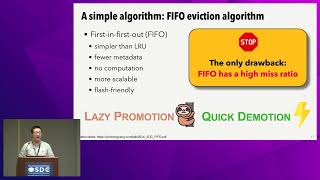
No More LRU: Simple Scalable Caching with FIFO Queues
Discover how S3-FIFO revolutionizes cache eviction algorithms, offering superior scalability and efficiency over traditional LRU methods through a simple three-queue design that optimizes data access in modern storage systems.

Supercharging OpenAI Training with Azure Blob Storage - Architecture and Best Practices
Dive into Azure Blob Storage's architecture and innovations enabling massive-scale AI training, featuring insights on achieving multi-exabyte storage and terabit-level throughput for advanced workloads.

Memory Optimizations in Machine Learning
Discover essential memory optimization techniques for machine learning, from data quantization to model pruning, and learn efficient strategies for minimizing resource consumption across different hardware setups.

Accelerating GPU Server Access to Network-Attached Disaggregated Storage Using DPU
Explore how DPUs optimize GPU server performance for AI workloads, focusing on network-attached storage acceleration, improved efficiency, and scalability for Large Language Models using AMD systems.
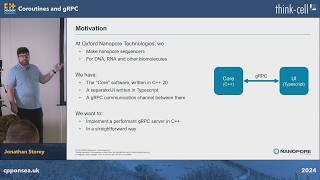
Introduction to C++ Coroutines and gRPC - Writing Coroutine Support Code
Dive into high-performance C++ coroutines and gRPC implementation, learning to write support code for production-ready applications with practical examples and composable library integration techniques.