Middleware for Quantum - Enabling Advanced Quantum Computing Workflows
Explore open-source Middleware for Quantum, integrating quantum computing with Kubernetes for complex tasks. Learn how it manages heterogeneous resources and enables advanced quantum-classical workflows.
Energy Aware Scheduler (EAS) for big.LITTLE ARM SoCs - An Unbiased Analysis
Explore the Energy Aware Scheduler for big.LITTLE ARM SoCs, its essentials, alternatives, and vendor variations. Gain insights into its strengths and weaknesses for efficient heterogeneous computing.
From Arm to Z - Building, Shipping, and Running a Multi-platform Docker Swarm
Learn to build, deploy, and run multi-architecture Docker services using manifest lists, emulation, and heterogeneous Swarms. Gain practical skills for creating cross-platform applications and managing diverse CPU architectures.
Heterogeneous Concurrency - A New Frontier for Weak Memory
Explore heterogeneous processors' shared memory interfaces and their impact on weak memory concurrency models in emerging computing domains.
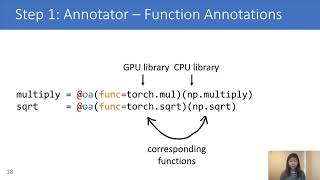
Offload Annotations - Bringing Heterogeneous Computing to Existing Libraries and Workloads
Explore offload annotations for efficient GPU computing in existing libraries, enabling seamless integration and performance gains without extensive code modifications.
Liquid Metal - Taming Heterogeneity
Explore IBM's Liquid Metal project for heterogeneous computing, unifying parallel programming paradigms and simplifying development for multicores, GPUs, and FPGAs.
Supercomputing Spotlights - Supercomputing Software for Moore and Beyond
Explore supercomputing software evolution, data locality challenges, and innovative solutions for post-Moore era. Learn about multicore architectures, heterogeneous computing, and emerging trends in high-performance computing.
Flor - An Open High Performance RDMA Framework Over Heterogeneous RNICs
Explore Flor, an innovative framework enabling high-performance RDMA across diverse network interface cards, addressing bandwidth imbalances and enhancing datacenter application efficiency.
MELF - Multivariant Executables for a Heterogeneous World
Explore MELF: a novel approach for including multiple function variants in a single binary, enabling runtime switching for optimized performance across heterogeneous systems.
Khronos Sycl Language Framework for C++ Accelerators - Take Advantage of All the MIPS
Explore SYCL, a C++ framework for heterogeneous computing, enabling efficient use of various accelerators. Learn its features, applications, and advantages for high-performance computing and AI/ML development.
Composite Arithmetic Types Are Greater Than the Sum of Their Parts
Explore advanced C++ arithmetic types using modern language features. Learn to build custom numeric types with improved safety, speed, and usability through compositional approaches and low-cost abstractions.
Taskflow - A Heterogeneous Task Graph Programming System with Control Flow
Explore heterogeneous task graph programming with control flow using Taskflow, a C++ system for efficient parallel and GPU-accelerated computing with high productivity.
Python Meets Heterogeneous Computing - An Exploration of Distributed Computations
Exploring distributed computations in Python across diverse hardware, addressing challenges and strategies for optimal performance in heterogeneous computing environments.
Heterogeneous Memory Management
Explore heterogeneous computing challenges, focusing on unified address spaces, memory management, and data placement across CPUs and parallel devices like GPUs.

Malloc for Everyone and Beyond NUMA
Exploring memory management in heterogeneous computing, addressing challenges beyond NUMA, and proposing a unified API for diverse memory types in modern systems.
DWARF Extensions for Optimized SIMT - SIMD - GPU Debugging
Explore DWARF extensions for GPU debugging, addressing challenges in heterogeneous computing and optimizing variable location tracking in SIMT/SIMD environments.
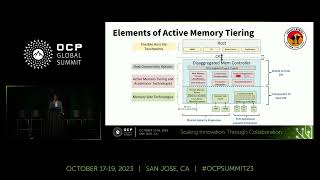
CXL-Enabled Heterogeneous Active Memory Tiering: Architecture and Implementation
Explore CXL Type2-based disaggregated memory architecture and how it extends far memory to remote heterogeneous memory using ethernet, featuring intelligent fabric control and memory tiering.
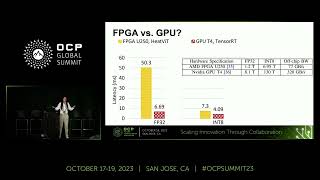
Architectural Challenges and Innovation for Compute Infrastructure Co-Design in Generative AI
Explore architectural solutions for generative AI computing challenges, focusing on heterogeneous computing infrastructure and chiplet-based systems for improved energy efficiency.
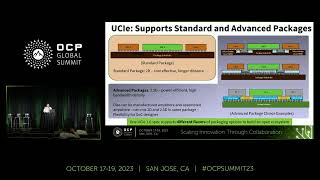
UCIe - Universal Chiplet Interconnect Express for Die-to-Die Integration
Discover how UCIe 1.0 standardizes die-to-die interconnects for high-performance computing, enabling efficient integration of heterogeneous processing units and on-package memory for AI, ML, and cloud computing.
The First Optimal Distributed SGD in the Presence of Data, Compute and Communication Heterogeneity
Explore optimal time complexities for parallel optimization methods with heterogeneous data, compute, and communication. Gain insights into efficient distributed SGD algorithms.

Addressing Challenges of Cross-Architecture Dynamic Migration Over Heterogeneous Acceleration Systems
Explore cross-architecture dynamic migration for AI applications on diverse accelerators. Learn unified abstraction, middle-compiler techniques, and runtime support for seamless transitions between hardware.