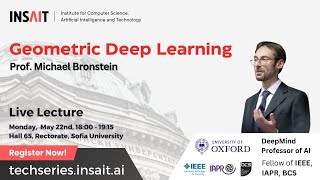
Geometric Deep Learning
Dive into geometric deep learning principles and advanced mathematical concepts with Prof. Michael Bronstein's comprehensive exploration of this cutting-edge field in artificial intelligence.
One Clean Qubit Suffices for Quantum Communication Advantage
Delve into groundbreaking research demonstrating how a single clean qubit enables quantum communication advantage, challenging previous assumptions about quantum versus classical communication complexity.
State Purification with Symmetry Subgroup Projectors
Explore quantum state purification techniques using symmetry subgroup projectors to enhance purity of quantum states with reduced overhead and improved scalability for near-term quantum systems.
Permutation Tests for Quantum State Identity
Delve into quantum state identity testing through permutation tests, exploring optimal measurements, SDP solutions, and innovative G-test approaches for comparing multiple quantum states.
Quantum Generic Hardness for Discrete Logarithms and Integer Factorization
Explore quantum computational complexity of discrete logarithm problems and integer factorization, examining generic algorithms' limitations and establishing new theoretical bounds for quantum operations.
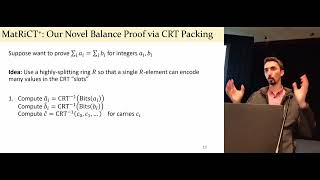
MatRiCT+: More Efficient Post-Quantum Private Blockchain Payments
Explore post-quantum blockchain privacy with MatRiCT+, featuring lattice-based cryptography, balance proofs, and innovative approaches for enhanced efficiency and security in digital payments.
David Gross: Stabilizer Formalism & Quantum Error Correction Through the Lens of Tensors
Explore advanced quantum error correction techniques, focusing on the stabilizer formalism and its applications in quantum fault tolerance, using tensor-based approaches and group theory.
Stabilizer Formalism & Quantum Error Correction Through the Lens of Tensors - Part 1
Explore stabilizer formalism and quantum error correction using tensor methods. Learn about many-body systems, error correction challenges, and connections to finite symplectic geometries.
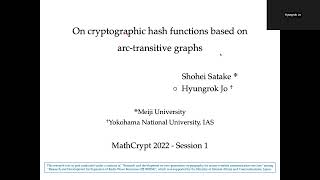
Cryptographic Hash Functions from Arc-Transitive Graphs - Part 1
Explore cryptographic hash functions derived from arc-transitive graphs, focusing on collision resistance, comparisons with Cayley hash functions, and potential attacks.
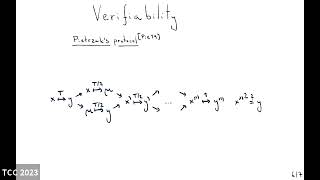
Group-based Cryptography - Advances and Applications
Explore cutting-edge developments in group-based cryptography at this TCC 2023 session, featuring expert insights and discussions on advanced cryptographic techniques.
Unsupervised Learning of Group Invariant and Equivariant Representations
Explore unsupervised learning of group invariant and equivariant representations. Gain insights into symmetry in data, practical examples, and results for graphs and various symmetries.
A New Perspective on Building Efficient and Expressive 3D Equivariant Graph Neural Networks
Explore advanced techniques for building efficient 3D equivariant graph neural networks, focusing on local substructure encoding and frame transition encoding for improved expressiveness and performance.
Subgroup Tests and Tailored Non-local Games - Lecture on Interactive Proof Systems
Explore advanced concepts in interactive proof systems, refuting the Aldous-Lyons conjecture through subgroup tests and tailored non-local games.
Higher Algebra and Koszul Duality - Talk 28
Delve into advanced mathematical concepts exploring higher algebra, operads, and Koszul duality, understanding the relationship between Lie algebras and commutative algebras in group theory.
Shtukas and Global Langlands for Function Fields - Talk 37
Delve into V. Lafforgue's groundbreaking proof of global Langlands correspondence, exploring shtukas, geometric Satake, and excursion operators in function fields through expert analysis.
Prismatic Dieudonné Theory and Classifying Stacks - Part 2
Delve into prismatic Dieudonné theory and explore p-divisible group classification through prismatic crystals, with applications to cohomology of classifying stacks.
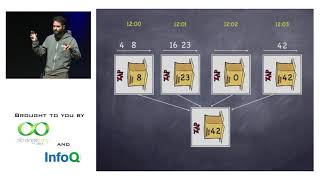
Add ALL the Things - Abstract Algebra Meets Analytics
Explore how abstract algebra principles apply to analytics systems, enhancing distributed and real-time aggregation efficiency through group theory laws and practical coding examples.
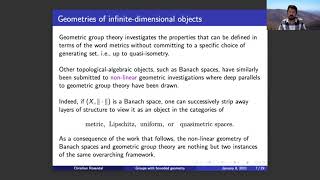
Groups with Bounded Geometry
Explore geometric groups, their properties, and connections to topology and transformation groups in this advanced mathematics lecture on groups with bounded geometry.
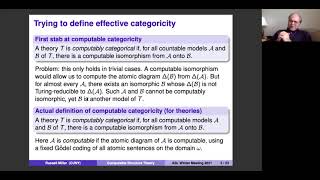
Computable Structure Theory with Noncomputable Structures
Explore computable structure theory, categoricity, and noncomputable structures in mathematics, focusing on fields and isomorphism types of subfields.
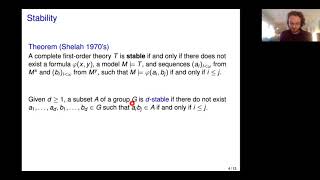
Model Theoretic Tameness in Multiplicative Combinatorics
Explore model theoretic tameness in multiplicative combinatorics, covering stable subsets, Freiman-Ruzsa theorems, and quantitative structures in groups.
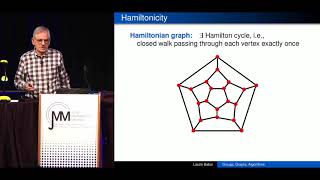
Groups, Graphs and Algorithms
Explore the intersection of group theory, graph theory, and algorithms with László Babai, delving into topics like graph irregularity, canonical coloring, and string isomorphism.