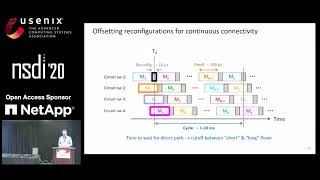
Expanding Across Time to Deliver Bandwidth Efficiency and Low Latency
Innovative network design for datacenters combining low-latency delivery and high-bandwidth efficiency through dynamic reconfiguration, outperforming static topologies for various workloads.
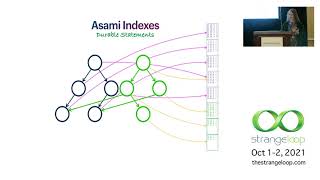
Turn Your JSON into a Graph in 2 Lines
Explore Asami, an open-source graph database with flexible data structures, functional operations, and easy JSON-to-graph conversion. Learn its architecture and novel graph analysis capabilities.
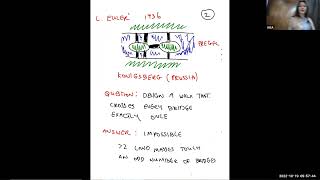
From Bridges to Cellphone Towers by the Way of Doughnuts - Some Problems in Graph Theory
Explore graph theory applications in real-world scenarios, from bridge construction to cellphone tower placement, with Princeton mathematician Maria Chudnovsky's engaging WIMSA Conference presentation.
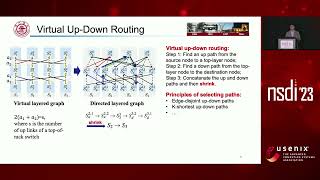
Flattened Clos - Designing High-performance Deadlock-free Expander Data Center Networks Using Graph Contraction
Innovative approach to designing high-performance, deadlock-free expander data center networks using graph contraction, offering improved efficiency and throughput compared to traditional Clos networks.
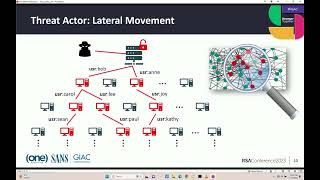
Hunting Stealth Adversaries with Graphs & AI
Discover how machine learning and graph modeling can uncover hidden adversaries in cybersecurity. Learn to apply the CHRYSALIS framework for effective threat detection using real-world data.
Interacting Stochastic Processes on Random Graphs
Explore interacting stochastic processes on random graphs, covering models like voter and neuronal hox, and examining challenges in sparse regimes and local convergence.
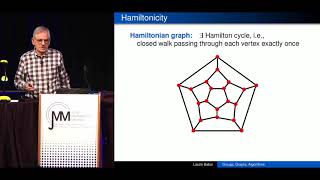
Groups, Graphs and Algorithms
Explore the intersection of group theory, graph theory, and algorithms with László Babai, delving into topics like graph irregularity, canonical coloring, and string isomorphism.
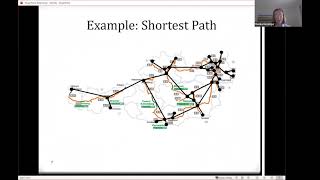
Dynamic Graph Algorithms and Their Implementation
Explore recent advances in dynamic graph algorithms, covering theoretical analysis and empirical evaluations for efficiently handling edge deletions and insertions in evolving graph models.
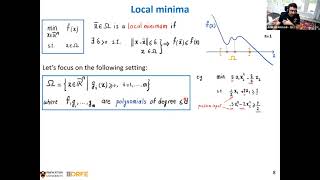
Local Minima, Stable Sets, and Sums of Squares
Explore polynomial optimization complexity, local minima, stable sets, and sum of squares polynomials. Uncover connections between graph theory and algebra in this advanced mathematical presentation.

Stochastic Games on Large Graphs in Mean Field and Sparse Regimes
Explore stochastic games on large graphs, focusing on mean field and sparse regimes. Learn about linear-quadratic models, graph-based player interactions, and large-scale asymptotics in dense and sparse scenarios.

Miracles of Algebraic Graph Theory
Explore algebraic graph theory's fascinating applications in spectral analysis, graph drawing, and network approximation. Discover how mathematical concepts revolutionize our understanding of complex structures.
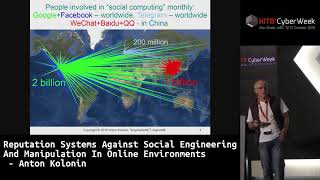
Reputation Systems Against Social Engineering
Explore innovative reputation systems to combat social engineering and opinion manipulation in online environments, enhancing security for individuals and organizations.
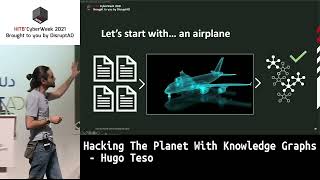
Hacking the Planet With Knowledge Graphs
Explore innovative approaches to cybersecurity for complex systems using knowledge graphs, graph theory, and machine learning. Learn to plan and execute effective engagements across diverse technological landscapes.
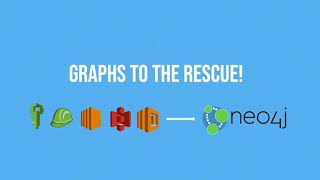
Inside Out - The Cloud Has Never Been So Close
Explore a novel graph-based approach to cloud infrastructure attacks, revealing vulnerabilities in resource relationships and demonstrating potential privilege escalation techniques.

Using Graph Theory and Network Science to Explore your Microservices Architecture
Discover how graph theory and network science can provide insights into microservices architecture, helping identify anti-patterns and optimize system boundaries for improved design and performance.
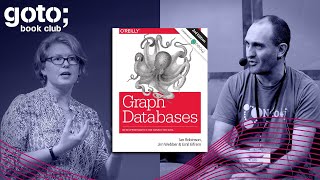
Discover the Power of Graph Databases
Explore graph databases' power in understanding complex data relationships. Learn use cases, theory, data science applications, and common pitfalls from industry experts in this insightful interview.
Identifying and Reducing Permission Explosion in AWS - A Graph-Based and Analytical Approach
Explore a graph-based approach to identify and mitigate permission explosion in AWS, enhancing cloud security and reducing potential risks in complex infrastructures.

Discover the Power of Graph Databases
Explore graph databases with experts Jim Webber and Nicki Watt. Learn about their potential, real-world applications, and how to leverage graphs for better data understanding and analysis.
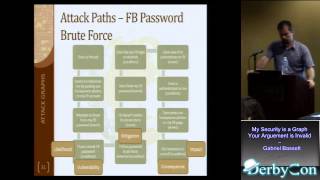
My Security Is a Graph - Your Argument Is Invalid
Explore graph-based security analysis techniques for enhanced threat detection and risk assessment in complex network environments.

Collect All the Data - Protect All the Things
Explore comprehensive data collection and protection strategies, covering network analysis, endpoint security, and intelligence operations for robust cybersecurity implementation.
Computational Integrity with a Public Random String from Quasi Linear PCPs
Explore computational integrity using quasi-linear PCPs and public randomness. Learn about protocol design, low-degree testing, and cryptographic assumptions in this advanced cryptography talk.